
Stylist Guide › Sections 6, 7 and 10: Buyer Psychology
Picture two buyers in a car outside their third open home of the morning. Neither mentions the ceiling height, the benchtop or the strata report. One says "the one with the olive tree". The other says "the one that smelled like a candle shop". Two homes, one sentence each. That's how most homes are remembered, and why the preparation that matters most is often the smallest.
The guide in one minute. Home staging psychology is the work of answering five silent questions every buyer asks in every room: can I picture my life here, can I read this home at a glance, has it been looked after, does it feel calm, and will I remember it? Buyers form a view in seconds and check it with facts later. These 76 rules work on both.
What is home staging psychology?
Home staging psychology is the study of how buyers feel in a home, and the styling that makes those feelings work for the sale. It isn't a trick. Buyers shortlist the homes that feel right, then use price, size and reports to confirm or veto the choice (Rule #261). Staging works on the first half of that decision so the second half gets a chance to happen.
The evidence for the first half is strong, if not precise. In the National Association of Realtors' 2025 Profile of Home Staging, 83% of buyers' agents said staging made it easier for a buyer to picture the property as a future home, and 31% said buyers were more willing to walk through a home they'd seen online. The same survey is honest about the limits: 60% of buyers' agents said staging affected some buyers but not always.
That's the right way to think about it. Staging doesn't change the house. It removes the things that stop a buyer seeing it: the noise, the doubts, the other family's life on the walls. What's left is the home, read clearly, by someone already imagining their first Saturday there.
Three of the book's sections deal with this directly:
- Section 6: Styling Logic and Emotional Design (27 rules) is how to build a story a buyer can step into.
- Section 7: Mistakes to Avoid (29 rules) is the list of small things buyers read as big signals.
- Section 10: Buyer Psychology (20 rules) is what buyers are really thinking, and why.
This page puts all 76 in one place, organised by the question each one answers.
How do buyers decide on a house?
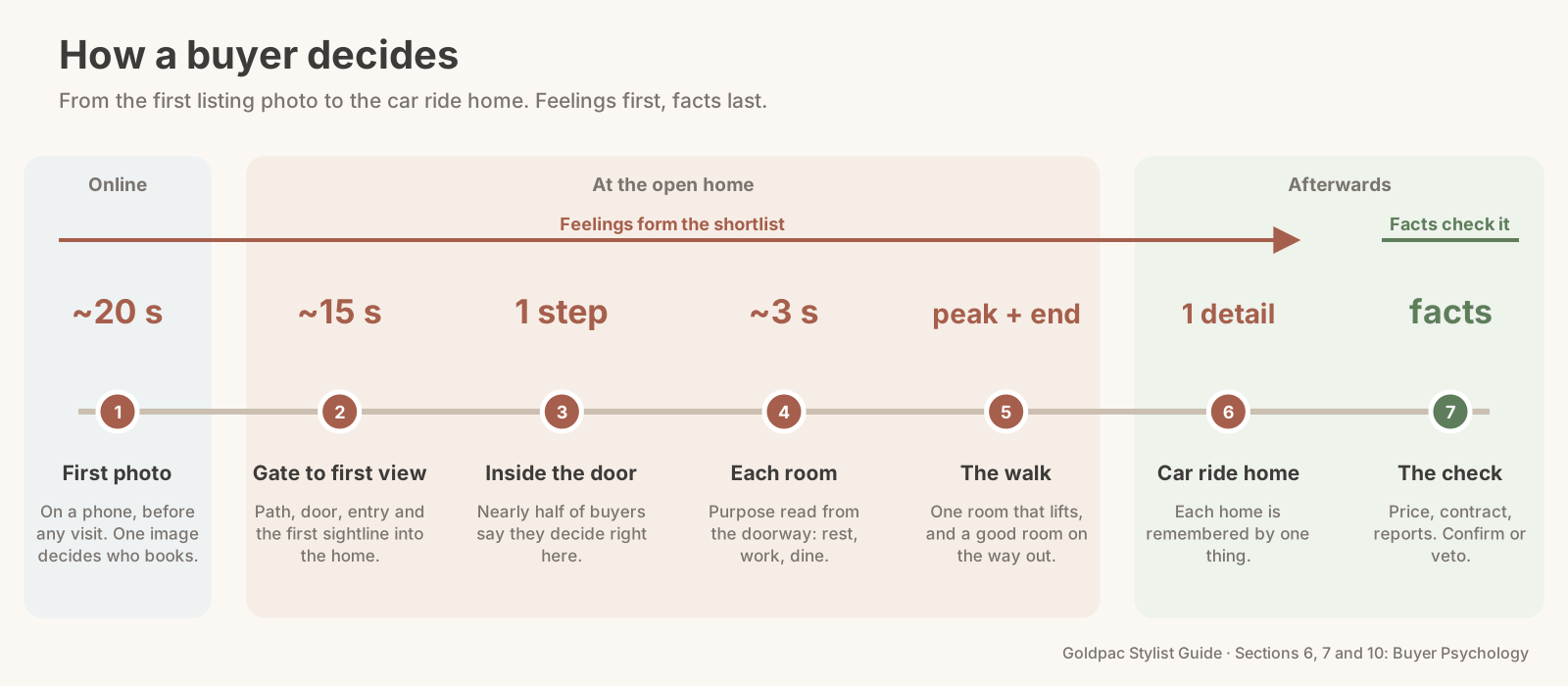
In stages, and faster than most sellers expect. A buyer's decision starts on a phone, firms up in the first few steps through the door, and is checked afterwards against facts. Each stage has its own clock, and each clock has rules that serve it.
- The first photo: about 20 seconds. In eye-tracking research at Old Dominion University, more than 95% of participants looked at a listing's first photo for a total of about 20 seconds, and the researcher's advice was to grab attention within two seconds (Michael Seiler, reported by the Star Tribune, 2013). The photo test, one hero corner and clean glass serve this stage (Rule #170, Rule #160, Rule #205).
- The gate and the door: about 15 seconds. The walk from the front gate to the first full view of the living area takes about 15 seconds in most homes (Rule #247). The entry has to feel like a welcome, not a corridor (Rule #159).
- The first step inside. In a finder.com.au survey, 47% of house hunters said they decide whether they like a property as soon as they step inside (Real Estate Business, 2016). The view from that doorway is the most valuable sightline in the home (Rule #167), and the door itself has to open fully (Rule #189).
- The rooms: about three seconds each. A buyer reads a room's purpose from the doorway in about three seconds (Rule #250). Rooms that can't be read count as smaller, or as wasted space (Rule #158, Rule #257).
- The peak and the exit. People judge an experience mainly by its most intense moment and by how it ended (Rule #251). One room should take their breath away, and the last room they see should be a good one.
- The car ride home. Buyers who see several homes in a day remember each by one standout detail (Rule #263). If you don't choose it, they will.
- The check. Then come the facts: price, contract, reports, inclusions. A home that feels right and checks out easily is the one that gets the second visit (Rule #253, Rule #259).
Notice what this order means. By the time a buyer asks a factual question, they've usually answered the emotional ones. Staging is how you answer those well.
The Five Silent Questions
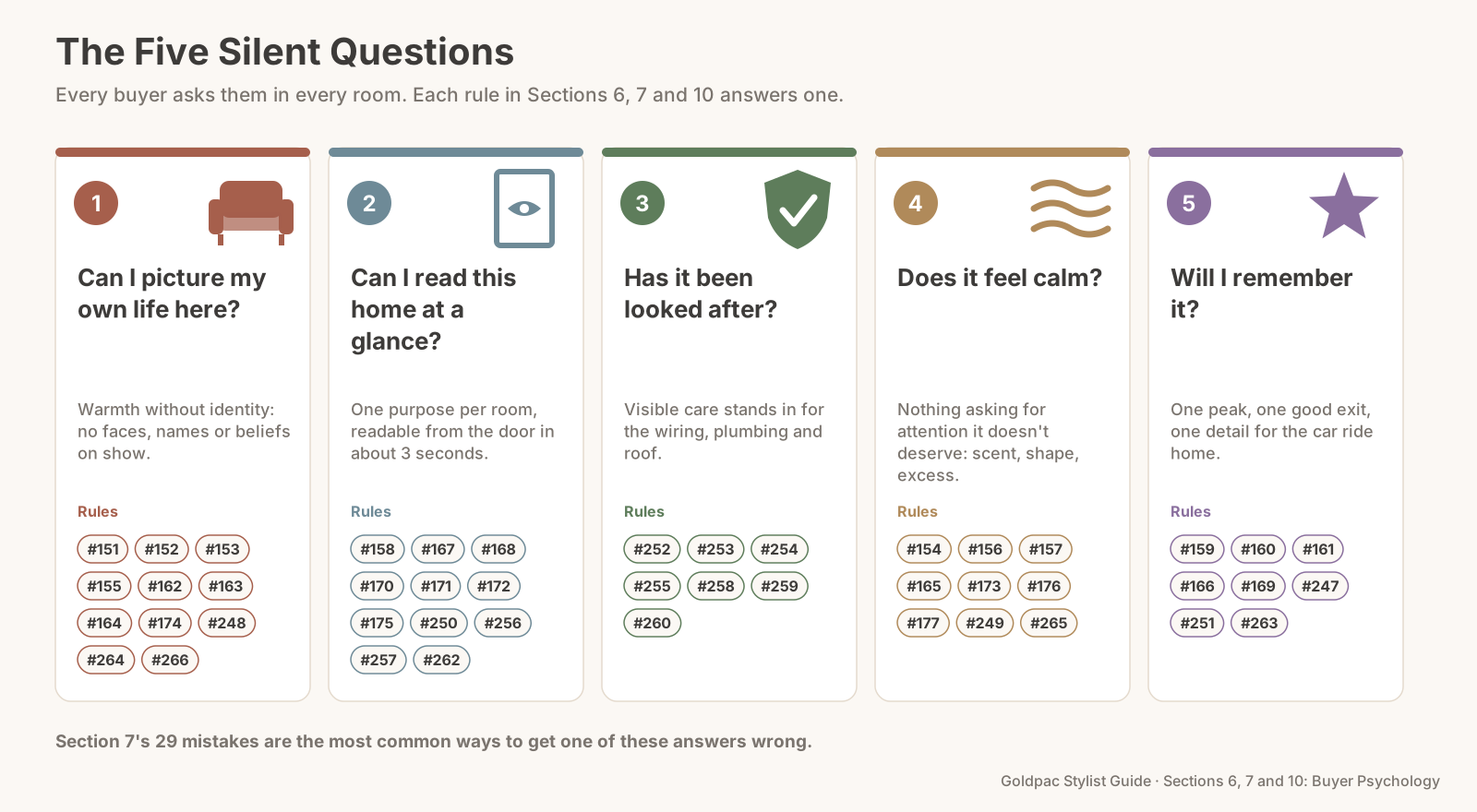
Every buyer, in every room, asks five things without saying any of them aloud. Each of the 76 rules in Sections 6, 7 and 10 answers one of them. Walk your home with these questions, room by room, and you'll find most of what needs doing.
- Can I picture my own life here?
- Can I read this home at a glance?
- Has it been looked after?
- Does it feel calm?
- Will I remember it?
The Five Silent Questions: every buyer asks five things in every room, in about the time it takes to cross the doorway, and each of the 76 rules in Sections 6, 7 and 10 answers one of them.
1. Can I picture my own life here?
Buyers decide by imagining their own life in your rooms, and your life on display gets in the way (Rule #248). In the NAR survey, 32% of buyers' agents said staging lifts a home's value when it's decorated to the buyer's taste, which in practice means decorated to nobody's taste in particular. The answer isn't an empty, beige box. It's warmth without identity.
- Rule #151: Style a neutral story any buyer can imagine living in. Write the home's story in ten words or fewer, then keep only what supports it.
- Rule #152: Remove personal items: photos, trophies and mail. One lidded box per room, and the fridge door cleared to nothing.
- Rule #153: Style around universal moments: coffee, rest and wellbeing. One shared pleasure per main room, built from two or three objects.
- Rule #155: Style small moments, like a tray of tea or a book on the bed. Three objects of different heights, on a surface no wider than about 45 cm.
- Rule #174: The home must feel liveable, not staged. An open book, a loosely folded throw: signs of an ordinary Tuesday.
- Rule #162: Keep political and religious symbols out of the staging and Rule #264: Keep personal beliefs out of the decor. Packed with care, set up again on the first night in the next home.
- Rule #163: Keep children's rooms simple and calm. Three to five well-chosen pieces, for any child at any age.
- Rule #164: Style for the buyers most likely to buy. Ask your agent who bought nearby in the past year, and aim the story at them.
- Rule #266: The goal isn't to impress, it's to connect. Stage for recognition, not wow.
2. Can I read this home at a glance?
A room that explains itself feels bigger, more useful and easier to trust. That last part has a name: processing fluency, the tendency to judge things that are easy to take in as more pleasing and more likely true (Rule #262). The brain is also bad at ignoring clutter. In brain-imaging work at Princeton, several objects in view at once competed for the visual system's limited attention, suppressing each other's signal (McMains and Kastner, Journal of Neuroscience, 2011). Every extra object is a small tax on the buyer's attention.
- Rule #158: Give every room a clear purpose and Rule #250: Each space must tell a clear story: rest, work, dine. One job per room, readable from the door in about three seconds.
- Rule #256: Empty rooms feel smaller than styled ones. If the home is vacant, stage at least the three anchor rooms: living, main bedroom, and dining or kitchen.
- Rule #257: Furniture shows how to use awkward spaces. Two or three pieces turn a dead corner into a feature.
- Rule #167: Make every doorway view photogenic. The first thing in sight from each door should be the room's best feature.
- Rule #170: Every room should pass the photo test. Visible floor in about a third of the frame, one clear focal point.
- Rule #168: Style shelves from eye level down. The strongest arrangement at about 140 to 160 cm, the top shelf almost bare.
- Rule #262: Minimalism feels trustworthy. Three objects per surface at most, one artwork per wall.
- Rule #175: Everything should look intentional. Square it up or angle it clearly; nothing that looks like it landed there.
- Rule #172: Let furniture and styling work together. Right furniture first, then three to five layers of styling.
- Rule #171: Create rhythm with repetition and variation. One colour, one material, one shape, each used three times, never identically.
3. Has it been looked after?
Buyers can't inspect the wiring, the plumbing or the roof on a Saturday morning, so they judge the hidden parts of a home by the visible ones (Rule #258). Australian surveys show how hard they look. In finder.com.au's 2016 survey, 49% of house hunters said peeling paint would put them off and 35% said the same of a messy interior (Real Estate Business, 2016). In a 2016 Mozo survey of 1,002 Australians, dark rooms put off 34% of buyers, more than twice the share who minded a dated kitchen at 16% (Real Estate Business, 2016). Light and care beat renovation.
- Rule #258: Visible mess suggests deeper problems. A tidy home tells buyers the care goes all the way through.
- Rule #253: Buyers fear unknown costs, so keep the home turnkey-ready. Work in three passes: 10 minutes, 1 hour, 1 weekend.
- Rule #252: Natural light builds trust. Know each room's best hour and hold inspections in it.
- Rule #255: Lighter colours make a home feel more valuable. Warm whites with a light reflectance value in the 70s and 80s for the main rooms.
- Rule #260: Make it feel ready to move in. Beds made, towels on rails, every light and door working.
- Rule #259: Buyers judge everything, even what isn't included. Take or replace what you're keeping before the photos.
- Rule #254: Avoid hovering during viewings. Leave 15 minutes before the first buyer arrives, and give the agent a one-page leave-behind.
4. Does it feel calm?
Calm is what buyers feel when nothing in a room is asking for attention it doesn't deserve. Scent is the clearest example, because buyers can look away from a flaw but they can't stop smelling. In finder.com.au's 2019 survey of 1,013 Australians, 61% said bad smells (pets, cigarettes, dampness) would turn them off a property (finder.com.au, 2019). Strong fragrance is no cure: one in three Australians report health problems from fragranced products (University of Melbourne, 2017).
Simple beats complex. In a Swiss home-decor store, shoppers spent 20% more on days with a plain orange scent than with a complex orange, basil and green-tea blend (Washington State University, Journal of Retailing, 2012). That was a shop, not an open home, but the lesson travels: one simple note leaves the mind free for the thing in front of it.
Shape matters too. In brain-imaging studies led by Oshin Vartanian, people were more likely to call curved interiors beautiful than straight-edged ones; a later study found non-experts showed little preference in beauty ratings but were more willing to enter the curved rooms (Smithsonian). For a sale, "more willing to walk in" is the useful half.
- Rule #154: One subtle scent for the whole home and Rule #249: Pleasant scents create quiet comfort. Fix odours at the source, then open the windows 30 minutes before every inspection.
- Rule #265: Use symmetry and softness to create calm. One centre line per room, and a few hard edges swapped for round ones.
- Rule #156: Avoid symmetry overload: break the pattern a little. About 80% order and 20% ease.
- Rule #176: Choose quiet luxury over visual excess. Linen, wool, timber, stone. Fewer, better, calmer.
- Rule #177: Staging should feel fresh, not theatrical. Maintained, not performed, so week four looks like photo day.
- Rule #157: Don't over-style kitchens and bathrooms. Three props in a kitchen, three in a bathroom.
- Rule #165: Make bathrooms feel like a day spa, not a family bathroom. The finishes stay; the mood changes.
- Rule #173: Match the colour story to the season. Change only the soft layers, and only when the weather does.
5. Will I remember it?
A buyer who sees five homes in a Saturday can't hold five floor plans in their head. They hold five feelings and five details. The peak-end rule, described by the Nielsen Norman Group as judging an experience by its most intense point and its end (NN/g), is why one great room beats five good ones.
- Rule #263: Buyers remember one standout detail, so create it. Pick one genuine, positive feature and make it unmissable.
- Rule #160: Create one photo-worthy spot in every home. One statement piece, one soft texture, one living element, one light source.
- Rule #251: Buyers remember feelings, not finishes. One peak room, and a good last room on the way out.
- Rule #247: The first 15 seconds shape the whole impression, so nail the entrance and Rule #159: Make the entry feel like a welcome. A two-minute reset before every open home.
- Rule #166: Style the kitchen for hosting. A picture of friends at the bench on a Saturday night.
- Rule #169: Stage balconies as usable outdoor rooms. A styled balcony adds a room to the floor plan in the buyer's mind.
- Rule #161: Every styled object should add to the story. Ask "why this?" of every object.
What are the biggest home staging mistakes?
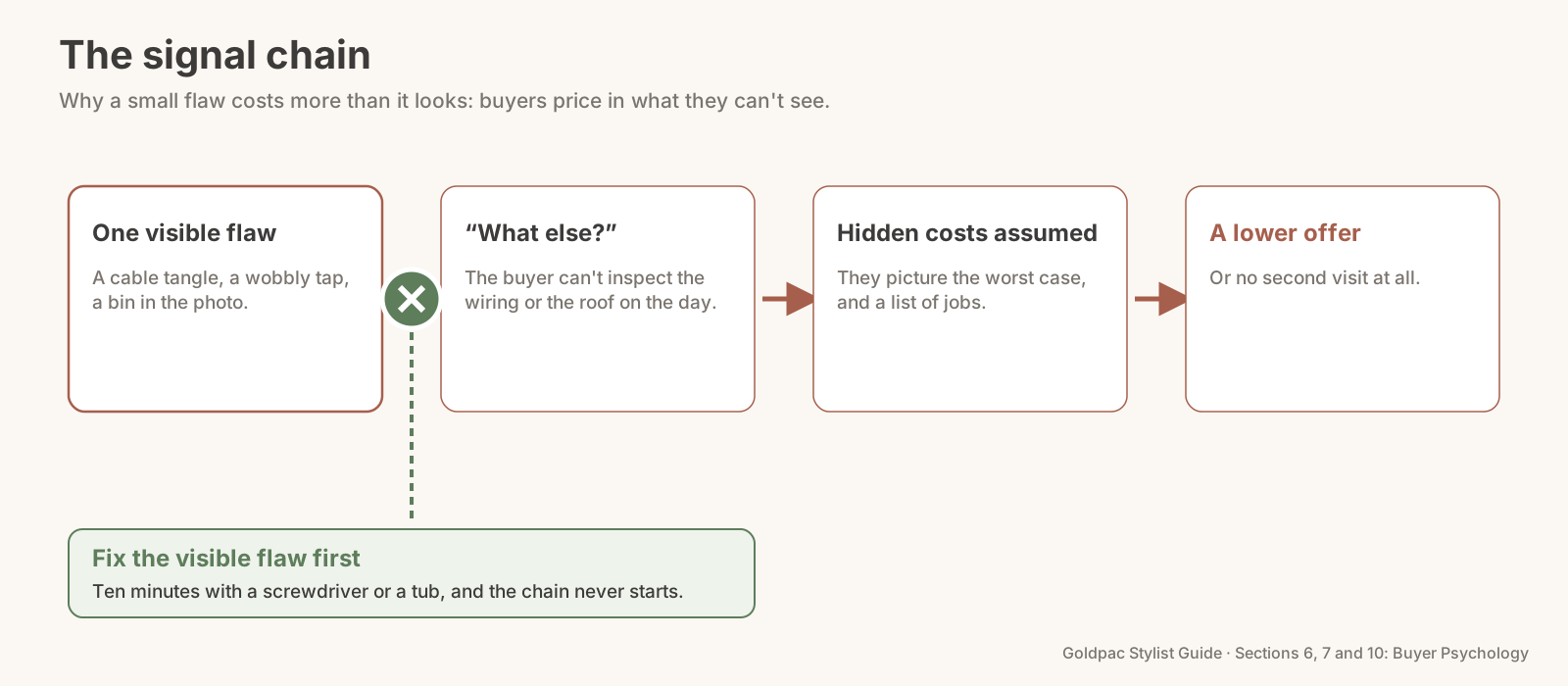
The biggest home staging mistakes are small things buyers read as big signals: fake fruit, a tangle of cables, a bin in the photo, magnets on the fridge, a door that won't open fully. None of them costs much to fix. Each one costs attention, and some cost trust.
The mechanism is the same every time. A buyer sees one visible flaw and asks "what else?" They can't answer that on the day, so they price in the worst case and quietly lower what they'll offer (Rule #253). We call it the signal chain, and Section 7 is a list of its most common first links.
| Mistake | What buyers read into it | The fix |
|---|---|---|
| Fake fruit or plastic flowers (#178) | Something here is pretending | Real fruit; greenery real or premium faux that passes a look from 30 cm |
| Empty picture frames (#179) | Unfinished | Fill it with a simple print or take it down |
| Single-use plastic decor (#203) | Temporary, cheap | Ceramic, glass, timber, linen, stone |
| Tags left on new textiles (#200) | Rushed, staged | De-tag and steam a day before photos |
| Brand packaging on props (#201) | An ad or a pantry | Decant, or turn labels to the wall |
| Dark, heavy furniture in tight rooms (#180) | Smaller than it is | Lighter pieces on legs in rooms under about 12 m² |
| Bean bags or inflatable furniture (#181) | Share house | One real armchair or a pouf |
| Furniture sets that match too much (#186) | Dated, catalogue | Swap one or two companions |
| Visibly damaged furniture (#191) | Worn hard, look for more damage | Keep, touch up, cover or remove |
| Crammed or stacked furniture (#204) | Storage, not a room | Walkways of about 60 to 90 cm |
| Doors blocked by decor (#189) | Cramped | Every door opens to at least 90 degrees |
| Walls loaded with clocks and signs (#182) | Busy, dated | One job per wall |
| Clutter on kitchen benches (#184) | Not enough bench space | Three deliberate items on the main bench |
| Visible cables, chargers and routers (#185) | Not enough power points | Plan furniture around the outlets |
| Wires dangling from the TV (#192) | Technical, messy | Cables hidden, unit nearly bare |
| Over-staging (#187) | What is the styling covering? | Give every item a one-word job; start by removing a third |
| Novelty items (#195) | A personality, not a property | Pack them for the campaign |
| Tired or dated decor (#199) | The whole home needs updating | Swap the most dated pieces for plain, current ones |
| Seasonal decorations (#188) | Someone else's celebration, an old listing | Pack before photo day |
| Religious objects used as decor (#190) | One tradition, or carelessness | Sculptural objects with no religious meaning |
| Wrinkled linen or worn rugs (#183) | Neglect | Steam the linen; a bare floor beats a tired rug |
| Bath mats in the photos (#193) | Damp, less floor | Floor clear for photos, one plain mat over the bath edge for inspections |
| Logo or loud towels (#196) | Casual, busy | Plain towels, folded in thirds |
| Bins and cleaning products (#194) | Chores | Out of sight before every inspection |
| Over-the-door hooks (#197) | Not enough storage | Hooks off, doors open flat |
| Magnets and calendars on the fridge (#198) | Busy, and a privacy risk | The "command centre" goes in a drawer |
| Pet bowls, beds and toys (#202) | Look for scratches, smells and hair | One or two lidded tubs |
| Styling in front of dirty windows (#205) | Neglect, magnified by the light | Clean every window before the hero chair goes in |
| No final walkthrough (#206) | The stray box the camera finds | Walk it in buyer order with every light on |
The pet row deserves a number. In the same 2016 finder.com.au survey, 42% of house hunters said signs of a pet dog or cat would put them off (Real Estate Business, 2016). That isn't a reason to hide the dog for good. It's a reason to give buyers 30 minutes in a home where they can't tell.
Real Sydney campaigns, read through the five questions
The rules come from what we see on Sydney jobs. Here is how they played out in real Goldpac campaigns, each published in full in Real Results. Across 34 tracked campaigns on that page, staged homes have sold in a median of 18 days against a 38-day median for their suburbs. It isn't a controlled trial, but the direction holds.
Northmead: a front door that opens into the lounge
On Balmoral Road, Northmead, the front door of a one-bedroom apartment opens straight into the living room. No hallway, no pause: the first 15 seconds and the first doorway view are the same moment. The stylist kept the seating low and set three chairs, not four, so the sightline from the door ran clean to the glass, and dressed the built-in desk as a working office with a chair, a lamp and a short stack of books. One white room now reads as five zones. Questions answered: two and five.
Kurraba Point: the column that became a wall
A studio on Kurraba Road had a structural column standing in its only room, and a buyer could admire the harbour and still leave unsure whether a bed, a sofa and a table could share the floor. The styling used the column as a wall: the bed behind it, the lounge in the window corner, a table for two on the quiet wall. That is Rule #257 at full strength. It sold in 14 days against a 39-day suburb unit median.
Ultimo: half a second to explain a loft
In a warehouse conversion on Ada Place, hardly two zones share a floor level. Empty, the apartment read as a puzzle. Each level got one anchor piece, and the two walls of built-in shelving were styled mostly at eye level and left partly open, so the wall reads as capacity rather than someone else's books (Rule #168). Every level now says what it's for at first glance.
Toongabbie: one of eight identical villas
Eight villas share one driveway on Memphis Crescent: same brick, same roof, same layout. The risk wasn't that buyers would dislike this one. It was that they wouldn't remember it. The bare deck beside the clothesline became a second living room with two timber armchairs (Rule #169), and the three bedrooms were styled so no two read alike. It sold in 18 days against a 34-day suburb unit median. Question five, answered.
Chatswood and Botany: twins on every side
On Anderson Street, Chatswood, another one-bedroom in the building next door listed the same week. The windowless study was styled as a lit destination, with the desk on the far wall so the eye travels the length of the room and lands somewhere warm. In Botany, a two-bedroom competing with a run of near-identical listings sold at the owner's price in 18 days, against a 34-day suburb median. In crowded markets, memory is the product.
Earlwood: the agent asked for less
For a freshly renovated semi on Ann Street, Earlwood, the brief was one word: less. Over-style it and buyers would remember the rug, not the new floorboards. The furniture had to explain the rooms, then step back: one palette repeated through the house, one idea per bedroom, most of the new storage left bare because it reads bigger empty. That's Rule #176 and Rule #187 as a brief.
The small green toy
In several of these homes, one object has no job at all: a small green plush toy on an armchair or an ottoman, Goldpac's mascot. In Kurraba Point it was a frog; in Toongabbie, a dinosaur. In the Chatswood case study it is described as the detail that makes the room look lived in rather than arranged. It is Rule #174 in one object: a home with nothing out of place, and one thing that's slightly out of place on purpose.
From our field notes
A few moments from Goldpac jobs, kept exactly as our stylists recorded them:
- Kellyville. After one weekend on a tired facade (a forest-green door, the bins behind the side gate, the path pressure-washed, two potted olive trees), buyers at the first open home slowed at the gate and took photos (Rule #247).
- Carlingford. First group, 10:04 am on a Saturday: a buyer turned the ensuite tap and it wobbled. By the following Saturday there was a new mixer, eight matte-black handles and two new switch plates (Rule #253).
- A home with a dog. A buyer knelt to check under the rug within ninety seconds of walking in. There was a dog bed by the front door (Rule #202).
- Mosman. In a townhouse, a buyer told the agent: "The living room just felt complete the moment I walked in."
What does the research say, and where does it stop?
The research behind buyer psychology is real, but most of it comes from surveys, shops and labs rather than controlled tests of staged and unstaged Sydney homes. Read it as direction, not as a promise about price.
| Finding | Source | What it means for staging |
|---|---|---|
| 83% of buyers' agents say staging makes it easier to picture the home as a future home | NAR, 2025 | Stage for imagination first |
| 31% say buyers are more willing to walk through a home they saw online | NAR, 2025 | The photos decide who comes |
| About 20 seconds on the first listing photo | Seiler, via Star Tribune, 2013 | One hero image matters most |
| 47% decide as soon as they step inside | finder.com.au, via Real Estate Business, 2016 | Style the entry and first view hardest |
| Dark rooms put off 34%; dated kitchens 16% | Mozo, via Real Estate Business, 2016 | Light before renovation |
| Bad smells put off 61%; lack of natural light 46% | finder.com.au, 2019 | Air and light are not optional |
| Objects in view compete for attention | McMains and Kastner, 2011 | Fewer objects, clearer rooms |
| A simple scent beat a complex one in a store | WSU, Journal of Retailing, 2012 | One simple note, or none |
| Curved interiors judged more beautiful, and more inviting to enter | Smithsonian | Soften a few hard edges |
Two cautions. Survey answers about what "puts people off" are not the same as what people actually pay. And agents' views of staging come from agents. That's why the rules lean on things you can see and measure in your own home: centimetres, minutes, counts. If a rule makes the home easier to read and easier to trust, it's worth doing whatever the next study says.
If you only have one weekend, which rules matter most?
When time is short, work the five questions in the order buyers meet them. This is the weekend version.
Saturday morning: what they see first
- Walk from the gate with a stopwatch and fix every second of it (Rule #247).
- Clean every window you'll style in front of (Rule #205).
- Personal items, fridge door and paperwork into one lidded box per room (Rule #152, Rule #198).
Saturday afternoon: what they read
- Give every room one job and remove whatever serves another (Rule #158).
- Take a third of the decor out of the busiest room (Rule #187).
- Hide cables, bins and cleaning products (Rule #185, Rule #194).
Sunday: what they feel and remember
- Fix the faults a buyer can touch in ten minutes each (Rule #253).
- Remove the scent, not mask it (Rule #249).
- Choose the one detail you want remembered and give it light (Rule #263).
- Do the final walkthrough with every light on (Rule #206).
The blind spot: you can't hear your own home's questions
Buyers ask the five questions because everything in your home is new to them. You stopped asking them years ago. The cable behind the TV, the magnets, the chair that half-blocks the door: you've stepped around them so often that they've become part of the floor plan.
We see it on almost every walkthrough. In a Penrith townhouse, the vendor said the place was "basically perfect". Our walkthrough found eleven items, all fixed in one Saturday. None were big. All were invisible to the people who lived there.
There's a quieter cost too. In a UCLA study of 60 dual-income spouses, wives who described their homes in terms of clutter and unfinished projects showed flatter daily cortisol patterns and more depressed mood across the day (Saxbe and Repetti, 2010). Clutter you no longer see can still weigh on you. Staging for the sale often makes the last weeks in the home calmer for the people still living in it.
Fresh eyes are the fix. Borrow a friend who's never been inside, give them a phone and the five questions, and follow them from the gate (Rule #267: You can't see your own home: get a fresh pair of eyes).
What if the rules don't fit your situation?
You're living in the home with kids or pets. Do the five questions room by room, but make the resets fast: one lidded tub per room, a two-minute entry reset, pets out for each inspection. The full lived-in system is in Selling Your House While Living in It.
The home is tenanted. You can't pack a tenant's life into boxes. Focus on what the landlord controls: repairs, light, windows and the street front. Ask for the tenant's help with the photo day, keep requests small, and give proper notice.
The home is empty. Most of question one answers itself, but question two gets harder: empty rooms can't be read and photograph small (Rule #256). That's the job of full or partial home staging.
It's a small apartment. Questions two and five do the heavy lifting. Twins in the same building are your real competition, so one standout detail and one clear purpose per zone matter more than anything else.
The auction is next week. Skip to the weekend list above. Do items 1 to 6 before the next open home and the rest before the one after.
FAQ
Does home staging actually change how buyers feel? For most buyers, yes, though not for all. In the NAR's 2025 survey, 83% of buyers' agents said staging made it easier for buyers to picture the home as their own, 26% said it affected most buyers' view of the home and 60% said it affected some buyers but not always.
What are the most common home staging mistakes? The common ones are small: cables and chargers on show, cluttered benches, bins and cleaning products, magnets on the fridge, fake fruit, bath mats in photos and too much decor. Buyers read each as a sign about the rest of the house.
Should the owner be home during an open home? No. Buyers who see the owner become polite guests: they talk less, look less and leave sooner. Leave at least 15 minutes before the first buyer arrives, and give the agent a one-page note with anything only you would know.
Five silent questions are hard to hear in a home you know by heart. A Photo Ready Consultation brings fresh eyes: a stylist walks your home and leaves a written room-by-room plan within 48 hours of the visit, built around exactly these questions. For an empty home or an agent listing, Goldpac stages it with our own furniture: send us the address and a fixed styling quote lands within two hours, through our home staging page. See current prices · Real Results
Keep reading: Furniture Placement for Home Staging (Section 1) · How to Sell Your House Faster in Sydney (Sections 8 and 9) · Selling Your House While Living in It (Section 11)
◀ Stylist Guide home · Start the section: Rule #151: Style a neutral story any buyer can imagine living in ▶
Part of the Goldpac Stylist Guide: 300+ home staging rules from Goldpac's Sydney styling team.