
Stylist Guide › Section 6: Styling Logic & Emotional Design › Rule #174
Have you ever walked into a display home and felt like you shouldn't touch anything?
The rule in one minute. A staged home must feel liveable, not staged: comfortable, relaxed and real enough that buyers can imagine an ordinary Tuesday there. Keep the styling calm and clean, then add a few honest signs of life, like an open book, a loosely folded throw, fresh fruit or a pair of slippers by the bed, and remove anything theatrical: fake food, set dinner tables, poured wine, perfect rows. Buyers buy a life, not a set.
Walking through, the way a buyer does
Picture two buyers at an open home, talking quietly as they go.
At the front door. "Oh, it's nice." "It's very… tidy."
A spotless hallway with a console, a vase and nothing else. It's clean, but no one seems to come home here. One bowl for keys and a coat on the hook would make it feel lived in.
In the living room. "Where would you sit?" "I don't know. It looks like we shouldn't."
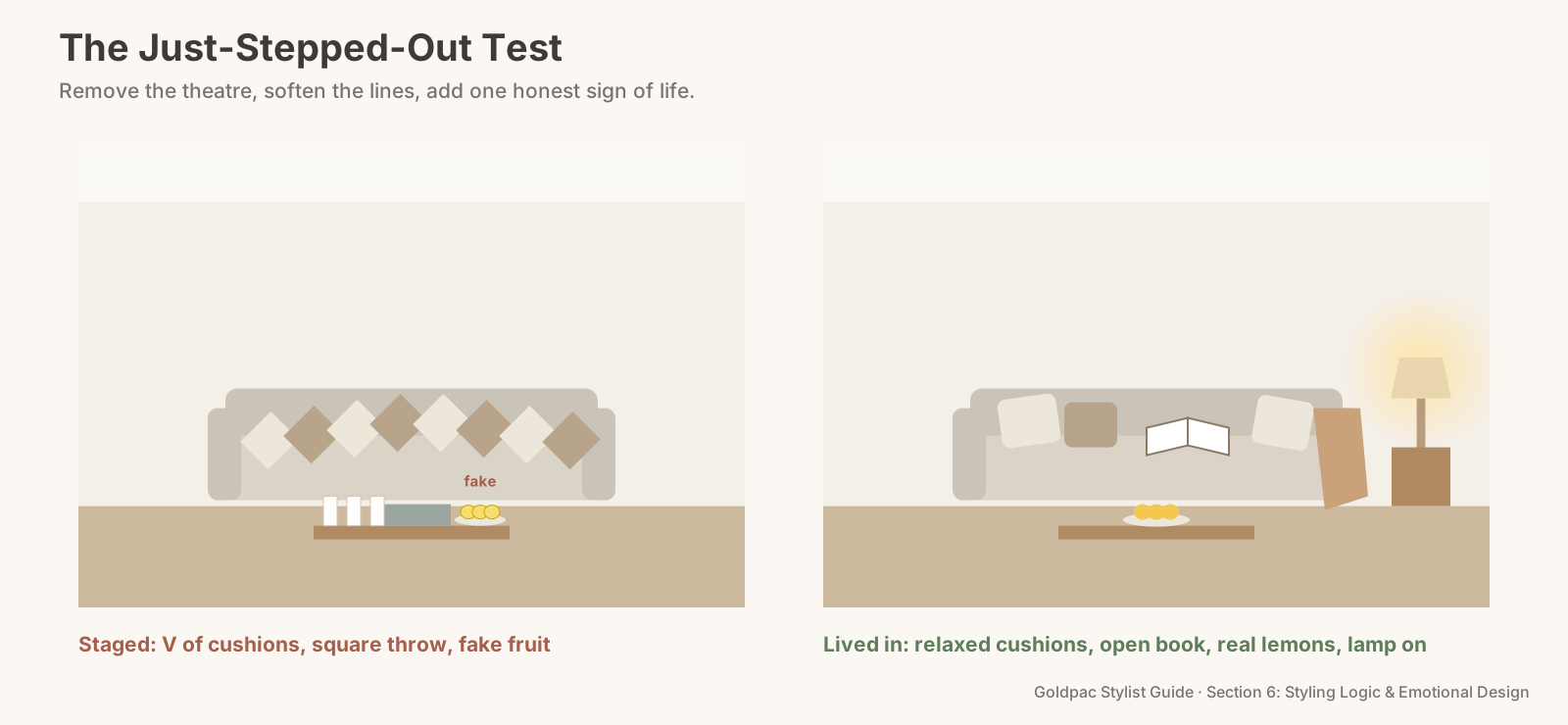
Eight cushions in a perfect V, a throw folded into a square, three identical candles. Nothing's wrong, but the room asks to be looked at, not used.
In the kitchen. "Is that a fake lemon?" "…Yes."
A bowl of plastic fruit, two wine glasses already poured, a cookbook open at a page no one is reading. Buyers spot props in seconds, and once they do, they wonder what else is hiding.
In the main bedroom. "This feels like a hotel." "In a good way?" "Not really."
Twelve pillows, a runner across the foot of the bed, a tray with a teapot and a single macaron.
In the backyard. "Oh, I could see us here."
Two chairs turned toward the sun, a throw on one, a book face-down on the arm.
The difference between the last stop and the others isn't money or furniture. It's whether the room looks used, gently, by someone who has just stepped out.
How do you make a staged home feel lived in?
Start with calm, clean styling, then add one or two honest signs of life in each main room, like a book left open, a throw folded loosely over an arm, fresh fruit in a bowl or slippers by the bed, and remove anything theatrical, like fake food, poured drinks, full dinner settings or perfectly regimented cushions. The test is simple: would a real, tidy person leave this here?
The Just-Stepped-Out Test
- Walk each room and ask: "Does it look like someone lives here and has just stepped out?"
- Remove the theatre: fake fruit, cheap or dusty artificial flowers, full table settings, poured wine, open cookbooks, breakfast trays, rows of identical objects, rigid V-shapes of cushions.
- Soften the perfection: fold the throw loosely over one arm instead of into a square; let one cushion lean (Rule #156 covers breaking symmetry).
- Add one sign of life per main room: an open book on the armchair, a pair of slippers by the bed, a jacket on a hook in the hallway, a bowl of real fruit, a watering can by a plant on the balcony.
- Keep it real and fresh: real fruit, fresh or convincingly realistic greenery, real books with real titles, and nothing that needs explaining.
- Stop at one or two per room. Signs of life work because they're few. Three or four become clutter.
The Just-Stepped-Out Test: remove every theatrical prop, soften every perfect line, and add one or two honest signs of life per main room, so each room looks used by a tidy person who has just stepped out.
Why staged-looking homes hold buyers back
Theatrical styling creates distance. A room that looks like a set makes buyers feel like visitors. They admire it, but they don't move in, in their heads. The emotional step that turns a viewing into an offer is picturing yourself on the sofa on a Tuesday night, and a set makes that harder.
It also raises suspicion. Fake fruit and poured wine look like effort to impress. Buyers start asking what the effort is covering: a damp corner, a noisy road, a small room. Honest, relaxed styling feels trustworthy.
The less obvious effect: a liveable home makes small rooms look bigger. When buyers can picture actually using a room, they stop measuring it and start furnishing it in their heads. A stiff room makes them notice its edges.
Mini-dialogue: what you want to overhear "Could you see us here?" "Yes. I already know where our bookcase goes." That's the conversation home staging is for. "It's beautifully staged" is a compliment; "I know where our bookcase goes" is a buyer.
Liveable isn't messy
The line is tidiness. A book open on the chair is a sign of life; five magazines on the coffee table is clutter. A throw over one arm is relaxed; a pile of washing on the sofa is not. Everything that's out should look chosen and cared for.
Everyday items still go away. Remote controls, chargers, mail, school bags, toiletries and cleaning products are life, but not the life buyers want to imagine. Signs of life are chosen, not left.
The blind spot: you're trying hard to impress
When you prepare your own home for sale, it's natural to over-prepare. Every cushion squared, every towel folded into thirds, every surface styled. It feels like respect for the buyer, and it comes from a good place.
But that effort shows. The more you try, the more the home looks staged. A stylist's trick is to finish the room, step back, and then undo one thing: loosen the throw, move a cushion, open the book.
Do-This-Sunday box Finish styling your living room. Then make yourself a cup of tea, sit on the sofa for ten minutes, and get up. Take away the cup, but leave everything else where your sitting left it. That's usually close to right.
What if…
The home is empty and fully staged with hired furniture. It's even more important here, because there's no real life to borrow. Add the small signs of life on purpose: books with real titles, a coat on a hook, a pair of shoes by the door, fresh fruit, lamps on (Rule #166 covers a kitchen that suggests hosting without props). Stylists sometimes call this the final layer, and it's the one buyers remember. Keep it fresh, never theatrical (Rule #177 covers fresh over theatrical).
You're living there with children. Your home already has plenty of life; the job is choosing which signs stay. Keep one tidy basket of toys in the living room and one picture book on the bed in the kids' room, and pack the rest. A family buyer will find that reassuring, not messy.
Your agent asks for the "magazine look". Give them the clean, calm version they want for the photos, then add the signs of life for the inspections, when buyers are standing in the rooms and deciding how they would feel living there.
FAQ
Should a staged house look lived in? Yes, gently. It should look clean and calm, with a few honest signs of life, so buyers can picture living there, but never cluttered or theatrical.
A home buyers can imagine living in is a home they're ready to buy. For empty homes and agent listings, Goldpac stages with our own furniture, finished with real signs of life, never props: send us the address and a fixed styling quote lands within two hours, through our home staging page. Living there? A Photo Ready Consultation helps your own home look its most liveable, in a written plan within 48 hours of the visit. See current prices.
Keep reading: Rule #156: Avoid symmetry overload: break the pattern a little (breaking symmetry gently) · Rule #166: Style the kitchen for hosting (a kitchen styled for hosting) · Rule #178: No fake fruit or plastic flowers (no fake fruit or plastic flowers)
◀ Previous: Rule #173: Match the colour story to the season · Section 6 contents · Next: Rule #175: Everything should look intentional ▶
Part of the Goldpac Stylist Guide: 300+ home staging rules from Goldpac's Sydney styling team.