
Stylist Guide › Section 6: Styling Logic & Emotional Design › Rule #158
A couple stops at the third doorway on the inspection. Inside: an exercise bike, two suitcases, a clothes airer, a desk with a printer, a single bed under a pile of folded washing. The agent says, brightly, "And this could be anything!" The couple nods, steps back into the hall and moves on.
The rule in one minute. Every room should say clearly what it's for: bedroom, study, dining, guest room, kids' play. Rooms that try to be three things, or nothing, read as smaller and less useful, and buyers subtract them from the value they see. Choose one purpose per room, matched to how the agent will describe it in the listing, and stage it with the furniture that purpose needs and nothing else.
Walk the hallway with the buyer
"That's the main bedroom. Nice."
"And this one?"
"A study, I guess? Or a spare room? There's a bed in it."
"Is that a dining room or where they keep the bikes?"
Every unclear room creates a question. Buyers keep a running tally as they walk: how many bedrooms, is there a study, where would we eat? A room that doesn't answer the question doesn't count, even if it's a perfectly good room.
Why one purpose beats "flexible"
Flexible is a word for the listing, not for the room. Agents can and should mention that a room could be a study or a fourth bedroom. But the room itself needs to show one of those clearly, or buyers see neither.
Mixed rooms look smaller. A single bed, a desk and a treadmill in a 3 × 3 metre room look cramped. The same room as just a bedroom, or just a study, looks generous.
Purpose tells the story. A fourth bedroom staged as a bedroom says "family home". The same room staged as a study says "work from home". Pick the story that suits the likely buyers (Rule #164 covers styling for them).
How do you stage a room with no clear purpose?
Decide the single most valuable purpose for that room in your market, usually a bedroom, a study or a dining area, then remove everything that doesn't belong to it and add the two or three pieces that make it obvious. Match the purpose to the floor plan label and the agent's description, so photos, plan and words all agree.
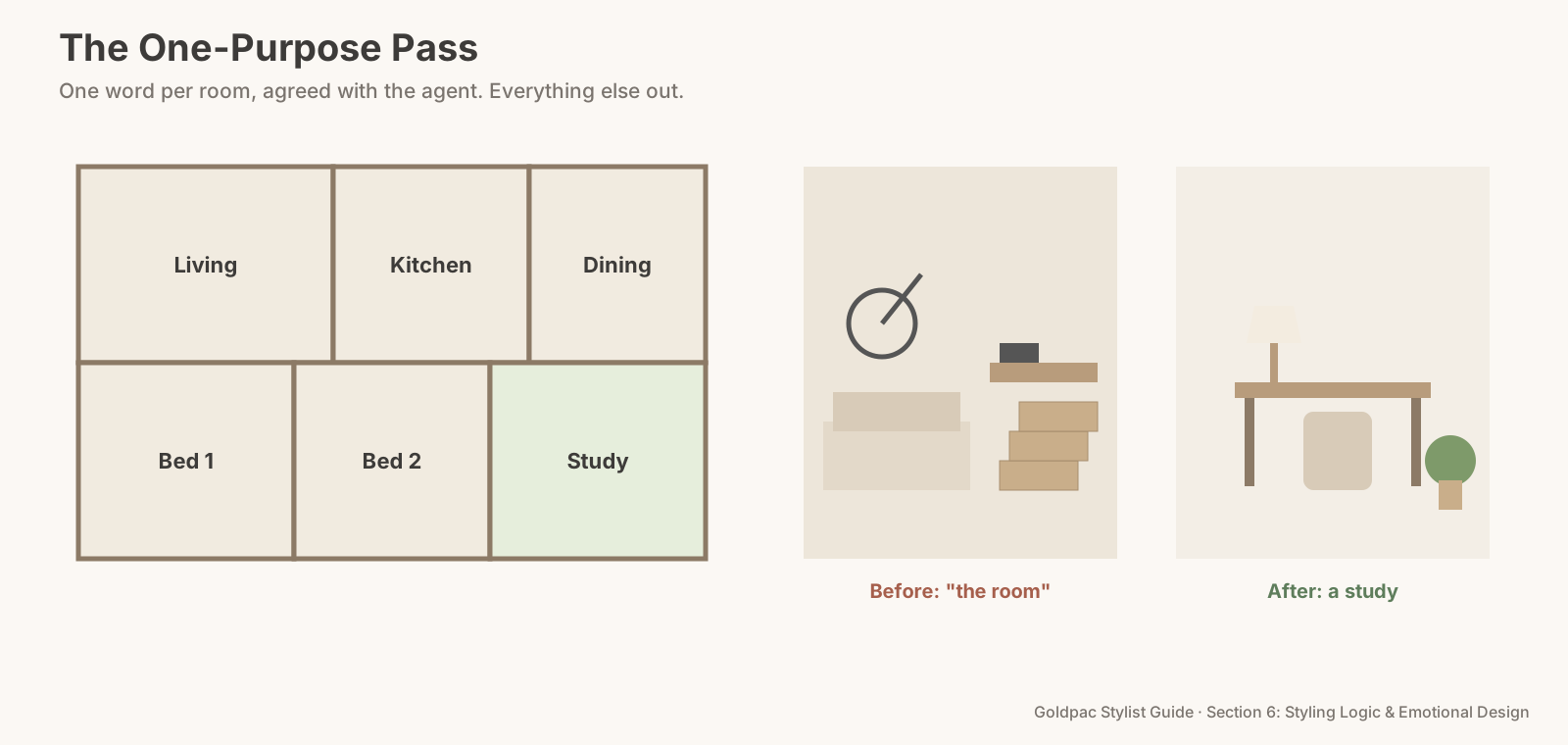
The One-Purpose Pass
- List every room and write its purpose in one word.
- Circle any room with two words, or none. Spare room, sunroom, storage, "the room".
- Ask the agent: how will this room be listed? Bedroom, study, dining?
- Remove everything else. Exercise gear, storage boxes, the clothes airer, the overflow from other rooms.
- Add the essentials for that one purpose: a made bed and bedside table, a desk and lamp (Rule #282 covers study staging), a table and chairs.
- Check the floor plan label matches what the photo shows.
The One-Purpose Pass: one word per room, agreed with the agent, with everything else removed and only the essentials for that purpose left in.
What to tell the agent
"Before the photographer comes, can you confirm how you'll list each room? We want the staging, the floor plan and the description to match. Is the small room a fourth bedroom or a study?"
If this, then that
- If the room is under about 9 square metres and has a window: a study often shows better than a cramped bedroom, unless bedroom count matters most in your market.
- If there's a formal dining room nobody uses: stage it as dining, simply. Buyers expect it.
- If there's a sunroom or enclosed verandah: a reading room or a second living space, with two chairs and a lamp.
- If there's a nook under the stairs: a small desk or a reading chair turns dead space into a feature.
The blind spot: rooms collect what has nowhere else to go
Every home has a room that absorbs overflow. It started as a guest room and became storage, a gym and an office in stages. You know what it is; you just haven't decided.
A buyer can't read that history. They see a room with no answer. Pick one for it before the photos.
What if…
You need the room for storage during the campaign. Rent a small storage unit for a few weeks, or use the garage. A room's purpose is worth more than its shelf space. Buyers pay for rooms they can picture using, not for boxes they have to look past.
The house has more rooms than furniture. Stage the purpose lightly: a bed with linen and one bedside table is enough to say "bedroom".
FAQ
Is it better to stage a spare room as a bedroom or an office? It depends on how the agent will list it and who the likely buyers are. Bedroom counts often matter for families; a study suits work-from-home buyers. Ask your agent.
Deciding what each room is for is easier with someone who doesn't use them. For empty homes and agent listings, Goldpac stages every room for one clear purpose with our own furniture: send us the address and a fixed styling quote lands within two hours, through our home staging page. Living there? A Photo Ready Consultation gives each room a purpose in a written plan within 48 hours of the visit. See current prices.
Keep reading: Rule #282: Turn the home office back into a study (turning a home office back into a study) · Rule #151: Style a neutral story any buyer can imagine living in (the neutral story) · Rule #180: Avoid dark, heavy furniture in tight rooms (lighter furniture for small rooms)
◀ Previous: Rule #157: Don't over-style kitchens and bathrooms · Section 6 contents · Next: Rule #159: Make the entry feel like a welcome ▶
Part of the Goldpac Stylist Guide: 300+ home staging rules from Goldpac's Sydney styling team.