
Stylist Guide › Section 6: Styling Logic & Emotional Design › Rule #151
One sentence, ten words or fewer. That's how long a home's story should be when it goes on the market: "a calm, sunny family home close to the water", not "our house, with the rugby trophies and the kids' art".
The rule in one minute. A staged home should tell a story any buyer can step into: a calm, well-kept life that suggests what living there feels like, without saying who lives there now. Write the story in one sentence of ten words or fewer, then keep only the furniture, colours and objects that support it, and remove anything that names a person, a team, a belief or a phase of life. Neutral doesn't mean empty: keep a few warm cues of everyday life.
Why a neutral story sells
- Buyers are casting themselves. At an inspection, people try to picture their own furniture, their own mornings, their own family in the rooms. A home that's already full of someone else's life gets in the way.
- Stories guide attention. A clear, simple story ("easy indoor-outdoor living", "quiet retreat near the station") tells buyers what to notice: the deck, the light, the calm.
- Specific stories narrow the market. A home styled around one family's hobbies, team colours or tastes appeals strongly to people like them and less to everyone else.
- Neutral stories travel. They work in the listing photos, the floor plan brochure, the open home and the agent's description, because they're simple enough to repeat.
What does a neutral story mean in home staging?
A neutral story is a simple picture of a pleasant life (rest, cooking, family, entertaining) told through the home's furniture and styling, without personal details that tie it to the current owners. It's not blank. It's the version of the home that most buyers can imagine as theirs.
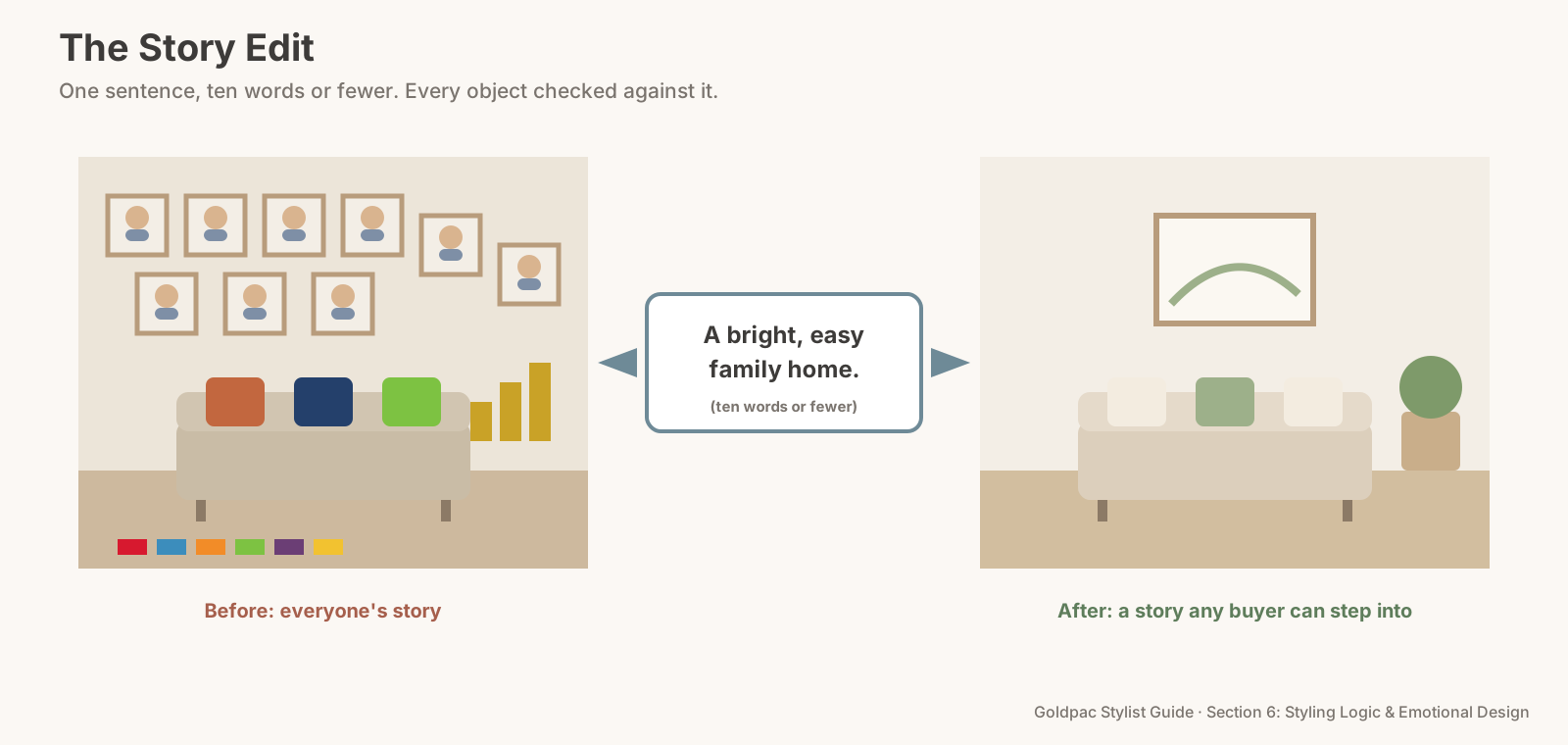
The Story Edit
- Write the sentence. Ten words or fewer, about life in the home, not about you. "A bright, easy family home with a great backyard."
- Walk each room and ask: does this object support the sentence?
- Keep what supports it. The dining table set simply, a throw on the sofa, a bowl of fruit, outdoor chairs facing the garden.
- Remove what contradicts it. Clutter, signs of a busy household, anything that says "renovation needed" or "temporary".
- Remove what names someone. Photos, trophies, certificates, kids' names on walls, team flags (Rule #152 covers personal items).
- Add two or three warm cues per main room, so the home doesn't feel like a display: a book on the bed, a tray with cups, fresh flowers.
The Story Edit: one sentence of ten words or fewer, every object checked against it, personal details removed and two or three warm cues kept in each main room.
Story sentences by property type
- Inner-city apartment: "Easy city living with the cafés downstairs."
- Family home in the suburbs: "Room to grow, with weekends in the backyard."
- Terrace or semi: "Character and calm, close to everything."
- Townhouse: "Low-maintenance living with space for guests."
- Downsizer's single level: "Light, easy and everything on one floor."
- Coastal home: "Salt air, open doors and long summer evenings."
Each one is ten words or fewer, and none of them mentions who lives there now.
How the story shows up, room by room
Living room: the furniture faces the view or the fireplace, not the TV. Kitchen: the bench is clear except for one moment, like coffee or a bowl of fruit (Rule #153). Dining: the table is set simply, as if friends are coming. Main bedroom: made bed, two lamps, one book. Outdoor area: chairs with cushions, facing the garden. Every room repeats the same story in its own way. When buyers walk out, the sentence should be the feeling they take with them, even if nobody ever says it out loud. That's the test of a good story: it's felt, not explained, and it holds from the front door to the back fence.
Example: the family home in the Hills
Picture a four-bedroom home in the Hills District. Every wall has school photos, the hallway has a rack of soccer boots, the study is a gaming room and the main bedroom holds the overflow from the garage. The owners love it. Buyers see someone else's very full life.
The story sentence: "A relaxed family home made for weekends outside." Photos come down and art goes up. The boots go to the garage. The gaming room becomes a study with a desk and a lamp. The main bedroom gets a made bed and two lamps. On the deck, four chairs face the garden with cushions on them. Nothing in the house says who lives there; everything says how good it would be to live there.
Don't overcorrect
Neutral isn't sterile. A home stripped of every sign of life looks like a display suite, and some buyers find that cold. Keep the warm cues: a throw, a plant, fresh flowers, a few books.
Neutral isn't anonymous either. A home with no story at all gives buyers nothing to imagine, and they move on to the listing that does.
Neutral isn't beige everything. Colour and character can stay, as long as they belong to the home (a brick wall, timber floors, a bold kitchen) rather than to the current owners.
Do this Sunday
Sit at the kitchen table with a pen. Write your home's story in ten words or fewer. Then walk through every room with the sentence on your phone screen, and put a sticky note on anything that argues with it. That's your packing list for the week.
The blind spot: your life is the story you see
You can't see your home as a stranger does. Every object comes with a memory, so the house looks like your family, not like a house. That's what makes it home.
It's also why the edit is hard. Write the sentence first, then let the sentence decide, not the memories.
What if…
You're living there during the campaign. Pack the personal items into labelled boxes now; you'll be packing them for the move anyway, so it's a genuine head start rather than extra work.
The home has a strong character of its own (a heritage terrace, a mid-century house). Let the home's story lead: "a 1920s terrace with original details, ready for its next family".
FAQ
Should a house for sale feel neutral or homely? Both. Neutral enough that buyers can picture their own life, homely enough to feel warm: a few books, a throw, fresh flowers.
Does neutral styling mean painting everything white? No. It means removing personal details and clutter. Colours that belong to the home itself can stay.
Writing your home's story is easier with someone who isn't part of it. For empty homes and agent listings, Goldpac stages with our own furniture to tell the story buyers want: send us the address and a fixed styling quote lands within two hours, through our home staging page. Living there? A Photo Ready Consultation turns your home's story into a written room-by-room plan within 48 hours of the visit. See current prices.
Keep reading: Rule #153: Style around universal moments: coffee, rest and wellbeing (universal lifestyle moments) · Rule #48: Give each room one colour story (one colour story per room) · Rule #173: Match the colour story to the season (seasonal colour stories)
◀ Previous: Rule #150: Pair knitted textures with smooth surfaces · Section 6 contents · Next: Rule #152: Remove personal items: photos, trophies and mail ▶
Part of the Goldpac Stylist Guide: 300+ home staging rules from Goldpac's Sydney styling team.