
Stylist Guide › Section 6: Styling Logic & Emotional Design › Rule #153
"What should we put on the bench?"
"What does everyone do in a kitchen in the morning?"
"Make coffee."
"Then start there."
The rule in one minute. Style the home around everyday pleasures almost every buyer shares: morning coffee, a quiet read, a long bath, an easy dinner outside. Each main room gets one universal moment, built from two or three objects (a coffee set by the window, a book and a throw on the armchair, a rolled towel and a plant by the bath). Avoid niche hobbies and strong personal themes. Universal moments let buyers see themselves; niche ones let them see you.
Your questions, our answers
Lifestyle styling sounds vague until you try it. These are the questions it raises, and our answers.
"What counts as universal?"
"Isn't everything someone's lifestyle?"
Universal means almost everyone does it, or wishes they did more of it. Coffee or tea in the morning. Reading in a comfortable chair. A bath at the end of the day. Eating outside on a warm evening. Sleeping in on a Sunday.
Niche means a specific hobby or identity. A home gym full of weights. A gaming setup. A surfboard rack. A wine collection in every room. Those are great to live with, but they speak to one kind of buyer.
What are lifestyle themes in home staging?
Lifestyle themes are small, styled scenes that suggest a pleasant daily routine (coffee, reading, bathing, outdoor dining) so buyers can picture themselves living in the home. Each theme uses two or three ordinary objects, placed where that moment would naturally happen.
"Which moment goes in which room?"
| Room | Universal moment | Two or three objects |
|---|---|---|
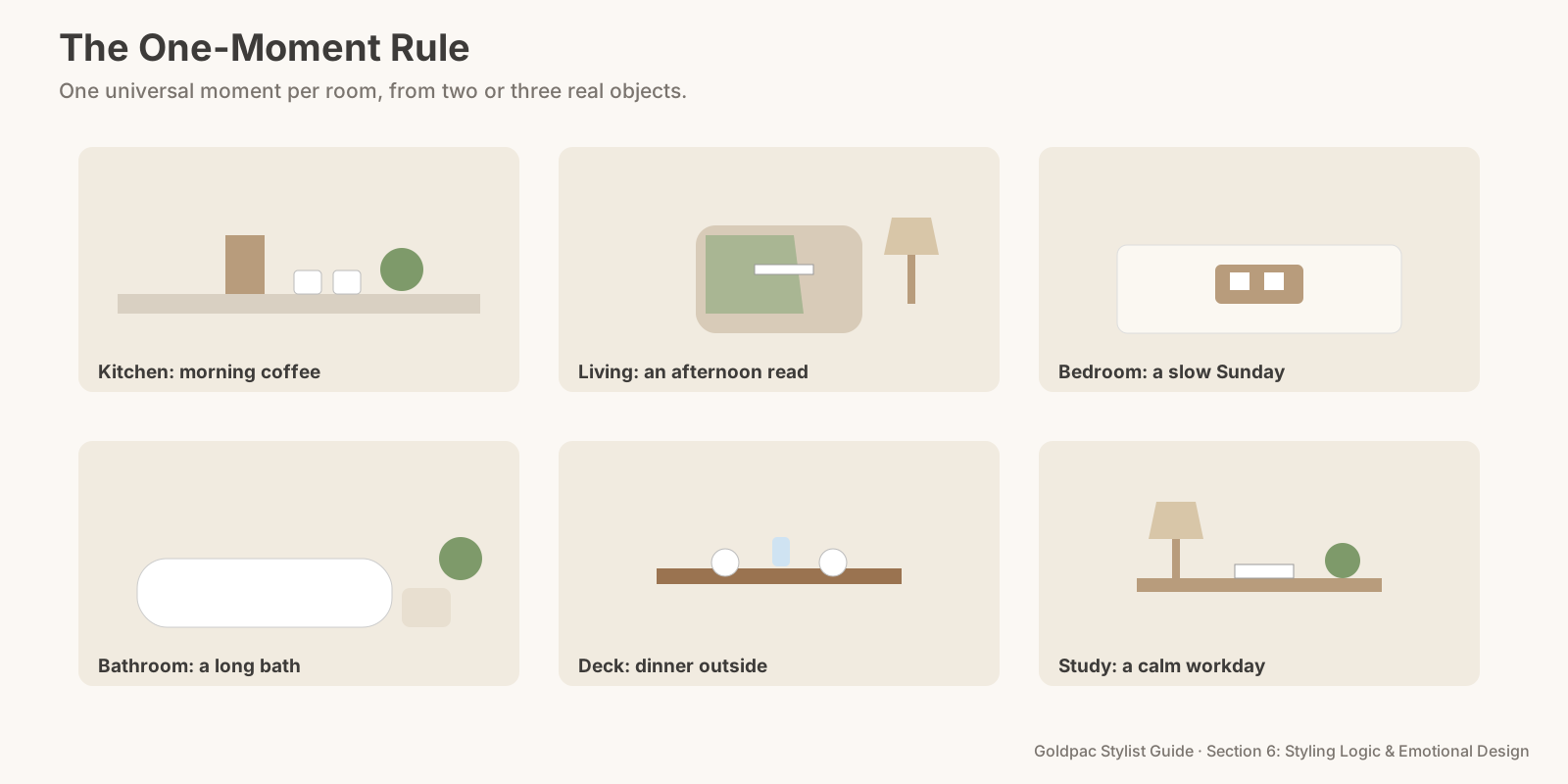
| Kitchen | morning coffee | a coffee pot or plunger, two cups, a small plant |
| Living room | an afternoon read | an open book, a throw over the armchair, a lamp on |
| Main bedroom | a slow Sunday | a tray with two cups, a book on the bed |
| Bathroom | a long bath | a rolled towel, a plant, one candle |
| Deck or balcony | dinner outside | two place settings, a jug, cushions on the chairs |
| Study | a calm workday | a lamp, a notebook, one plant |
The One-Moment Rule
- Pick one moment per room from the table above, matched to the room's best spot: the sunny window, the armchair, the deck.
- Use two or three objects, not five. A moment is a suggestion, not a shop display.
- Place it where it would really happen. Coffee near the machine or the window. A book on the chair that gets the light.
- Keep it practical. Real cups, a real book, a real plant. Nothing fake or plastic.
- Remove niche themes from the main rooms: hobby gear, collections, team colours.
- Check from the doorway: the moment should be noticed in the first few seconds, then fade into the room.
The One-Moment Rule: one universal moment per room, built from two or three real objects placed where that moment would really happen.
"Isn't this a bit fake?"
Only if it's overdone. A champagne bucket, four croissants and a newspaper on the bench at 11 am looks like a set. Two cups and a coffee pot looks like Saturday. The test: would a real person leave it like that for ten minutes? If yes, it works.
Moments to skip
Wine glasses and an open bottle at 11 am. It reads as a party, and some buyers won't love it. A laptop on the bench. It says work, not life. Exercise gear in the living room. A yoga mat in a spare room can work; dumbbells by the sofa don't. Kids' toys as a "family moment". One basket, lid on, is enough to say "children welcome". Everything else waits in the car until the open home is over.
If this, then that
- If the home has a great view: put the coffee moment in front of it.
- If there's a pool or deck: the outdoor dinner moment matters more than any indoor one.
- If the buyer pool is downsizers: a reading chair and a garden moment may matter more than a kids' study.
- If it's a small unit: one moment in the main room is enough.
The blind spot: your routine isn't the one on show
Your real morning is probably messier. School lunches, a laptop, the dog's bowl. That's life, and it's not what you're selling.
The moment you style is the morning buyers wish they had. It's easier to see when you stand back and ask what the room is best for, not what you use it for.
What if…
You don't have nice cups or trays. Simple white cups and a timber board are enough. The moment matters far more than the props, and buyers notice the scene, not the brand.
FAQ
What props should I use to stage a kitchen? Keep it to a universal moment: a coffee pot or plunger, two cups and a small plant, or a bowl of fruit. Everything else off the bench.
Lifestyle styling works best when it's light. For empty homes and agent listings, Goldpac stages each room around one moment with our own furniture and props: send us the address and a fixed styling quote lands within two hours, through our home staging page. Living there? A Photo Ready Consultation picks the moment for each room within 48 hours of the visit. See current prices.
Keep reading: Rule #151: Style a neutral story any buyer can imagine living in (the neutral story) · Rule #47: Echo accent colours with flowers and books (flowers and books as accents) · Rule #155: Style small moments, like a tray of tea or a book on the bed (small styled moments)
◀ Previous: Rule #152: Remove personal items: photos, trophies and mail · Section 6 contents · Next: Rule #154: One subtle scent for the whole home ▶
Part of the Goldpac Stylist Guide: 300+ home staging rules from Goldpac's Sydney styling team.