
Stylist Guide › Section 6: Styling Logic & Emotional Design › Rule #155
The smallest styling in a house often does the most selling: a tray with two cups on a made bed, an open book on an armchair, a folded towel and a sprig of eucalyptus on a bath ledge.
The rule in one minute. A styled moment is a tiny scene that suggests someone just stepped away: a tray with two cups on the bed, a book open on the armchair, a towel and a plant beside the bath. Build each one from three objects of different heights, grouped tightly on a tray or surface no wider than about 45 cm, and use real, everyday things. One moment per room is enough; more than that turns a home into a shop window.
Why small moments work
- They tell buyers what the room is for. A tray on the bed says "slow mornings here". A book on the chair says "this is the reading spot".
- They stop rooms feeling empty. A neat, made bed is good; a made bed with a tray on it is inviting.
- They give photographers a focal point. A small, lit, styled detail draws the eye in a wide shot and makes a good close-up.
- They're cheap and quick. Everything you need is already in your cupboards.
"Nobody actually eats breakfast on a made bed." Probably not. A moment isn't a documentary; it's a suggestion. As long as it uses real, ordinary objects and stays small, it reads as a pleasant hint rather than a set.
What is a styled moment?
A styled moment is a small vignette of three everyday objects, grouped on a tray or surface, placed where that activity would naturally happen, so it suggests a pleasant routine without saying whose it is. It's the micro version of the room's lifestyle theme (Rule #153 covers choosing one theme per room).
The numbers
- 3 objects: a number the eye reads as a group. Two looks like a pair; four or five starts to look cluttered.
- 3 heights: one tall (a small vase, a teapot), one medium (a cup, a candle), one low (a book, a folded napkin).
- About 45 cm: the widest a moment should spread. Bigger, and it stops being a moment.
- 1 per room: one moment in the main rooms; none in small rooms like laundries.
- 1 living element: a sprig of greenery, a flower or a piece of fruit in at least half of your moments.
- 0 brand names facing the camera: turn labels away.
The Three-Object Moment
- Choose the spot where the activity would happen: the bed, the armchair, the bath ledge, the kitchen bench.
- Choose a base: a timber tray, a linen napkin, a small board. It holds the group together.
- Pick three objects of different heights. Tall, medium, low.
- Group them tightly on the base, slightly off-centre, overlapping a little.
- Add one living element if you can.
- Step back to the doorway. The moment should catch the eye, then let it move on to the room.
The Three-Object Moment: three everyday objects at three heights, grouped on a base no wider than about 45 cm, one per main room.
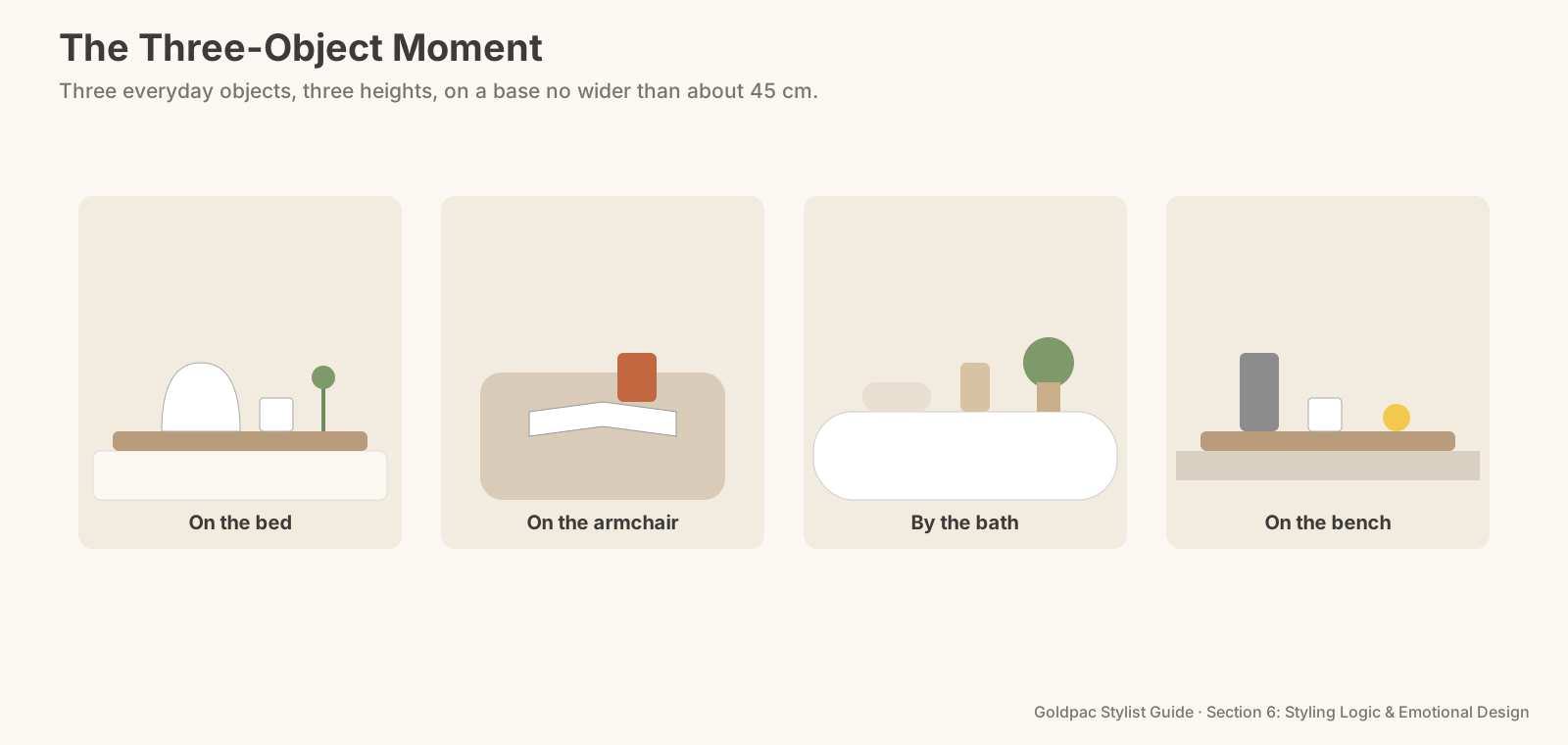
Where moments work best
On the main bed, at the foot or on one side. On an armchair by the window. On the kitchen bench, away from the sink. On a bath ledge or vanity. On an outdoor table for twilight photos. Not on dining tables (a set table is its own story), and not in small rooms like laundries, where the space itself is the point.
Pack-away list
Goes in the box: anything that makes a moment look staged for a photo shoot (champagne, croissants, fake fruit), branded packaging, more than one moment per surface, wilted flowers.
Stays out: a tray, two plain cups, one book, one small vase or sprig, a folded towel, a single piece of fruit.
The blind spot: you see a tray, buyers see a Sunday
At home, a tray is a tray. You carry tea on it and put it back in the cupboard. Nothing about it seems special.
A buyer seeing it on a made bed reads it as a lazy Sunday morning they'd like to have. That's why the smallest objects can change how a room feels, and why they're easy to skip when you're styling your own home.
What if…
You have young children or pets who'll move it. Set moments up just before photos and each open home, and put them away afterwards.
There's no bedside table or chair for the moment. Use the bed itself, the end of a kitchen bench or a window sill.
FAQ
How do you style a tray on a bed for photos? Use a timber or woven tray, two cups or a small teapot, one book and a sprig of greenery. Place it slightly off-centre on the bed, at the foot or on one side.
The small moments are the easiest to forget when you're packing a whole house. For empty homes and agent listings, Goldpac stages every room with our own furniture and finishing touches: send us the address and a fixed styling quote lands within two hours, through our home staging page. Living there? A Photo Ready Consultation picks the moment for each room in a written plan within 48 hours of the visit. See current prices.
Keep reading: Rule #153: Style around universal moments: coffee, rest and wellbeing (universal lifestyle moments) · Rule #47: Echo accent colours with flowers and books (flowers and books as accents) · Rule #161: Every styled object should add to the story (objects that add to the story) · Rule #168: Style shelves from eye level down (styling shelves from eye level down)
◀ Previous: Rule #154: One subtle scent for the whole home · Section 6 contents · Next: Rule #156: Avoid symmetry overload: break the pattern a little ▶
Part of the Goldpac Stylist Guide: 220+ home staging rules from Goldpac's Sydney styling team.