
Stylist Guide › Section 2: Colour & Visual Impact › Rule #48
"What's the theme in here?"
"There isn't one."
"I can tell."
The rule in one minute. A colour story is a short, consistent palette for one room: one base tone, one accent family and one natural material, used everywhere you look. Rooms with one story look calm and planned in photos. Rooms with three or four (coastal blues, boho terracotta, grey Scandi and gold glam all at once) look busy and unfinished, even when they're tidy. Edit each room down to a single story before the photographer arrives.
The mistake in the wild
Picture a living room on the morning of the photos.
Grey fabric sofa. Navy and white striped cushions from a coastal phase. A terracotta tufted rug from a boho phase. A gold-framed round mirror. A green velvet armchair. A yellow kids' play tent in the corner. Black-and-white prints over the sofa. A red coffee machine on the bench behind.
Every piece is fine. Together, the room is telling five stories at once.
What it costs you
The eye can't settle. Buyers look for where the room starts and ends. They find navy, then terracotta, then gold, then green. The furniture and the floor plan become background noise.
The photos look cluttered. Even with nothing on the floor, a room with too many colours reads as messy at listing-photo size on a phone.
The room looks smaller. Every colour change draws an edge. Too many edges chop a room into pieces.
Buyers can't picture their own things. A room with no clear story looks like it's waiting to be finished. A room with one story looks finished and ready for them.
What is a colour story in interior design?
A colour story is a deliberate, limited palette for a room: usually one base tone, one accent family and one natural material, repeated throughout. "Warm white, rust and timber" is a story. "Soft grey, sage and linen" is a story. "Everything we've ever bought" isn't.
The ten-minute fix: The One-Story Edit
- Find the anchor. What in the room can't move? The floor, the sofa, the kitchen, a big artwork. That decides the story.
- Name the story in three words. Base, accent, material. For example: "white, sage, timber."
- Walk the room with a basket. Anything that doesn't fit the three words goes in.
- Swap, don't add. If a cushion is the wrong colour, replace it with one from another room that fits. Don't buy new things until you've shopped your own home.
- Repeat the accent three times at different heights (Rule #42).
- Check the next room. In open-plan spaces, living, dining and kitchen share one story.
The One-Story Edit: name each room's story in three words (base, accent, material), then remove everything that doesn't fit them.
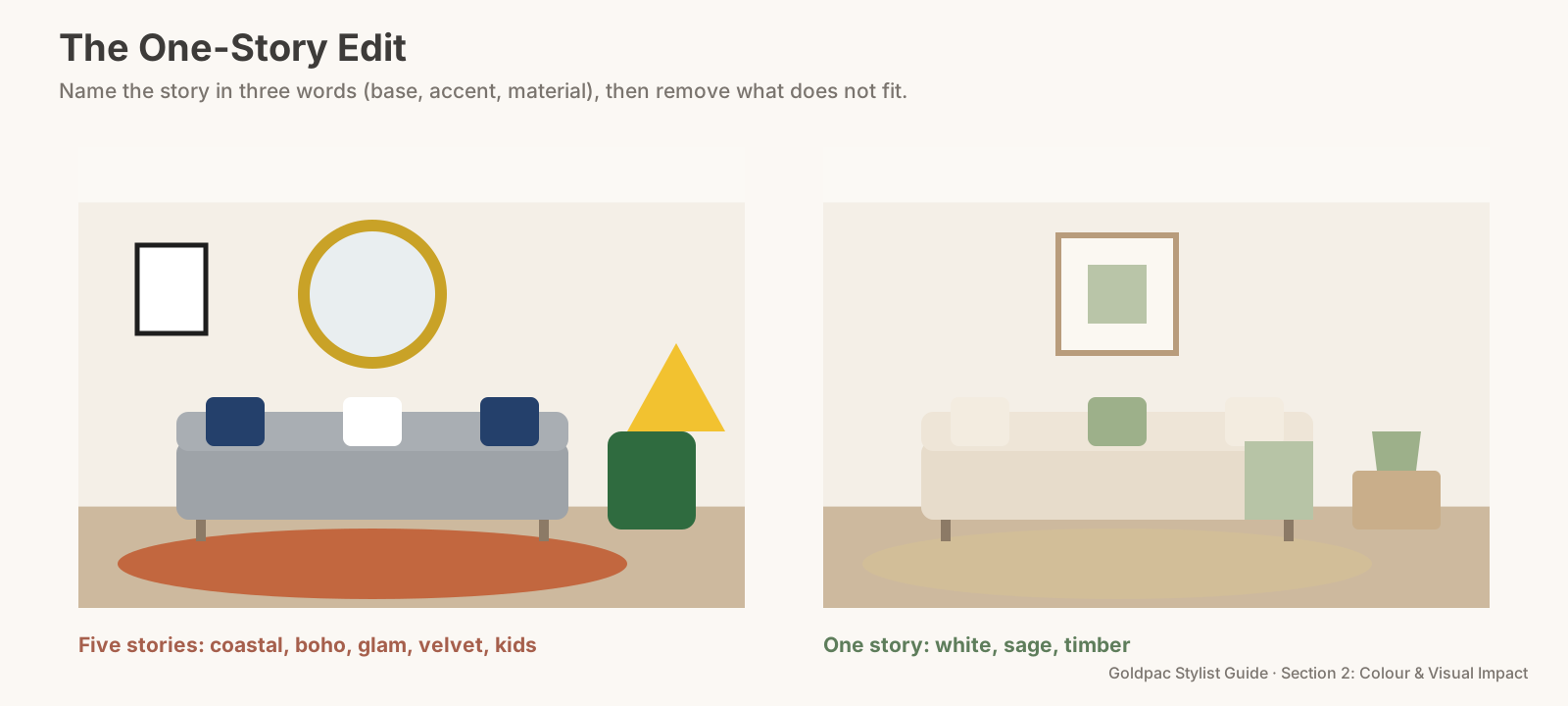
Mistake and fix
Mistake: coastal blue cushions on a grey sofa, terracotta rug underneath. Fix: choose one. Keep the terracotta rug and swap the cushions to cream and rust, or keep the blue and swap the rug to jute.
Mistake: gold mirror, silver lamp, black tapware, brass handles. Fix: metals are part of the story too. Keep one warm metal or one cool metal in view, and store the rest. Black counts as its own line (Rule #43).
Mistake: the kids' bright plastic toys in the living room. Fix: one lidded basket in the story's material. Everything goes in before each inspection.
The phone-camera test
Stand in the doorway and take a photo. Then zoom into the photo until the objects blur and only colour patches remain.
Count the colours. If you see more than three main colours plus timber and greenery, the room has more than one story. Find the patch that doesn't belong, and remove it.
The objection: "But I love an eclectic look"
Eclectic rooms that work always have one thread. A collected, eclectic room in a magazine looks varied but usually shares one palette, or one material, running through everything. The variety is in shape and age, not in colour.
And you're not styling your forever home. You're styling a listing that needs to be read in two seconds on a phone. Eclectic can come back after the move.
The blind spot: every piece has its own story
Homes collect colour slowly. A gift here, a sale there, a phase that lasted three years. Each object made sense when it arrived, and you remember why you chose it.
Buyers don't know any of those stories. They only see colours, and they see them all at once. That's why the edit feels hard for you and obvious to a stranger.
What if…
The sofa is a strong colour. Then the sofa is the story. A green velvet sofa sets "green, cream, timber"; everything else follows it.
It's an open-plan apartment. One story for the whole space. Kitchen, dining and living all draw from the same three words.
You have kids and can't remove everything. Pick storage in the story's material (woven baskets, timber boxes) and give each child one basket to fill before inspections.
FAQ
How many colours should be in one room? Usually three main colours, plus natural materials like timber and greenery. The 60-30-10 split (Rule #32) is a good starting point.
Can each room in a house have a different colour story? Yes, especially in separate rooms like bedrooms. Keep one shared thread, such as the same base tone throughout, so the home flows when buyers walk from room to room.
The edit is harder in your own home, because every piece has a reason. A Photo Ready Consultation names the colour story for each room and lists what stays and what goes, in a written plan within 48 hours of the visit. If the home is empty, Goldpac stages each room around one clear story: send us the address and a fixed styling quote lands within two hours, through our home staging page. See current prices.
Keep reading: Rule #43: Black adds contrast and polish when used sparingly (black as a line, not a block) · Rule #35: Avoid bright or clashing wall colours (the Loud Wall Hunt) · Rule #49: Change tones gradually from room to room (colours that flow from room to room) · Rule #56: Limit how many colours show in one view (counting colours in one view) · Rule #151: Style a neutral story any buyer can imagine living in (styling a neutral story)
◀ Previous: Rule #47: Echo accent colours with flowers and books · Section 2 contents · Next: Rule #49: Change tones gradually from room to room ▶
Part of the Goldpac Stylist Guide: 220+ home staging rules from Goldpac's Sydney styling team.