
Stylist Guide › Section 2: Colour & Visual Impact › Rule #43
"Is black too much for a staged room?"
"Depends. Is it the sofa, or the picture frame?"
"Both."
"Then one of them has to go."
The rule in one minute. Black adds contrast and polish to a pale room, but only in small, sharp doses: picture frames, a lamp base, tapware, a chair frame, the spine of a few books. Three to five small black pieces spread across a room give it definition. A black sofa, black rug or black feature wall does the opposite: it becomes a hole in the photos. Use black as a line, not as a block.
Why black works
Black is the strongest contrast a pale room can have. A thin black frame on a white wall, a black lamp on a timber table, a black chair leg on a pale rug. Each one draws a crisp edge. The eye reads crisp edges as quality and precision.
It also sharpens everything near it. Next to black, white looks whiter and timber looks warmer. It's a big part of the appeal of black tapware and window frames: they make a plain white kitchen look finished.
And it needs very little space. A two-centimetre black frame does as much work as a whole coloured wall.
Why black backfires
Black absorbs almost all the light. The blackest paints sit near the bottom of the light-reflectance scale, around 5 out of 100 (Composite Paint, 2026). A big black surface is a dark patch in every photo, and Rule #41 explains what that does to the size of a room.
Big black shapes have no detail. A black leather sofa photographs as a flat silhouette. Buyers can't see the cushions, the stitching or the shape. It just reads as heavy.
Black shows everything. Dust, pet hair, fingerprints, water marks. On a black benchtop or a black coffee table, the camera sees all of it.
Black two ways
Picture the same living room twice. Soft white walls, pale oak floor, a cream sofa.
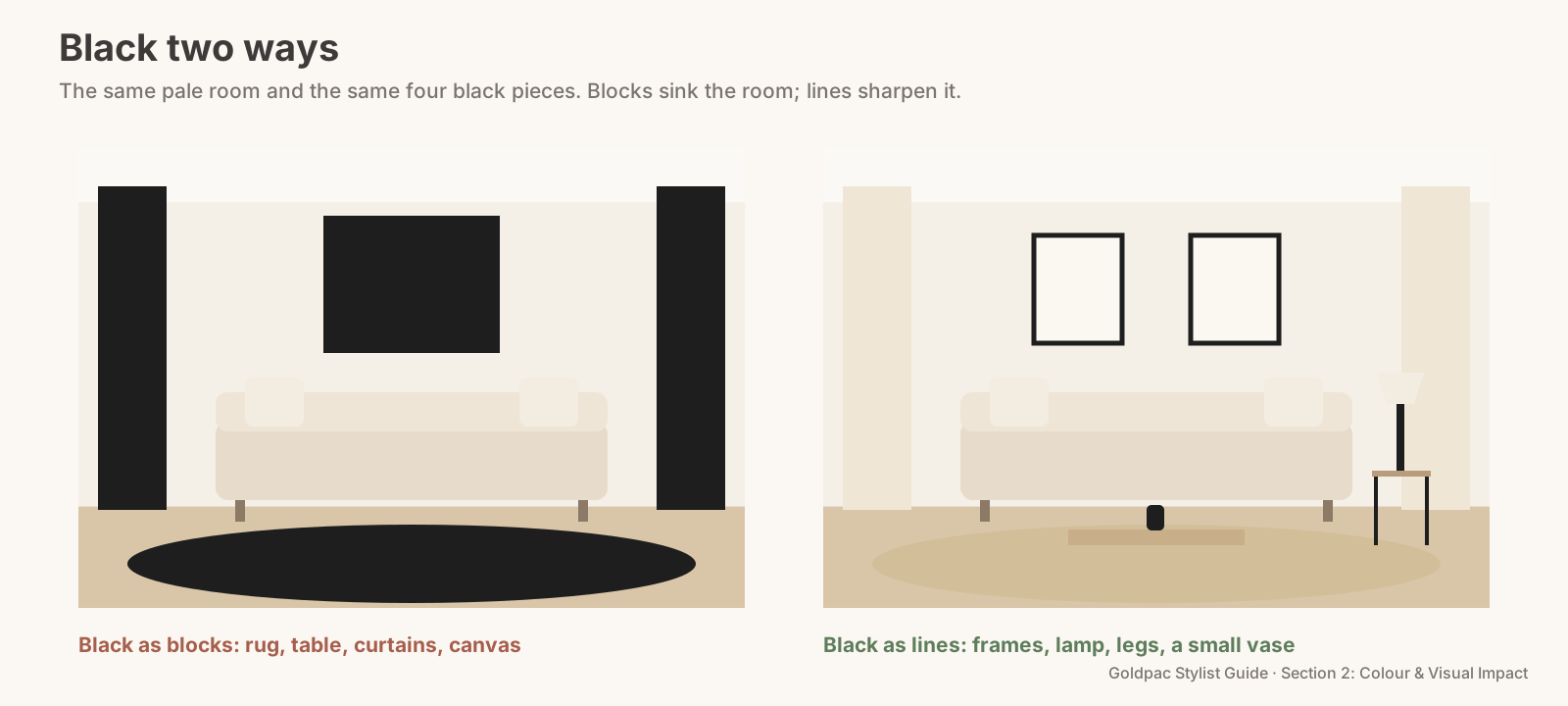
Version one: black as blocks. A black rug. A black coffee table on top of it. Black curtains. One large black canvas over the sofa.
Version two: black as lines. Two thin black frames on the wall. A black lamp base on the side table. A side chair with slim black legs. A small black vase on the coffee table. The rug is jute, the curtains linen.
| Black as blocks | Black as lines | |
|---|---|---|
| How much black | 4 large pieces | 4 small pieces |
| Share of the view | about a third | under a tenth |
| What the eye does | stops at the rug | moves around the room |
| In photos | the floor disappears | edges look crisp |
| Feel | heavy, moody | sharp, finished |
Verdict: the same number of black pieces, very different results. Version two wins every time in a sale.
How much black should be in a room?
Usually three to five small black pieces, spread across the room, adding up to well under a tenth of what you see. Fixed black (window frames, tapware, light switches, a black range hood) counts too, so a modern kitchen with black fittings may need no extra black at all.
The Black Line Rule
- Count the black you can't move. Window frames, tapware, handles, light fittings, the TV.
- Remove the black blocks. Black rugs, throws, large cushions, curtains and big black canvases go into storage.
- Add thin black lines if the room looks washed out. Frames, a lamp base, a chair frame, a candlestick, book spines.
- Spread them out. No two black pieces touching, ideally at different heights.
- Stop at five. If you can count more than five black items from the doorway, take one away.
The Black Line Rule: black works as a line, not a block, in three to five small pieces spread around the room.
The blind spot: black feels neutral to you
Most people treat black as a non-colour. It goes with everything, it's in every wardrobe, and the black TV, black bin and black speaker have been in the room for years. You stopped seeing them.
The camera sees them first. In a pale room, every black object is the highest-contrast thing in the frame. Count them through your phone screen, not with your eyes.
What if…
The sofa is black and it stays. Cover most of it: a large pale throw over the back and seat, and pale cushions. Then put a pale rug under it and keep the rest of the black in the room to two small pieces.
The TV is the biggest black object. Switch it off and keep the screen clean. For the photos, ask the photographer whether it can be framed out, or put a simple artwork image on the screen.
It's a modern home with black windows and black kitchen fittings. You already have your black lines. Don't add more. Lean on timber, linen and greenery.
FAQ
Does black furniture make a room look smaller? Large black furniture usually does, because it absorbs light and reads as a heavy block. Small black pieces, like a slim chair or side table on legs, don't, and they can make a pale room look sharper.
Black is the colour you stop noticing first. A Photo Ready Consultation counts what the camera will see in every room and tells you which black pieces to keep and which to store, in a written plan within 48 hours of the visit. If the home is empty, Goldpac stages it with pale furniture and a few sharp black details: send us the address and a fixed styling quote lands within two hours, through our home staging page. See current prices.
Keep reading: Rule #41: Use dark colours only in small doses (dark colours in small doses) · Rule #38: Use the same colour in different textures for depth (three textures in one colour) · Rule #48: Give each room one colour story (one colour story per room)
◀ Previous: Rule #42: Repeat one accent colour to tie a room together · Section 2 contents · Next: Rule #44: Soft, pale colours help bedrooms feel restful ▶
Part of the Goldpac Stylist Guide: 300+ home staging rules from Goldpac's Sydney styling team.