
Stylist Guide › Section 2: Colour & Visual Impact › Rule #41
Eight times. That's roughly how much more light a soft white wall sends back into a room than a deep charcoal one does. Dark colours aren't wrong. They're just expensive in the one currency a sale runs on: light.
The rule in one minute. Dark colours (charcoal, navy, forest green, chocolate, black) make a room feel smaller and dimmer because they absorb most of the light that hits them. Use them in small doses: a cushion, a lamp base, a picture frame, a single chair. As a guide, keep dark tones to about a tenth of what you see from the doorway, and keep them off the largest surfaces: walls, ceilings, big rugs and sofas.
How much light does a dark wall absorb?
Most of it. Paint makers measure this with Light Reflectance Value, or LRV, on a scale from 0 (absorbs all light) to 100 (reflects all of it). The light a surface doesn't reflect, roughly 100 minus its LRV, is absorbed (Resene Architect's Memo 87, 2007).
Soft whites and off-whites usually sit around LRV 75 to 85. Deep colours sit between 10 and 25, and near-blacks under 10 (Composite Paint, 2026). So a soft white at 80 reflects about eight times the light of a charcoal at 10.
In a room, that difference compounds. Light bounces off walls, ceiling and floor several times before it reaches your eye or the camera. Every dark surface it meets takes a large share.
Why dark rooms look smaller
Edges disappear. In a pale room, you can see where the wall meets the ceiling and where the floor meets the skirting. Those lines tell the brain how big the space is. In a dark room, corners fall into shadow, and the room reads as smaller than the floor plan.
Furniture merges. A charcoal sofa against a navy wall becomes one dark shape. Buyers can't tell how much floor is left around it.
The camera works harder. A photographer shooting a dark room has to lift the exposure. Then the windows blow out to white, and the view, often one of the best features in a Sydney home, disappears. Dark walls cost you the room and the window at once.
The objection: "But dark rooms look amazing in magazines"
They do. Those rooms are lit by a team with professional lights, styled for a single angle and shot for hours. And the magazine reader isn't trying to work out whether their bed fits.
A buyer at an open home has one question: how big is this room? Dark colours make that question harder to answer, and an uncertain buyer is a harder buyer to win.
What "small doses" means
These are guidelines we use when we style a room, not laws of physics.
- About 10 per cent of the view. Stand in the doorway and estimate. If dark tones cover more than a tenth of what you see, they're taking over.
- Small and scattered, not big and in one place. Three dark accents spread across a room give it definition. One large dark block makes it heavy.
- At different heights. A dark lamp base on a side table, a black frame on the wall, a charcoal cushion on the sofa. The eye travels around the room.
- Off the largest surfaces. Walls, ceilings, rugs and sofas are where dark does the most damage.
Small doses do real work. Black window frames, a dark timber bowl, a navy cushion: these give a pale room contrast, so it looks crisp instead of washed out (Rule #37 covers the opposite problem, dark floors that need pale pieces on top).
The Fix Ladder: three levels
Pick the level that matches your time before the photos.
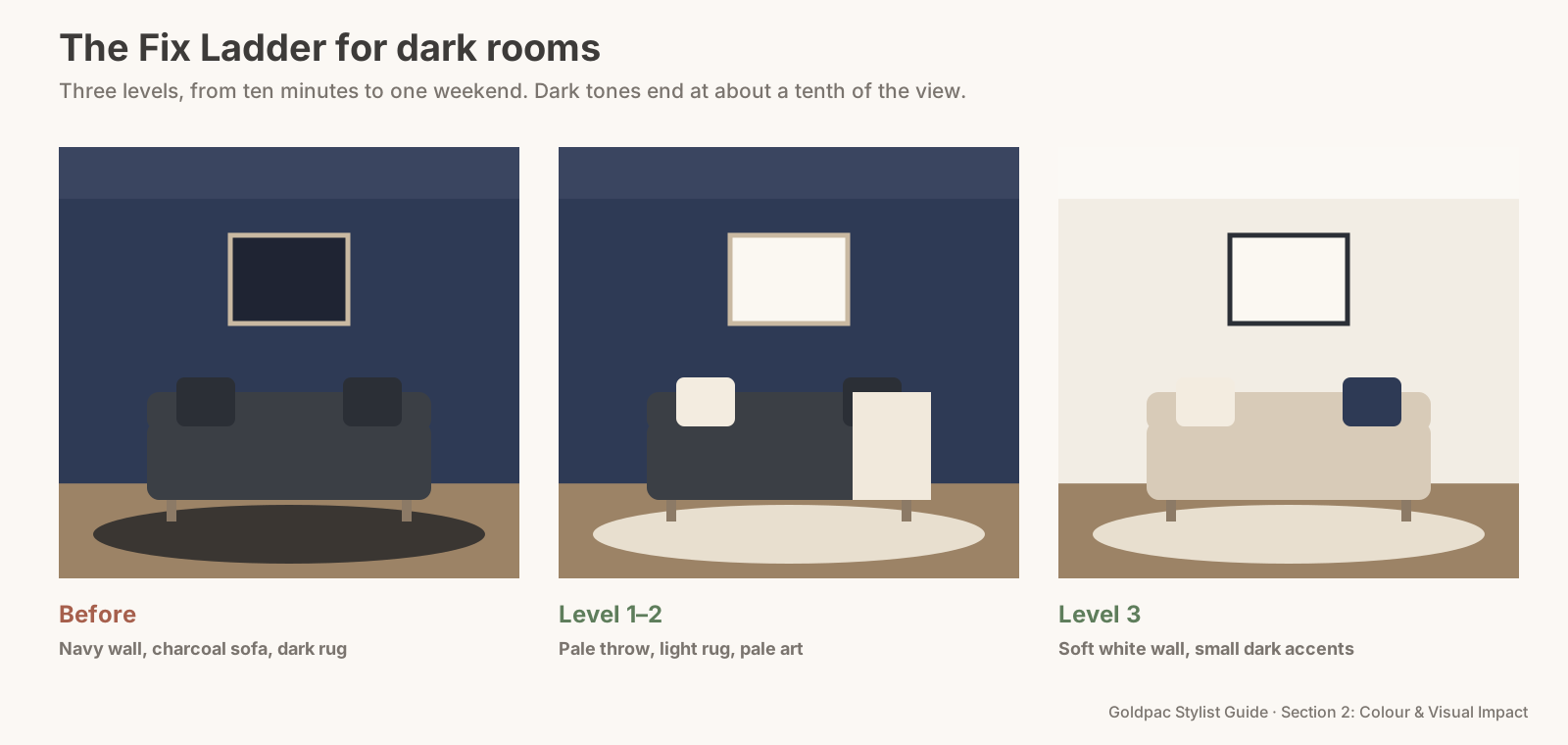
Level 1: ten minutes
- Cover the dark sofa. A large pale throw over the back and one arm, plus light cushions.
- Lift the floor. If the rug is dark, roll it up and store it, or swap it for a pale one.
- Open everything. Blinds up, curtains fully back, every lamp on.
- Clear dark clutter. Black appliances off the bench, dark coats off the hooks, dark bags out of sight.
Level 2: one hour
- Swap the soft furnishings. Dark bedding, cushions and throws go into storage. Pale or mid-tone ones come in.
- Change the lampshades. Black or dark shades stop light. Swap to white or linen.
- Add a large pale artwork or mirror on the darkest wall to break it up.
- Keep three dark accents, no more, in three different spots.
Level 3: one weekend
- Repaint the dark feature wall in the same soft white as the rest of the room.
- Repaint a dark ceiling. It's the surface people notice least and the one that steals the most light.
- Repaint dark doors and trims in small rooms and hallways.
| Level | Time | What changes |
|---|---|---|
| 1 | about 10 minutes | Dark sofa covered, floor lifted, light in |
| 2 | about 1 hour | Dark soft furnishings and shades swapped |
| 3 | 1–2 days | Dark walls and ceiling repainted |
Pack-away list
Goes in the box: dark throws and cushions beyond your three accents, dark bath mats and towels, dark lampshades, a dark rug in a small room, black kitchen appliances, dark storage tubs that live in view.
Stays out: one or two dark cushions, a dark lamp base, black picture frames, a dark timber bowl, black tapware and window frames (they're fixed, and they're fine).
The blind spot: you see the room at night
Most people choose dark colours for the evening. A navy living room with lamps on at 8 pm feels cosy and wrapped. That's the room you sit in.
Buyers see the room at 11 am on a Saturday, with daylight competing against the walls. And the photographer sees it at whatever time suits the sun. Neither will see your lamp-lit version.
Walk into each room at mid-morning, lights off, and ask how big it feels.
What if…
You're renting and can't repaint. Use Level 1 and Level 2. A pale throw, a light rug and white lampshades get most rooms a long way.
It's a media room or a cinema room. Dark walls make sense there. Keep it dark, and say so in the listing. A purpose-built cinema room reads as a feature, not a mistake.
The dark wall is new and expensive. Then make it the only dark surface in the room. Pale furniture, a light rug and white bedding in front of it, and nothing else dark nearby.
It's a small apartment. Be stricter. In a unit under about 60 square metres, even a navy sofa can tip the balance. Keep dark tones to tiny accents, and let the pale walls carry the light from one end of the unit to the other.
FAQ
Do dark walls make a room look smaller? Usually, yes. Dark walls absorb most of the light, hide corners and edges, and make the room read as smaller than it is. A dark wall can work in a large, bright room, but it's risky when you're selling.
What dark colours work as accents? Charcoal, navy, deep green and black are the most flexible. One or two of them, in small pieces, give a pale room contrast and definition.
Should I paint over a dark feature wall before selling? If it's in a small or dim room, it's usually worth it. In a large, bright room with pale furniture, it can stay. Check the room in daylight with the lights off before you decide.
Dark colours are easy to love and hard to judge when you live with them every evening. A Photo Ready Consultation looks at every room in daylight and tells you which dark pieces to keep, which to store and whether a wall is worth repainting, in a written plan within 48 hours of the visit. If the home is empty, Goldpac stages it with pale, light-friendly furniture: send us the address and a fixed styling quote lands within two hours, through our home staging page. See current prices.
Keep reading: Rule #37: Dark floors add stability but need contrast (contrast on dark floors) · Rule #33: Cool tones open a room up; warm tones draw it in (cool walls, warm details) · Rule #43: Black adds contrast and polish when used sparingly (black as a line, not a block) · Rule #52: Avoid strong, saturated colours in small rooms (colours for small rooms)
◀ Previous: Rule #40: Skip strong red-and-green combinations, unless it's Christmas · Section 2 contents · Next: Rule #42: Repeat one accent colour to tie a room together ▶
Part of the Goldpac Stylist Guide: 300+ home staging rules from Goldpac's Sydney styling team.