
Stylist Guide › Section 7: Mistakes to Avoid › Rule #180
Three metres by three metres. That's a common size for a second bedroom in a Sydney unit, and one dark timber wardrobe can make it feel like half that.
The rule in one minute. Avoid dark, heavy furniture in tight rooms. Solid, dark pieces that sit right on the floor absorb light, block sightlines and make small rooms look smaller in person and in photos. In rooms under about 12 square metres, choose lighter tones, pieces on legs with visible floor beneath, open or slim forms, and fewer, smaller items. If a dark piece must stay, balance it with light textiles and keep everything around it pale.
Why dark, heavy furniture shrinks a room
Dark colours absorb light, and small rooms have little to spare. A small bedroom or study often has one window. A dark timber bed, a black wardrobe and a mahogany desk soak up what light there is, and the room photographs dim and closed in, even on a bright day.
Solid bases hide the floor, and visible floor is how buyers judge size. When a piece sits flat on the ground with no legs, the eye reads it as a solid block. Furniture raised on legs, even 10 to 15 cm off the floor, lets the floor continue underneath, and the room feels larger.
Heavy forms crowd the walkways. Bulky arms, deep bases and wide frames take up walking space. In a tight room, 10 or 15 cm less around the bed is the difference between "it fits" and "it's tight".
Dark furniture shows up first in a photo. In a small, light-coloured room, the darkest object is where the eye lands. If that's a heavy wardrobe, it becomes the subject of the photo.
What furniture makes a small room look bigger?
Lighter-toned pieces raised on slim legs, with open or slender frames, in fewer and smaller numbers, so more floor and wall stays visible and light moves freely around the room. Pale timber, white, light grey or natural rattan read as lighter; glass, acrylic and open shelving barely register at all.
The same small bedroom, two ways
| Dark and heavy | Light and lifted | |
|---|---|---|
| Bed | Dark timber sleigh bed on a solid base | Upholstered or pale timber bed on legs |
| Bedside | Two chunky dark drawers | One slim table each side, on legs |
| Storage | Dark freestanding wardrobe | Built-in robe only, or a slim pale chest |
| Desk | Heavy dark desk with drawers to the floor | Narrow desk on legs, 100 cm wide |
| Textiles | Dark quilt, dark rug | White linen, pale throw, light rug |
| Visible floor | Almost none | Under every piece |
| Feel in the photo | Dim, crowded | Bright, roomy |
Verdict: light and lifted. The room is the same size; it simply doesn't look like it.
The Lighten-Up Swap
- Find the heaviest piece in each small room: usually the darkest, largest item that sits on the floor without legs.
- Remove it if the room still works without it. A second wardrobe, a chest of drawers or a bookcase is often surplus in a staged room.
- Swap it if you can: a lighter piece from another room, or a slimmer one on legs.
- If it must stay, balance it: white or pale linen on a dark bed, a light rug under a dark desk, pale art on the wall above.
- Clear around it: at least 60 cm of walkway beside the bed, and nothing stacked on top of a dark wardrobe.
- Check the light: open the blinds, turn on a lamp, and photograph the room from the doorway.
The Lighten-Up Swap: in every room under about 12 square metres, remove or swap the darkest piece that sits flat on the floor, choose pieces on 10 to 15 cm legs, and balance anything dark that stays with pale textiles.
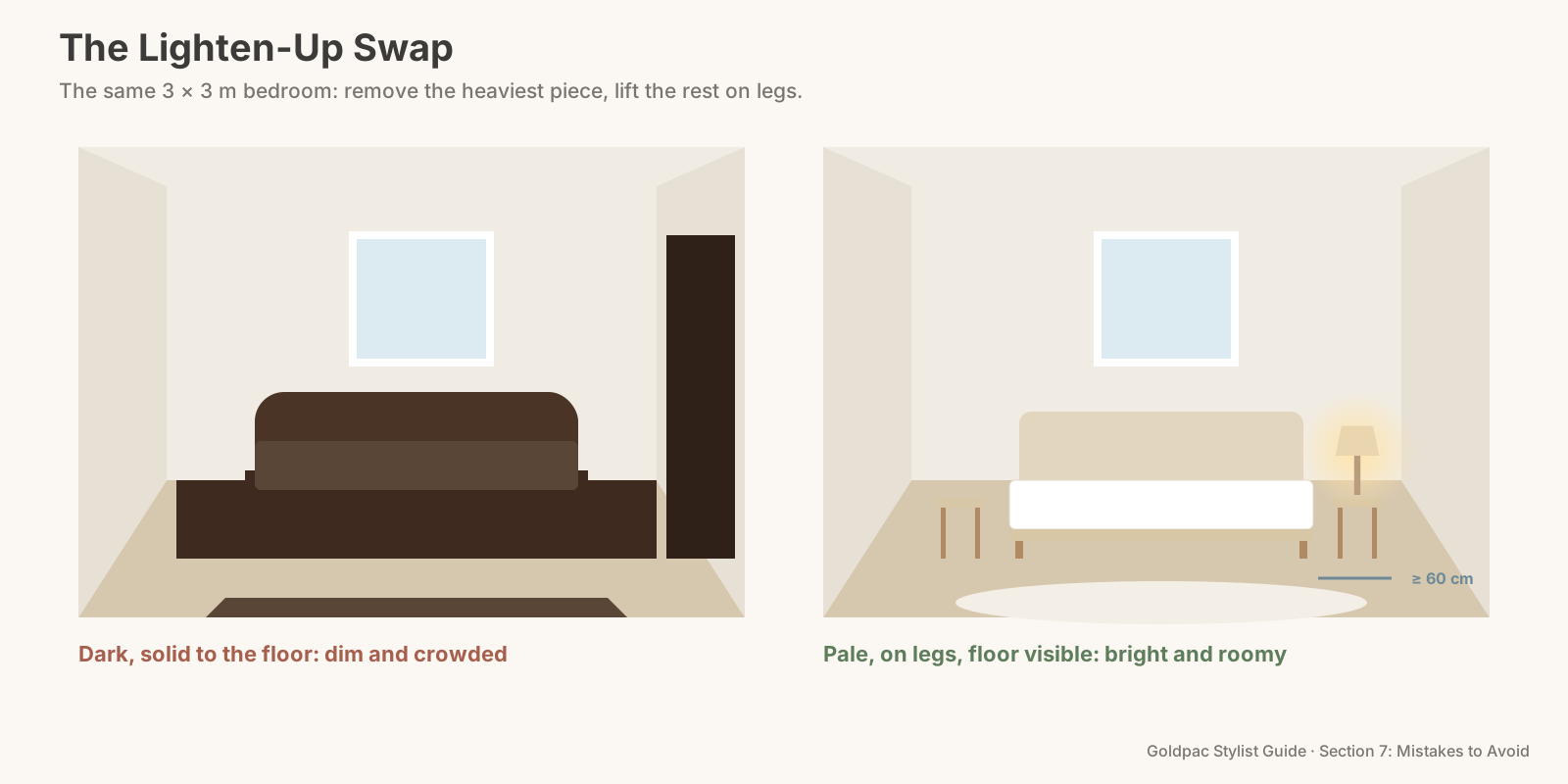
Numbers panel Rooms under about 12 m² · legs of 10 to 15 cm to show floor · at least 60 cm beside the bed · 1 dark piece at most per small room · 0 items on top of wardrobes
Picture it: a three-bedroom unit
Picture a three-bedroom unit where the third bedroom is used as a study. It holds a dark timber desk, a dark bookcase floor to ceiling, a filing cabinet and an office chair. In the listing photo, the room looks like a storeroom with a window.
Remove the bookcase and the filing cabinet. Swap the dark desk for a slim pale desk on legs. Add a light rug, a lamp, one plant and one print. The same 3 by 3 metre room now reads as a bright study that could also take a single bed, which is exactly what a family buyer wants to know (Rule #158 covers giving each room one purpose).
Why a good dark piece still doesn't help
Many of the best pieces in older homes are dark: solid timber dining suites, antique wardrobes, leather lounges. They feel valuable, and they often are. But in a small room, value doesn't help: weight and colour are what the eye registers. Keep your best dark pieces for the largest, brightest rooms, where they can be the feature.
The blind spot: you know how big the room really is
You've measured the room, you know what fits, and you've lived with it for years. Your brain knows its true size, so the heavy wardrobe doesn't make it feel small to you.
Buyers only have the photo and a few seconds in the doorway. In that time, a dark wardrobe takes up most of what they see.
What if…
The heavy piece is built in, like a dark timber robe or a bulkhead cupboard. Keep everything else light: white linen, a pale rug, no other dark furniture, and every light on for the photos.
A tenant's furniture is in the room. You can't swap it, so ask your agent whether the tenant would agree to light linen and a pale rug being placed for photo day, and photograph the room from the angle where the heavy piece takes the least space.
The floors are dark too. Then the furniture matters even more. Pale rugs under the bed and desk break up the dark mass, and white linen gives the eye somewhere light to land first.
You love the dark piece and it's moving with you. Store it for the campaign. A few weeks in a garage or a storage unit is a small price for a room that looks noticeably bigger in the photos.
FAQ
Does dark furniture make a room look smaller? Usually, yes, especially in rooms under about 12 square metres with limited light. Dark pieces absorb light and read as solid blocks.
Should furniture have legs in a small room? It helps. Pieces raised 10 to 15 cm on legs show the floor underneath, which makes a small room feel larger.
Small rooms sell on how roomy they feel in the first few seconds. For empty homes and agent listings, Goldpac stages small rooms with our own light, scaled furniture: send us the address and a fixed styling quote lands within two hours, through our home staging page. Living there? A Photo Ready Consultation shows which heavy pieces to store and how to balance the rest, in a written plan within 48 hours of the visit. See current prices.
Keep reading: Rule #158: Give every room a clear purpose (one purpose per room) · Rule #179: Never use empty picture frames (never using empty frames) · Rule #204: Don't cram or stack furniture to make it fit (not cramming furniture to fit)
◀ Previous: Rule #179: Never use empty picture frames · Section 7 contents · Next: Rule #181: No bean bags or inflatable furniture ▶
Part of the Goldpac Stylist Guide: 300+ home staging rules from Goldpac's Sydney styling team.