
Stylist Guide › Section 7: Mistakes to Avoid › Rule #187
The living room has two sofas, an armchair, two side tables, a coffee table, an ottoman, a console, a bar cart, eleven cushions, four throws, nine candles, two vases of flowers, a bowl of decorative balls, a lantern, a tray of coasters and a stack of coffee-table books. Every piece is lovely. The room can't breathe.
The rule in one minute. Don't over-stage: every item in a staged room needs a reason to be there, whether that's seating, light, life, scale or one quiet story. Over-staging hides the room's size and finishes, looks like a showroom and makes buyers wonder what the styling is covering. Audit each room, give every item a job in one word, and remove anything without one. A good starting point in an over-styled room is to remove about a third of the decor.
The autopsy: a room with too much love in it
What it looks like. Over-staging usually starts with good intentions. A seller or a stylist adds one more cushion, one more vase, one more throw, because each addition looks nice on its own. The room fills by degrees until every surface, corner and wall has something on it.
What it costs. Three things buyers came to see disappear: floor space, the finishes (the stone, the timber, the windows) and a sense of how they'd live there themselves. In photos, a busy room reads as smaller and more cluttered than it is. At inspections, buyers feel like guests in someone's display.
The quieter cost: suspicion. When a room is heavily dressed, some buyers start looking for what it hides. A rug that's suspiciously large, a throw draped over one particular sofa cushion, a plant in an odd corner: each makes them look harder (Rule #174 covers liveable over staged).
Two-term glossary
Over-staging: adding so much furniture and decor that the styling, not the home, becomes the subject of the photos and the inspection.
Reason: the one-word job an item does in a staged room: seat, light, life, scale, warmth or story.
How much decor is too much when staging?
Too much is when you can't name a job for each item, when surfaces carry more than three objects, or when the floor and the home's best finishes are hard to see in a photo of the room. A useful benchmark: if removing an item doesn't make the room feel emptier, it was surplus.
The Reason Audit
"Why is that here?" "It looks nice." "What does it do?" "…It looks nice."
That's the conversation to have with every item in a staged room.
- Stand in the doorway and photograph the room as it is.
- Walk the room and name each item's job in one word: seat, light, life, scale, warmth, story. "Looks nice" isn't a job.
- Remove everything without a job. Put it in another room or a box.
- Where two items share a job, keep the better one. Two throws on one sofa are one throw too many; two vases of flowers in one room are one too many.
- Check the surfaces: three objects per surface at most (Rule #155 covers the three-object moment).
- Check the furniture: if a piece only fills space, it's a candidate to remove. The lived-in version of this rule takes one piece out of every room (Rule #287).
- Photograph the room again from the same spot and compare.
The Reason Audit: every item named with a one-word job, anything without one removed, one item per job, three objects per surface at most, and the before and after photos compared from the same doorway.
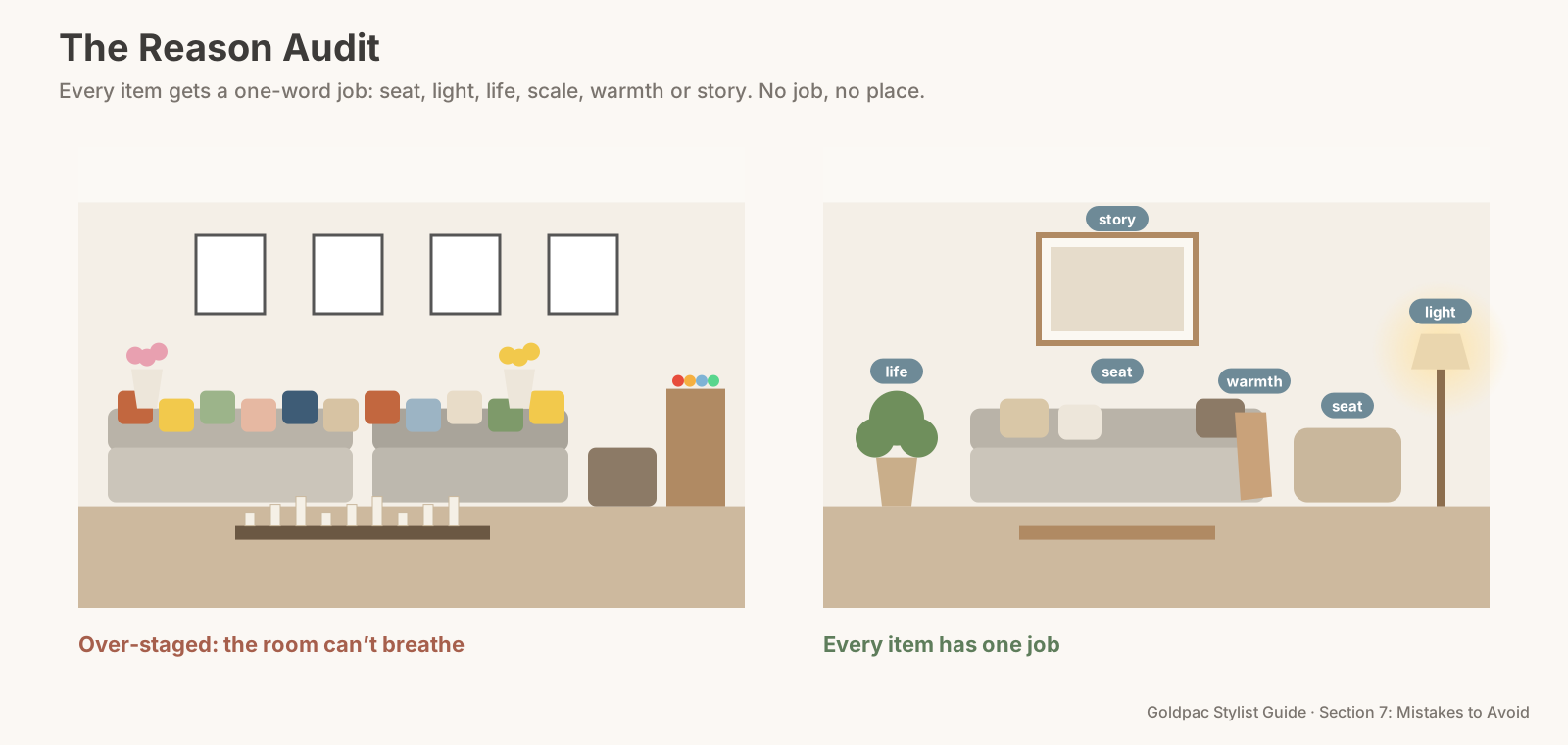
Time & effort The Reason Audit takes about 15 to 20 minutes per room, plus the time to box what comes out. Expect a fair share of the decor to come out, and often one piece of furniture.
Where over-staging hides
Beds. Eight decorative pillows, a runner, a throw and a tray with a teapot. Two sleeping pillows, two European pillows and one throw are enough for a queen bed.
Dining tables. Full place settings, chargers, napkin rings, a centrepiece and candlesticks. One runner and one low vase let buyers see the table and picture their own dinners.
Bathrooms. Rolled towels, three candles, a reed diffuser, a plant, a soap dish and a tray of bottles. One towel set, one plant and a soap pump do the job (Rule #165 covers the spa feeling).
Entries. A console with a lamp, a mirror, a bowl, a vase, a stack of books, a sculpture and a tray. Lamp, bowl, one plant.
Outdoor areas. Two settings, a day bed, lanterns, cushions on every seat and a rug on the deck. One setting, set well, reads as more generous.
"But the empty room looked so bare."
Bare and calm aren't the same. An over-staged room often started as a bare one that someone was afraid of. The cure for bare is a few right pieces in the right size, not many small ones. One large rug, one generous sofa, one big plant and one large artwork make a room feel full without making it busy (Rule #176 covers quiet luxury over excess).
The blind spot: each addition looked good
Over-staging is never one decision. It's twenty small ones, each of which made sense: a cushion to pick up the art, a candle to soften the corner, a tray to group the candles. Judged one at a time, every piece passes.
Judged together, in one photo, they're a crowd. That's why the audit starts with a photo: it shows the whole room at once, the way a buyer sees it.
What if…
You've hired furniture or bought decor and want to use it all. Use it across the home, not all in one room. A piece that crowds the living room might be exactly what the empty study needs.
FAQ
Can you over-stage a house? Yes. Too much furniture and decor hides the home's size and finishes, looks like a showroom and can make buyers suspicious of what's being covered.
How many cushions and throws should be on a sofa when staging? Usually two to four cushions and one throw on a three-seater. More starts to look crowded.
Should every item in a staged room have a purpose? Yes. Each item should seat, light, add life, set scale, add warmth or tell a small story. If it does none of those, remove it.
The best-staged rooms look effortless because every piece earns its place. For empty homes and agent listings, Goldpac stages with our own furniture, chosen to fill each room just enough: send us the address and a fixed styling quote lands within two hours, through our home staging page. Living there? A Photo Ready Consultation runs the Reason Audit on your rooms in a written plan within 48 hours of the visit. See current prices.
Keep reading: Rule #287: Remove one piece of furniture from every room (removing one piece of furniture from every room) · Rule #176: Choose quiet luxury over visual excess (quiet luxury over excess)
◀ Previous: Rule #186: Avoid furniture sets that match too much · Section 7 contents · Next: Rule #188: Avoid seasonal or holiday decorations ▶
Part of the Goldpac Stylist Guide: 300+ home staging rules from Goldpac's Sydney styling team.