
Stylist Guide › Section 7: Mistakes to Avoid › Rule #186
A room bought in one trip to one store looks like a showroom, and buyers can tell from the doorway.
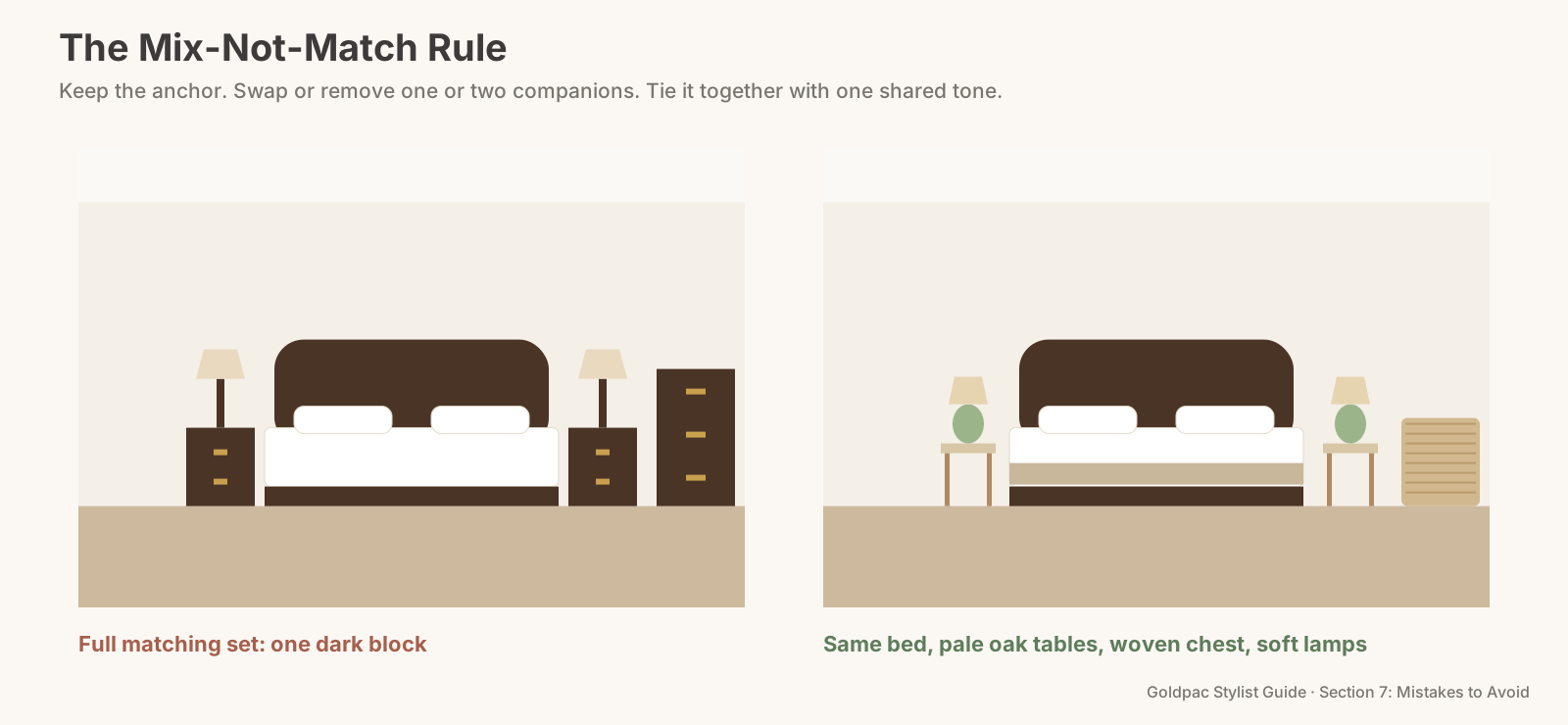
The rule in one minute. Avoid furniture sets that match too much: the bed, bedside tables and dresser in the same timber and handles, or the lounge suite in three identical pieces. A fully matched set looks like a catalogue page, flattens the room and dates it to the year it was bought. Keep the main piece, swap one or two companions for a different material or shape, and tie them together with one shared colour or tone.
Why matching sets fall flat
They look bought, not chosen. Interiors that feel warm and expensive are usually collected: a timber bed with linen-covered bedside tables, a leather sofa with a fabric armchair. A full set skips that layering, so the room reads as quick and generic.
They date the room. Sets follow a particular year's style closely: the same stain, the same handles, the same curves. When every piece shares them, the room looks frozen in that year.
They flatten the photo. Identical tones and textures blur together on camera, so a matched bedroom or living room photographs as one large block rather than distinct pieces with depth.
They make rooms feel smaller. Three large matching lounge pieces fill a living room with the same heavy shape three times.
How do you stop furniture from looking too matchy?
Keep the anchor piece of the set, replace one or two of its companions with pieces in a different material, colour or shape, and connect everything with one shared element, like a timber tone, a colour or a metal finish. Mixed, but related: that's what reads as designed rather than bought.
The same bedroom, two ways
| Fully matched set | Mixed, not matched | |
|---|---|---|
| Bed | Dark timber sleigh bed | Same bed, kept as the anchor |
| Bedside tables | Matching dark timber, same handles | Two slim tables in pale oak, or white with brass knobs |
| Dresser | Matching dark timber, same handles | Removed, or swapped for a woven chest |
| Lamps | Matching set from the same range | Ceramic lamps in a soft colour from the linen |
| Feel in the photo | Heavy, dated, one block | Layered, current, collected |
Verdict: mixed, not matched. The bed stays; the room looks years younger.
The Mix-Not-Match Rule
- Name the anchor in each room: the largest or best piece of the set, usually the bed, the sofa or the dining table.
- Swap one or two companions for a different material or shape: bedside tables, an armchair, the end chairs at the dining table.
- Keep one common thread so the mix looks intended: the same timber tone, a repeated colour or one metal finish (Rule #171 covers rhythm through repetition and variation).
- Remove a matching piece if you can't swap it. Two pieces of a set look far less matched than four.
- Break the set with textiles: a throw, cushions and a rug in contrasting textures.
The Mix-Not-Match Rule: keep the anchor of every set, swap or remove one or two of its companions, and tie the room together with one shared tone, colour or metal.
Dining and living sets
Dining sets are the easiest to break. Keep the table and swap the two end chairs for a different style, such as upholstered chairs at the ends of a timber table, or replace a matching bench with chairs. It instantly reads as chosen.
Lounge suites are the heaviest. A three-seater, a two-seater and an armchair in the same fabric fill a living room three times over. Keep the three-seater, remove the two-seater, and swap the matching armchair for one in a different fabric or a timber-framed chair. The room gets lighter and more interesting at once (Rule #180 covers heavy furniture in small rooms).
Do-This-Sunday box Pick one room where everything matches. Swap the bedside tables with two small pieces from elsewhere in the house: a stool, a side table, a small chest. Take a phone photo before and after. In most homes the second photo looks warmer and more expensive straight away.
The blind spot: the set was a milestone
Many matching sets were bought at a moment that mattered: a first home, a wedding, a renovation. They were chosen together, paid off together and have always lived together. Splitting them up feels wrong.
Buyers don't see the milestone. They see a showroom from some years ago. Splitting the set for a few weeks of photos and inspections is temporary; the pieces can all go back together in your next home.
What if…
Your whole home is furnished in one range. Pick the two most visible rooms, usually the living room and the main bedroom, and break the set there. Textiles and lamps can do a lot of the work if furniture swaps aren't possible.
FAQ
Is matching furniture outdated? Fully matched sets usually look dated in listing photos. Mixing one or two pieces with a shared colour or timber tone looks more current and more considered.
Rooms that look collected feel lived in and cared for. For empty homes and agent listings, Goldpac stages with our own mixed, coordinated furniture: send us the address and a fixed styling quote lands within two hours, through our home staging page. Living there? A Photo Ready Consultation tells you which pieces of your sets to keep, swap or store, in a written plan within 48 hours of the visit. See current prices.
Keep reading: Rule #171: Create rhythm with repetition and variation (rhythm through repetition and variation) · Rule #172: Let furniture and styling work together (furniture and styling together) · Rule #114: Avoid too many matching accessories (too many matching accessories)
◀ Previous: Rule #185: Hide all cables, chargers and routers · Section 7 contents · Next: Rule #187: Don't over-stage: every item needs a reason ▶
Part of the Goldpac Stylist Guide: 300+ home staging rules from Goldpac's Sydney styling team.