
Stylist Guide › Section 7: Mistakes to Avoid › Rule #185
One power board. Six plugs. Two chargers, a lamp, the router, the TV and a phone stand. In the listing photo, that's a black snake on the floorboards.
The rule in one minute. Hide every cable, charger, power board and router before photos and inspections. Cables are thin, but cameras turn them into dark lines that pull the eye, and a visible tangle says "this home doesn't have enough power points". Plan furniture and lamps around the power points, run cords along skirting and behind legs, clip them in place, and move routers and modems out of sight without boxing them in.
The numbers behind tidy cables
Cables are small.
Photos are sharp.
One cord across a wall is a line.
Six behind a TV is a nest.
- Skirting-height routing: a cord that runs at floor level along the skirting is close to invisible; the same cord across the middle of a wall is the first thing you see.
- Clips every 30 to 50 cm: cord clips or adhesive cable tidies at that spacing keep a cord tight to the skirting or the back of a desk leg.
- Within reach of the power point: many table-lamp cords are around 1.5 to 2 metres long, so plan lamps close enough that the cord drops straight down behind the furniture.
- One power board per zone, hidden: behind a sofa, inside a cabinet with a cable cut-out, or under a desk, never on the open floor.
- About 10 minutes per room to tidy, once you have clips and a couple of cord covers.
How do you hide cables when staging a house?
Plan lamps and furniture so cords drop straight down behind them, run any visible cords along the skirting with clips every 30 to 50 cm, put power boards behind or inside furniture, and move chargers, routers and modems out of the photographed rooms or into ventilated cabinets. Paintable cord covers handle the few runs that can't be hidden.
The Power Point Plan
- Find every power point in each photographed room. Note which wall each one is on.
- Place lamps next to them, on the same wall, so each cord drops straight down behind a side table, bedside table or sofa.
- Run every visible cord along the skirting, clipped every 30 to 50 cm, and behind furniture legs rather than across open floor.
- Hide power boards behind or inside furniture. Never leave one on open floor or on top of a surface.
- Remove all chargers from bedside tables, benches and desks. Phones and laptops charge in a drawer during inspections.
- Move the router and modem out of sight: into a cabinet with an open back or a ventilated cut-out, on a shelf behind a closed cupboard door that stays slightly open, or into a hallway cupboard. Never seal them in a box.
The Power Point Plan: lamps on the same wall as a power point so cords drop straight down, every visible cord clipped along the skirting every 30 to 50 cm, power boards behind furniture and routers in ventilated cupboards, about 10 minutes a room.
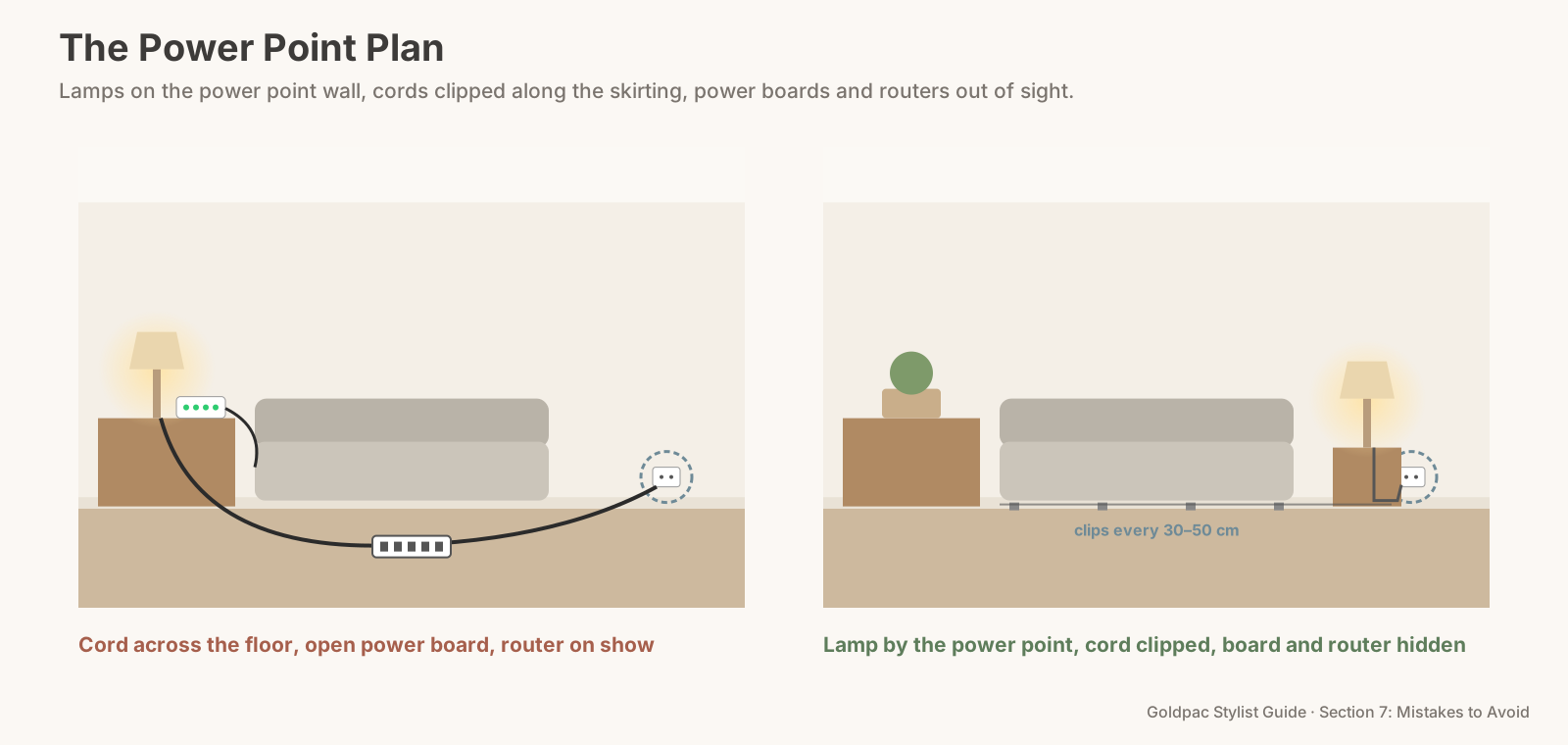
Numbers panel Clips every 30 to 50 cm · lamps on the same wall as a power point · 1 hidden power board per zone · 0 chargers in view · router ventilated, never boxed · about 10 minutes per room
Where cables hide in plain sight
Behind the TV. The worst nest in the house, and the subject of its own rule (Rule #192 covers the TV wall).
Beside the bed. Phone chargers, lamp cords and a power board on the floor. Move the lamp to the power point side, charge the phone elsewhere.
At the desk. Monitor, laptop, printer and lamp cables hanging in a loop. Bundle them with one cable sleeve and run them down a leg.
In the kitchen. The kettle, toaster and coffee machine cords draped across the bench. Store the appliances, or tuck each cord behind its appliance.
On the balcony and in the garden. Extension leads for lights or pumps across the paving. Disconnect them or run them along an edge.
The router corner. Blinking lights, a modem, an NBN connection box on the wall, and a tangle beneath. Move what you can; for a fixed wall box, a plant or a piece of furniture in front (with airflow) does the job.
If this, then that
- If a lamp can't reach a power point without crossing the floor, move the lamp, not the cord. Light the room from a different spot (Rule #65 covers floor lamps).
- If the router has to stay in a living area, put it on a lower shelf of a bookcase behind a row of books, with space around it to breathe.
- If a room has no power point where a lamp is needed, don't run extension leads across the room. Talk to a licensed electrician about adding one before the campaign, or style that corner without a lamp.
- If you're renting and can't add clips, use removable adhesive cord tidies, and test one first on an unseen spot of the paint.
Safety first
Tidy is never at the cost of safe. Don't run cords under rugs where they can overheat or be walked on, don't coil long leads tightly while they're carrying a heater or appliance, and don't cover a router or modem so closely that it can't shed heat. If a power point is loose, scorched or sparking, stop and call a licensed electrician.
The blind spot: cables are infrastructure
You don't see cables as objects; you see them as the house working. The router has to be there, the phone has to charge, the lamp has to plug in. They've been part of the room for so long that they disappear.
A buyer sees every line on the floor and the wall. In a photo, each cable becomes a dark stroke that the eye follows. The lived-in version of this rule counts every cable in the house (Rule #284 covers hiding every cable while you live there).
What if…
It's an empty home being staged. The same plan applies to staging: lamps go next to power points, and every cord is tucked or clipped before the photographer arrives.
FAQ
How do I hide cables for real estate photos? Place lamps next to power points so cords drop behind furniture, clip visible cords along the skirting, hide power boards behind furniture and remove chargers from view.
Where should I put the router when selling a house? Out of the photographed rooms if possible, or in a cabinet or bookcase with ventilation. Never seal it in a box.
Do visible cords make a room look messy in photos? Yes. Cameras turn thin cords into dark lines the eye follows, so even one cord across a wall or floor can make a room look untidy.
Clean lines make rooms look finished. For empty homes and agent listings, Goldpac stages with our own furniture and lamps, placed around the power points so no cord crosses a room: send us the address and a fixed styling quote lands within two hours, through our home staging page. Living there? A Photo Ready Consultation marks where every lamp and cord should go, in a written plan within 48 hours of the visit. See current prices.
Keep reading: Rule #284: Hide every cable, charger and router (hiding cables while you live there) · Rule #184: Avoid visual clutter on kitchen benches (clear kitchen surfaces)
◀ Previous: Rule #184: Avoid visual clutter on kitchen benches · Section 7 contents · Next: Rule #186: Avoid furniture sets that match too much ▶
Part of the Goldpac Stylist Guide: 220+ home staging rules from Goldpac's Sydney styling team.