
Stylist Guide › Section 10: Buyer Psychology › Rule #249
What does your home smell like to someone who has never been inside it?
The rule in one minute. Buyers can look away from a flaw, but they can't stop smelling. The goal is a home that smells of almost nothing, then one quiet natural note: fresh air, fresh flowers, citrus, clean linen. Skip sprays, plug-ins and scented candles. One in three Australians report health problems from fragranced products, and a strong scent makes buyers wonder what it's covering. Open the windows 30 minutes before every inspection.
Why smell works on buyers
- It arrives first. Buyers smell a home in the doorway, before they've looked at a single room.
- It can't be switched off. A buyer can turn away from a stained carpet. They can't stop breathing.
- It's read as information. Fresh air reads as "well looked after". Damp reads as "hidden problem". Heavy perfume reads as "hiding a problem".
- It sticks. Buyers who see five homes in a morning often remember one by its smell, good or bad.
How do you make a house smell good for an open home?
Start from nothing, then add one natural note. A clean, aired home with a single quiet scent beats any fragrance product. The order matters: remove bad smells first (Rule #210), air the home, then add a little of something real.
The recipe
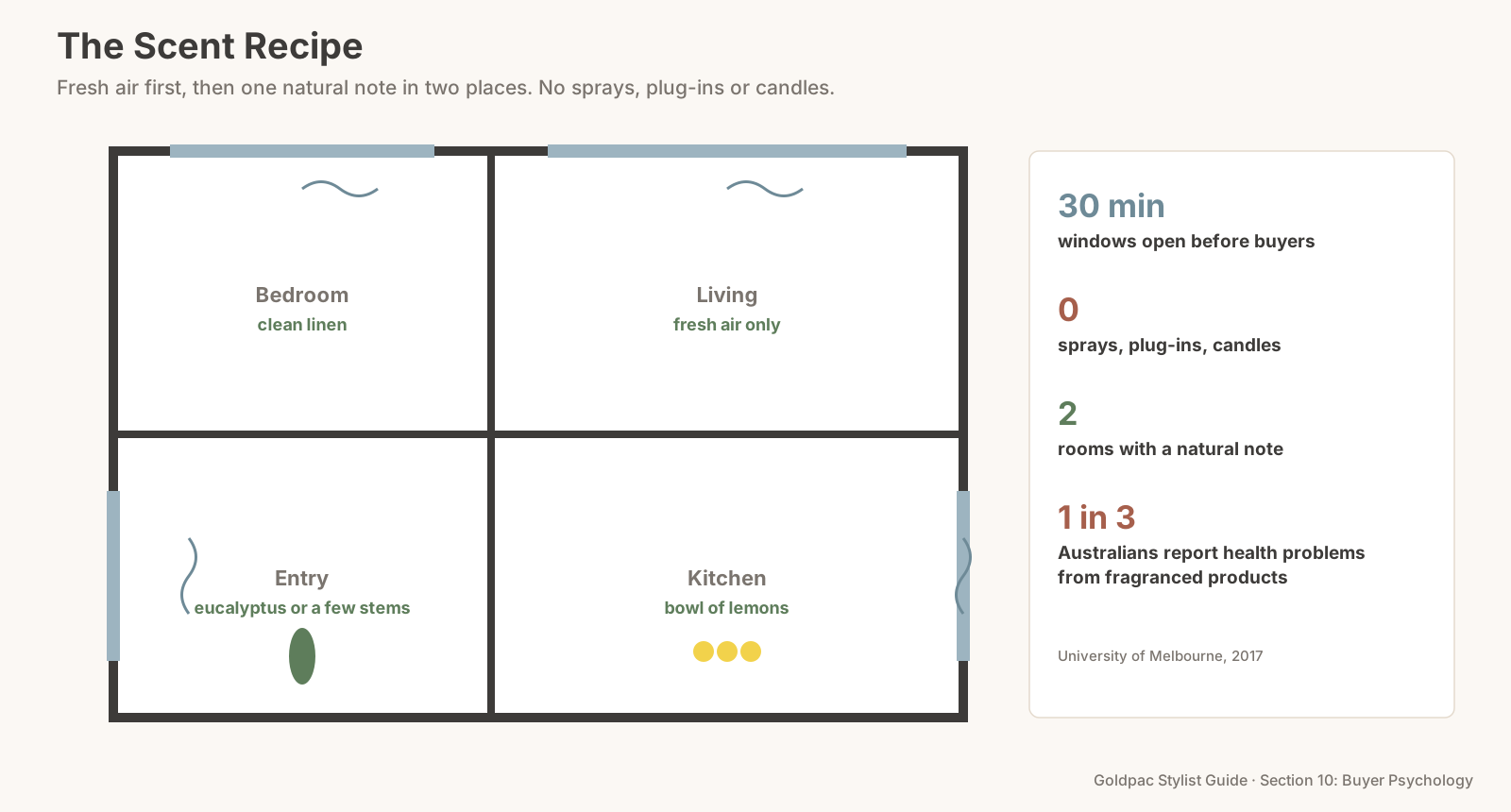
Scent Recipe, for one open home. Fresh air: 30 minutes, windows open · Base smell: none (clean, dry, aired) · Natural notes: 1 per zone, at most · Sprays, plug-ins and scented candles: 0 · Rooms with a deliberate scent: 2 at most (entry and kitchen)
Ingredients
- Fresh air. Every window you can open, 30 minutes before the agent arrives. Close them again just before buyers come if it's noisy, cold or windy.
- A clean base. Bins emptied and taken out, dishwasher and fridge empty of anything strong, laundry dry and put away, bathroom towels fresh.
- One natural note in the entry. A small vase of eucalyptus, a few stems of fresh flowers with little perfume, or nothing at all.
- One natural note in the kitchen. A bowl of lemons or oranges, a pot of herbs on the bench, or a recently brewed coffee in an empty kitchen.
- Clean linen in the bedrooms. Freshly washed, unscented or lightly scented bedding does more than any room spray.
Method
- Two days before: deep clean anything that holds smell: bins, drains, fridge, carpets near pet areas, the rubbish area outside.
- The night before: wash bedding and towels. Empty the kitchen bin.
- One hour before: no cooking. No frying, no garlic, no fish, no toast.
- 30 minutes before: windows open, fans on low if the air is still.
- 10 minutes before: windows closed if needed, flowers and fruit in place, a last walk through with your nose, not your eyes.
The Scent Recipe: 30 minutes of fresh air, zero sprays, and one natural note each in the entry and the kitchen.
Why not air freshener and a scented candle?
Because a strong scent raises the question it's meant to answer. Buyers have walked through enough homes to know what heavy fragrance usually means: there was a smell, and someone tried to cover it. A plug-in in every room makes careful buyers sniff harder.
And fragrance isn't neutral for everyone. In a University of Melbourne survey, one in three Australians reported health problems such as headaches or asthma attacks when exposed to fragranced products like air fresheners (University of Melbourne, 2017). A buyer with a headache isn't imagining their life in your living room.
What about baking bread or cookies? It's an old trick, and it can work in a home you're living in, as long as it's subtle and the kitchen is clean. In an empty staged home it reads as staged in the wrong way. Fresh air and a bowl of lemons are safer.
The second-order effect: smell sets the trust level
A home that smells clean and neutral gets the benefit of the doubt everywhere else. Buyers assume the parts they can't see (the drains, the subfloor, the wall cavities) are in the same condition as the air. A home with a strange smell gets the opposite: every mark becomes a symptom, every corner a place to look for damp.
The blind spot: you can't smell your own home
Noses adapt. After a few minutes in any room, you stop noticing its smell, and after years in a home you can't smell it at all. Pets, cooking, damp in a cupboard, the bin under the sink: all normal to you, all obvious to a stranger.
Ask a friend whose honesty you trust to walk in after a few hours away and tell you the first thing they notice. Or leave the house for an hour, come back and stand in the doorway with your eyes closed.
What if…
There's a dog or cat. Wash pet bedding the day before, take the pet out during inspections, and give the areas where they sleep the most air (Rule #213).
There's a damp or mould smell. No scent will fix it. Find the source (a leak, a blocked vent, a wet cupboard) and deal with it before the campaign. Buyers' building inspectors will find it anyway.
You cook every night with strong spices. Air the home well for the whole campaign, wash curtains and soft furnishings once, and keep cooking light on inspection days.
FAQ
Should I use a diffuser or essential oils for an open home? It's safer not to. Many buyers are sensitive to fragrance, and a strong smell can make buyers suspect it's covering something. Fresh air and one natural note, like flowers or citrus, work better.
A neutral, fresh home is one buyers trust. For an empty home, Goldpac stages with our own clean furniture and soft furnishings, so the rooms feel fresh as well as look it: send us the address and a fixed styling quote lands within two hours, through our home staging page. Living there? A Photo Ready Consultation covers smell along with every room, in a written plan within 48 hours of the visit. See current prices.
Keep reading: Rule #210: Eliminate smells: cooking, mould, cigarettes (removing bad smells first) · Rule #247: The first 15 seconds shape the whole impression, so nail the entrance (the first 15 seconds inside) · Rule #154: One subtle scent for the whole home (one subtle scent for the whole home)
◀ Previous: Rule #248: Buyers want to imagine their life, not yours · Section 10 contents · Next: Rule #250: Each space must tell a clear story: rest, work, dine ▶
Part of the Goldpac Stylist Guide: 220+ home staging rules from Goldpac's Sydney styling team.