
Stylist Guide › Section 10: Buyer Psychology › Rule #250
Three words. That's how long a room's story should be. If a buyer standing in the doorway can't say what a room is for in three words, the room is telling too many stories, and buyers don't buy confusion.
The rule in one minute. Every room should tell one clear story a buyer can read from the doorway in about three seconds: rest, work, dine, cook, play. Rooms with two or three jobs (study, guest room and gym) read as "not enough space". Give each room one purpose, stage it for that purpose, and mention any flexibility in the listing copy instead. Buyers' agents rate the living room, main bedroom and kitchen as the most important rooms to stage.
A familiar conversation
"So what's this room?"
"It's the study. Well, the guest room too, when Mum visits. And the treadmill's in here because there's nowhere else."
"What do you want a buyer to think it is?"
"…A study, I suppose. A really good study."
"Then that's all it gets to be."
Why one story beats three
Buyers read rooms fast. At an open home they walk through in a few minutes. Each room gets a glance from the doorway and a few seconds inside. In that time they're answering one question: what would I use this for?
A room with one story answers it. A desk, a chair, a lamp and a bookshelf say "work from home" instantly. The buyer pictures their laptop on the desk and moves on, happy.
A room with three stories asks a question instead. A desk, a sofa bed and a treadmill say "this household ran out of space". The buyer doesn't think "flexible". They think "small", and then they start wondering whether the whole house is too small for them too.
How do you show the purpose of each room when selling?
Furnish each room for one job, with the three or four pieces that job needs, and nothing else. That's the whole technique. Every extra piece from a different job weakens the story.
Prioritise the rooms buyers care most about. In the US 2025 Profile of Home Staging, buyers' agents named the living room as the most important room to stage (37%), then the main bedroom (34%), then the kitchen (23%) (National Association of Realtors, 2025).
The Three-Word Test
Do it room by room, standing in each doorway.
- Say the room's story in three words or fewer. "Main bedroom: rest." "Second bedroom: kid sleeps." "Nook: work from home."
- If you need more words, pick one story. The one most buyers in your price range will want.
- Remove everything from the other stories. The treadmill, the sewing table, the spare mattress against the wall. Store them or move them out.
- Add the three or four pieces the story needs. Rest: bed, two bedside tables, two lamps. Work: desk, chair, lamp, shelf. Dine: table, chairs, pendant or centrepiece.
- Check from the doorway again. Three seconds. Can you read it? Could a stranger?
The Three-Word Test: every room's story in three words or fewer, readable from the doorway in about three seconds, with only the pieces that story needs.
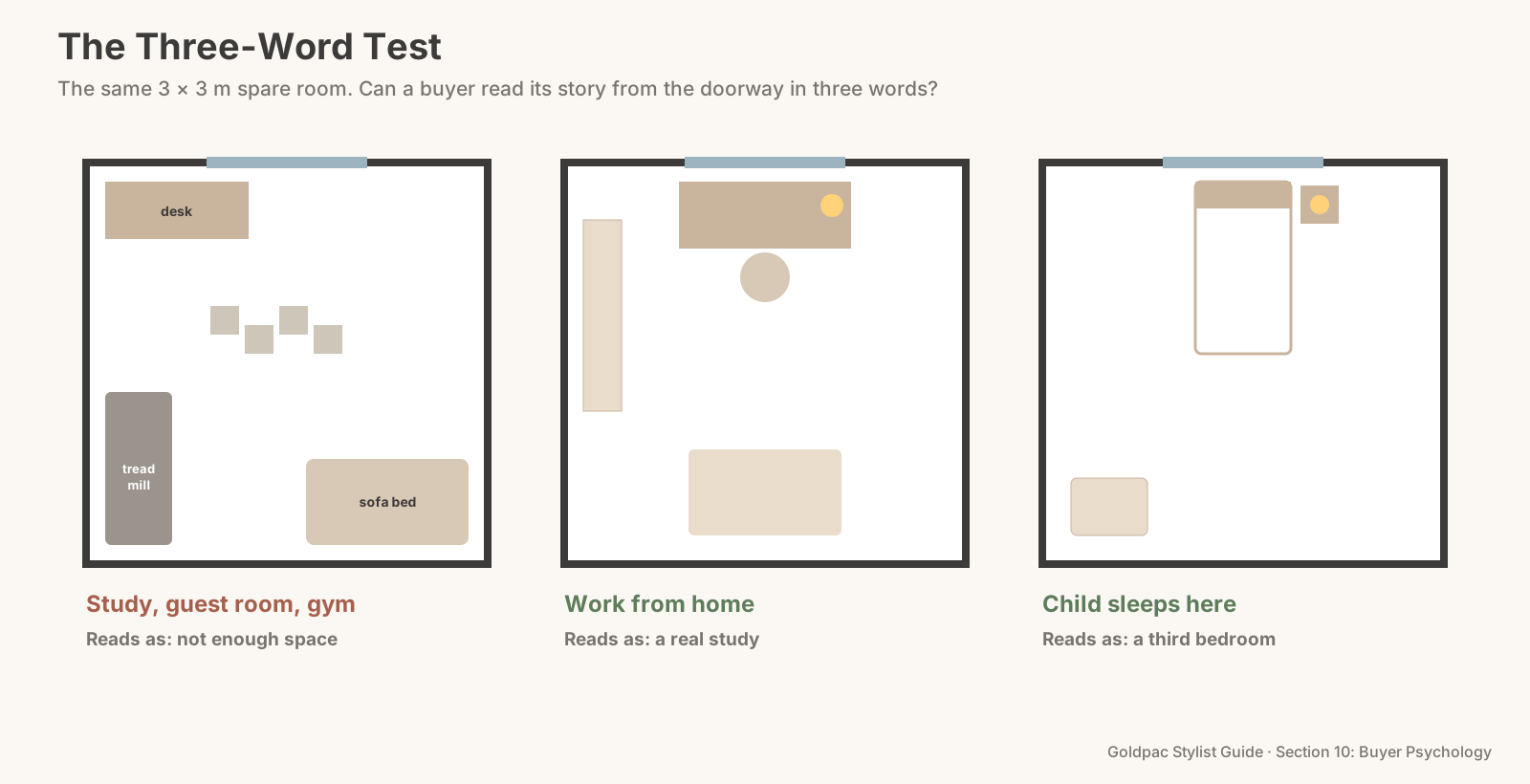
"But showing it as multi-purpose shows flexibility!"
It shows flexibility in words, and that's where flexibility belongs. Put it in the listing: "Third bedroom, currently set up as a study." The room shows one clear story; the copy tells buyers it could be another. They get the clarity and the option.
What doesn't work is trying to show all the options at once. A room set up for three jobs doesn't look flexible. It looks crowded.
The second-order effect: clear rooms make the whole home feel bigger
When every room has one job, buyers count rooms, not problems. They walk out thinking "three bedrooms, a study nook, a proper dining area". When rooms blur, buyers mentally merge them: "two bedrooms, and a sort of room with stuff in it". The home shrinks in their memory by a room. That's why this rule sits next to staging, not decluttering (Rule #214 covers the junk room itself).
The blind spot: rooms change jobs slowly
No room becomes a three-job room overnight. The study gets a sofa bed when the grandparents start visiting. The treadmill arrives in January. The kids' craft table moves in during lockdown. Each change made sense at the time, and you've lived with the result so long it feels normal.
Buyers see the result without the history. Stand in each doorway and ask the question as a stranger would: what is this room for?
What if…
It's an open-plan living area. Each zone gets its own story: a rug and sofa for "relax", a table and pendant for "dine", stools at the bench for "cook and chat". The rug edges and the light fittings draw the lines buyers can't see in the floor.
The second bedroom is tiny. Pick one: a single bed for a child, or a desk for working from home. A tiny room with both looks like a storeroom.
You're living there and need the room for two jobs. Set it up for its sale story before photos and each inspection, and keep the other job's things in one box or cupboard that can be packed away in five minutes.
FAQ
Should a spare room be staged as a bedroom or an office? Whichever most buyers in your price range will want. Families usually want bedrooms; buyers working from home often value a study. Ask your agent, then stage one and mention the other in the listing.
How many pieces of furniture should a staged room have? Only what its one story needs: usually three to five main pieces. A bedroom needs a bed, bedside tables and lamps; a study needs a desk, chair, lamp and shelf.
Is it better to leave a room empty than to stage it? No. An empty room tells no story at all, and buyers struggle to judge its size or use. One clear story, lightly furnished, always reads better.
One clear story per room is what staging is for. For an empty home, Goldpac stages every room for a single purpose with our own furniture: send us the address and a fixed styling quote lands within two hours, through our home staging page. Living there? A Photo Ready Consultation gives each room its story and its shopping list, in a written plan within 48 hours of the visit. See current prices.
Keep reading: Rule #214: Define each room's purpose clearly: no junk rooms (the junk room problem) · Rule #248: Buyers want to imagine their life, not yours (leaving room for buyers to imagine)
◀ Previous: Rule #249: Pleasant scents create quiet comfort · Section 10 contents · Next: Rule #251: Buyers remember feelings, not finishes ▶
Part of the Goldpac Stylist Guide: 300+ home staging rules from Goldpac's Sydney styling team.