
Stylist Guide › Section 10: Buyer Psychology › Rule #247
Saturday. 10.31 am. The gate clicks. The path. The step. The door opens. A hallway. A glimpse of the living room. That's it. Fifteen seconds, and the buyer already has a feeling about your home that the next twenty minutes will mostly confirm.
The rule in one minute. The walk from the front gate to the first full view of the living area takes about 15 seconds in most homes, and it sets the tone for everything after. Stage it as one sequence: a clear, swept path; a clean, well-lit front door; an empty, styled entry; and a first view that lands on light and one strong piece of furniture. Time the walk yourself and fix every second of it.
The walk, second by second
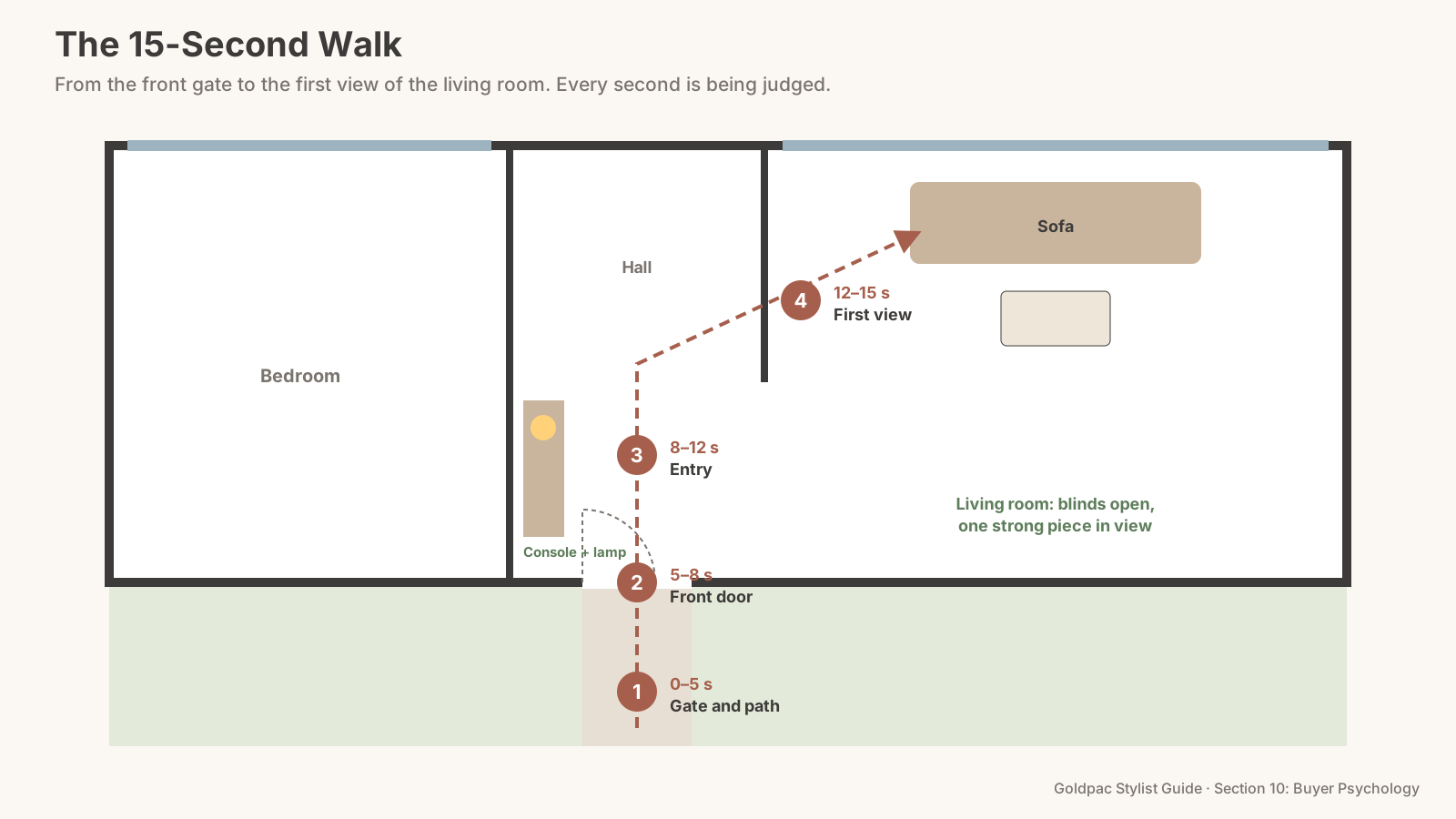
Seconds 0 to 5: the gate and the path. The buyer is still outside. Still deciding. They see weeds in the cracks. A bin by the step. A dead pot plant. Or they see a swept path, a clear step and a front door that looks cared for. One says "work". The other says "home".
Seconds 5 to 8: the door. The agent opens it. The buyer looks at the door itself for the first time: the paint, the handle, the doormat. A scuffed door and a curling mat are small. But they're the first small thing.
Seconds 8 to 12: the entry. Shoes. School bags. Keys. A pram. A coat stand doing too much. Or: a narrow console, a lamp, a mirror, nothing on the floor. The hallway is where buyers decide whether this home feels calm or busy.
Seconds 12 to 15: the first view. The buyer looks through to the living room. What do they see first? A window full of light? A styled sofa? Or the back of the television, a pile of washing and a dark corner?
That first view is the one they'll compare everything else with.
How long does a buyer take to form a first impression of a house?
Seconds, not minutes. In most homes, the buyer has walked from the gate to the first full view of the living area in about 15 seconds, and has a strong feeling about the home before the agent has finished saying hello. Time your own walk. That's the window you're styling for.
The 15-Second Walk
Do it on a weekday morning, as a stranger.
- Start at the footpath. Stopwatch on. Walk to the door at a normal pace.
- Stop at every second where your eye catches something wrong. Write it down: weeds, a bin, a broken light, a cobweb on the door frame.
- Open the door and stand still. What's the first thing you see? Is it the thing you'd want a buyer to see first?
- Clear the entry to almost nothing. One console or narrow table, one lamp, one mirror or artwork, one plant. Shoes, bags and keys go out of sight.
- Fix the first view. Blinds open on the window opposite the door. One strong piece in the line of sight: a styled sofa, a dining table with a centrepiece. Nothing on the floor in between.
- Walk it again. Stopwatch on. Every second should look intentional.
The 15-Second Walk: time the route from the gate to the first view of the living room, then style every second of it: path, door, entry, sightline.
"It's only the hallway. Buyers come for the rooms."
They do. But they see the hallway first.
A calm, clear entry makes everything after it look calmer. A cluttered one makes buyers start looking for problems, and once they're looking, they find them. The entry doesn't sell the home. It decides the mood the home is judged in.
Where staging comes in
The entry is small, so it's cheap to get right and expensive to get wrong. A narrow console about 30 to 35 cm deep fits most Sydney hallways without blocking the walking path (Rule #1). A lamp gives warm light at eye level even on a bright day. A mirror doubles the light from the front door. One plant brings life.
Beyond the entry, the first view should hold one clear focal point that reads from the door. That might be the sofa facing the window, the dining table under a pendant, or a large artwork on the far wall. If the first thing a buyer sees is the side of a bookcase or a television, move the furniture until it isn't.
For homes you're still living in, the day-to-day version of this is keeping the entry empty every single day of the campaign (Rule #291).
The blind spot: you don't use your front door
Many owners come and go through the garage, the side gate or the back door. The front door is for visitors and couriers. You may not have walked the front path slowly in months.
So you've never seen the 15 seconds a buyer sees. The cracked step, the dusty light fitting, the door that sticks: they're invisible to you because you never pass them. Walk in through the front door, slowly, once a week during the campaign.
What if…
The front door opens straight into the living room. Then the first view is the whole room at once. Make sure the area just inside the door is clear for a metre, and the room's best feature is what the door faces.
It's a unit. The 15 seconds start in the building's corridor. You can't style the corridor, but you can make sure your door is clean, the doormat is new and the first view inside is clear and bright.
There's a long, narrow hallway. Make the far end the destination: a lit lamp, a bright artwork or an open door to a sunny room. A hallway with something good at the end feels like a path; one that ends in a closed door feels like a corridor.
The stairs face the front door. Clear every step completely and keep the wall beside them bare or hung with one piece of art. Stairs are often the first thing buyers see, so they should look easy to climb.
The entry is dark. Add a lamp and switch it on before every inspection, even at midday. A warm light by the door is the first thing a buyer reads as welcome.
FAQ
What should be in an entryway when selling a house? Very little: a narrow console or table, a lamp, a mirror or artwork, and a plant. Everything personal (shoes, keys, bags, mail) goes out of sight.
Does the front door colour matter when selling? Condition matters more than colour. A clean, well-painted door with working hardware and a new doormat does most of the work; a fresh coat is worth it if the paint is tired or peeling.
Should lights be on during an open home, even in daytime? Yes, in the entry and any room without strong daylight. Warm light at eye level makes the first view feel welcoming.
The first 15 seconds are the easiest part of a home to style and the most expensive to get wrong. For an empty home, Goldpac stages the entry and first view with our own furniture, so the walk from the gate lands on a room worth stopping in: send us the address and a fixed styling quote lands within two hours, through our home staging page. Living there? A Photo Ready Consultation walks your 15 seconds with fresh eyes and leaves a written plan within 48 hours of the visit. See current prices.
Keep reading: Rule #291: Empty the entry: shoes, bags and keys out of sight (emptying the entry every day of the campaign) · Rule #209: Improve street appeal and the entrance (street appeal: the path to the door) · Rule #266: The goal isn't to impress, it's to connect (connecting rather than impressing)
◀ Previous: Rule #246: Build a mini-site for premium listings · Section 10 contents · Next: Rule #248: Buyers want to imagine their life, not yours ▶
Part of the Goldpac Stylist Guide: 90+ home staging rules from Goldpac's Sydney styling team.