
Stylist Guide › Section 9: Getting More Attention to Your Listing › Rule #246
What does a home get when it's too good for one portal page? Its own website.
The rule in one minute. For premium and prestige listings, a single-property website (a mini-site with its own address) gives the home room the portals can't: full-screen photos, a film, the floor plan, documents and a booking button, all in one place with nothing else competing for attention. It works when every room can stand up to full-screen scrutiny, so the styling and photography have to be finished first. For most homes, a strong portal listing is enough.
What is a property mini-site?
A one-home website, usually with the street address as its web address, built for the campaign and taken down after it. It sits alongside the portal listings, not instead of them. Buyers find it from the signboard QR code (Rule #236), the agent's emails and social posts, and the link in the portal listing where the agent can add one.
A good one holds:
- A full-screen lead image and 30 to 40 photos, large.
- A short film, 60 to 120 seconds.
- The floor plan, with room sizes (Rule #237).
- A page about the location, with walking times (Rule #232).
- Documents to download: contract, strata report, building report if available.
- Inspection times and a booking button.
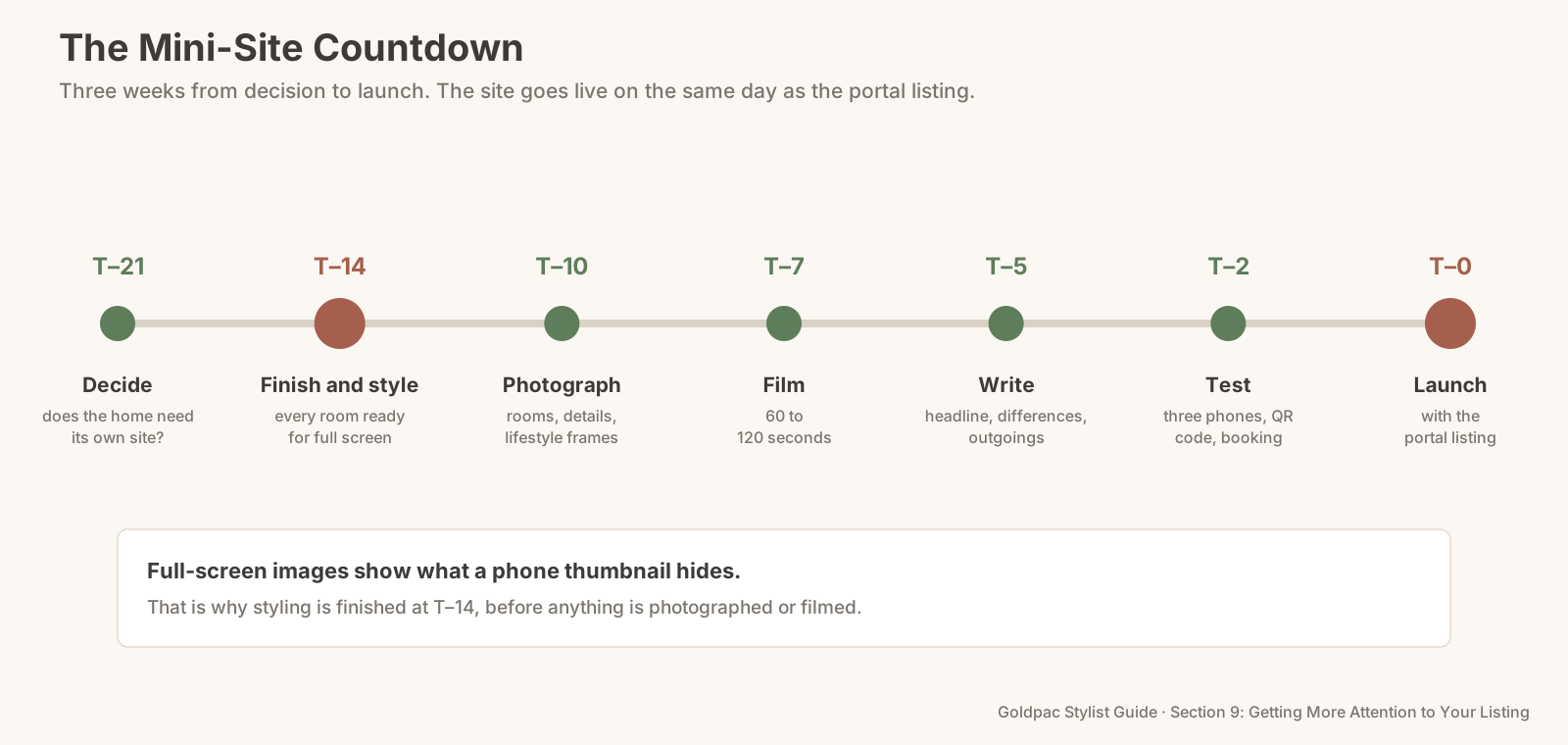
The mini-site countdown
T–21 days: decide if the home needs one. Ask your agent directly. Prestige homes, architect-designed homes, waterfront and acreage, and homes with a story worth telling usually justify it. A standard three-bedroom house in a busy market usually doesn't.
T–14 days: finish the home. Full-screen photos show everything. A scuff on the skirting that disappears on a phone is visible on a laptop at full size. Styling, repairs and the final clean all happen before the photographer comes.
T–10 days: shoot more than the portal needs. Ask the photographer for detail shots and lifestyle frames as well as room shots: the light on the stair, the view from the bath, the table set on the terrace. A mini-site has space for 30 images; the portal set might use 20.
T–7 days: film. The film should walk the home in order, slowly, with the best rooms given time (Rule #235).
T–5 days: write the pages. Headline, three differences (Rule #245), lifestyle copy (Rule #241), outgoings (Rule #242) and upgrades (Rule #240). Everything Section 9 asks for, in one place, with room to breathe.
T–2 days: test it on three phones. Most visitors will arrive from a phone, often from a QR code. The site must load fast and the booking button must be easy to find.
T–0: launch with the portal listing. Same day, same lead photo, same headline. The mini-site is the deep version of the same story, not a different one.
The Mini-Site Countdown: decide at T–21, finish and style at T–14, shoot extra at T–10, film at T–7, write at T–5, test at T–2, launch with the portal listing on day zero.
"Isn't the portal enough?"
For most homes, yes. Portals are where buyers search, and a strong listing with good photos, a floor plan and honest copy does the job.
A mini-site earns its place when the home has more to show than a portal page can hold, and when the buyers are the kind who will look closely: prestige buyers, interstate and overseas buyers, people who take weeks to decide and come back to the listing again and again. For them, a dedicated site with nothing else on the page feels like a private viewing on a screen.
Why styling matters more here than anywhere
A mini-site removes every hiding place. Portal thumbnails are small; mini-site images fill a laptop screen. A styled room has to work at full size, in detail: linen pressed, books chosen, cushions plumped, every surface considered.
And a mini-site invites lifestyle images. Close-ups of a set table, a reading chair by the window, towels rolled on a bathroom bench. These only exist if someone styles them. They're often the images that make a premium buyer say "this is how we'd live".
The blind spot: you think the website is the agent's job
It is, but it's built from your home. The agent can design a beautiful site, but the pictures on it are your rooms on the day of the shoot. If the rooms aren't ready, a premium website just shows unready rooms in more detail.
Ask to see the site before it goes live, and look at every image full-screen.
What if…
The campaign is short, with an auction in three weeks. Build the site in the first week from the portal assets, then add the film and extra pages as they arrive.
FAQ
Who pays for a property mini-site? It depends on the agency. Some include it in the marketing for premium listings; others add it to the vendor-paid advertising. Ask what's included, and whether the site comes down after the sale.
A full-screen website shows every room in full detail, so every room has to be ready. For an empty prestige home, Goldpac stages it with our own furniture and styling for close-up photography: send us the address and a fixed styling quote lands within two hours, through our home staging page. Selling with your own furniture? With Photo Ready Styling, our stylist styles your home with your own pieces before the photos. See current prices.
Keep reading: Rule #236: Include a QR code that leads to the listing (the QR code that leads to it) · Rule #235: Use a virtual tour or 360° walk-through (the film for the site)
◀ Previous: Rule #245: List why the property beats similar ones · Section 9 guide: how to sell faster · Next: Rule #247: The first 15 seconds shape the whole impression, so nail the entrance ▶
Part of the Goldpac Stylist Guide: 90+ home staging rules from Goldpac's Sydney styling team.