
Stylist Guide › Section 9: Getting More Attention to Your Listing › Rule #232
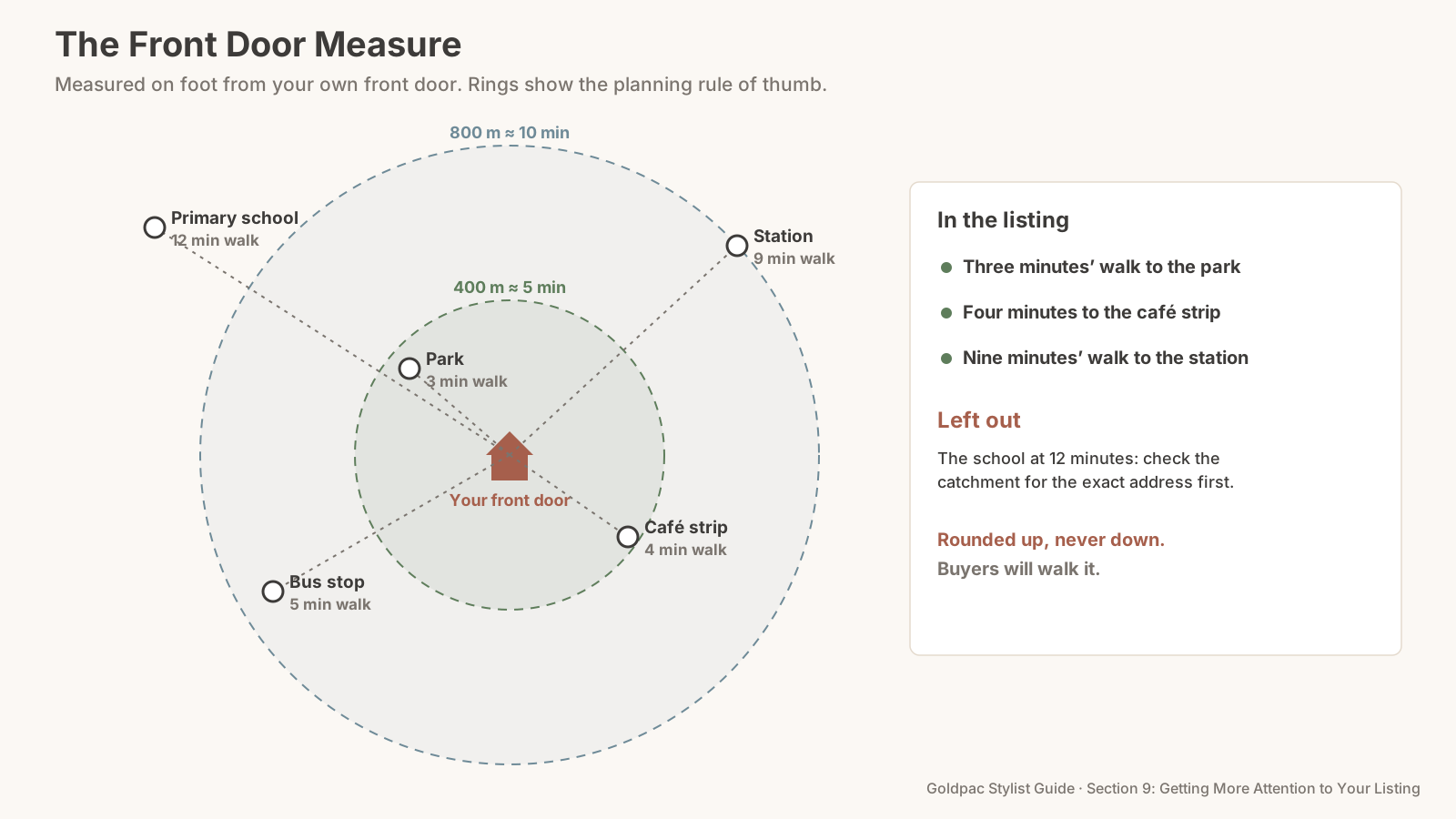
Four hundred metres. That's roughly five minutes on foot, and in transport planning it's the standard walking distance to a bus stop. Double it, 800 metres or about ten minutes, and you have the standard walking catchment of a train station (Transport for NSW, 2023). Those two numbers explain why "walk to station" sells a home and "close to transport" doesn't.
The rule in one minute. Buyers buy the walk, not the map. In a listing, name the places that matter (a school, a café strip, a station, a park) and give honest walking times measured from your front door: about 5 minutes for 400 m, about 10 minutes for 800 m. "Six minutes' walk to Epping Station" is a fact a buyer can picture. "Close to everything" is a phrase they skip.
How do you describe location in a real estate listing?
Use a named place and a walking time, measured from your own door. "Four minutes' walk to the station" beats "close to transport" because it answers the buyer's real question: can I do this every day without the car?
Location copy usually fails in one of two ways. It's either vague ("conveniently located", "moments to amenities") or it's a list of every shop within five kilometres. Neither helps. The useful version picks the three or four places your likely buyer will use every week, names them, and gives each one a number. That turns a paragraph of adjectives into something a buyer can check, believe and repeat to their partner over dinner.
The numbers that matter
Numbers panel 400 m ≈ 5 minutes' walk: the planning distance to a bus stop · 800 m ≈ 10 minutes' walk: the planning distance to a train station · 3 or 4 named places in the listing, not 12 · 1 school catchment, checked for the exact address · 0 driving times passed off as walking times
Five and ten minutes are the thresholds buyers feel. A walk under five minutes reads as "right there". Up to ten minutes is still an easy daily walk for most people. Beyond that, buyers start mentally reaching for the car keys, and the distance stops being a selling point and becomes a fact to weigh.
School catchments are the number that can't be approximate. Many Sydney families shop by public school catchment, and catchments are drawn for specific addresses and can change. Check your exact address in the NSW Department of Education's School Finder before the word "catchment" goes anywhere near your listing, and ask the agent to word it carefully.
The Front Door Measure
- Pick your buyer. Families care about the school, the park and the oval. Young professionals care about the station, the café strip and the gym. Downsizers care about the shops, the bus, the medical centre and a flat walk.
- Choose three or four places that buyer will use weekly. Name them properly: "Epping Station", "the Beecroft Road café strip", "Dence Park".
- Measure each one from your front door with a maps app set to walking. Not from the end of the street, not by car.
- Round up, not down. If the app says 6 minutes 20, write "seven minutes' walk". Buyers will walk it.
- Walk the slowest one yourself. Hills, missing footpaths and a busy crossing change the real time. If the walk is unpleasant, choose a different place to mention.
The Front Door Measure: three or four named places, each with an honest walking time from your own front door, rounded up.
"Buyers will look it up on Google Maps anyway"
Yes, and that's exactly why the numbers have to be right. Serious buyers check. A listing that says "five minutes to the station" when the map says twelve loses credibility on every other claim it makes, including the ones that are true. A listing that says "nine minutes' walk" and turns out to be eight earns a small, quiet piece of trust.
The listing also gets to frame the walk first. A buyer who reads "a flat ten-minute walk past the park to the station" pictures the park. A buyer who finds the same route on a map sees a blue line. Same distance, different feeling.
The second-order effect: the walk becomes part of the inspection
Buyers who read a walking time often test it on the day. They park at the station, or walk from the café strip to your open home, and arrive at your front gate after exactly the route you described. Your street and your entrance are the last minute of that walk, and the first minute of the inspection.
That's why street appeal sits in the same plan as the listing copy (Rule #209). A clean path, a swept entry and a front door that opens into a bright, styled hallway finish the story the listing started.
The blind spot: you measure in car minutes
After years in a home, distance turns into habit. You drive the kids to school because it's on the way to work, so the school feels "five minutes away". On foot, it might be fifteen. You know a shortcut through a laneway that a buyer won't find. You've stopped noticing the hill.
Owners also tend to list the places they personally love: a favourite restaurant, a particular gym. Buyers want the places a stranger would use. Measure fresh, on foot, with a stopwatch, as if you'd just arrived.
What if the location isn't the selling point?
No station nearby. Name the bus with its walking time, and lead with what the distance buys: a quieter street, a bigger block, easy parking. Never stretch "close to transport" over a 25-minute walk.
Close to a busy road or rail line. Be honest about convenience and let the inspection show how quiet the inside is. Overclaiming peace and quiet backfires the minute a buyer opens the window.
A unit in a large complex. Measure from the building's main entrance, not from your balcony or the car park. Buyers will walk out of the lobby, and in some complexes that adds two or three minutes to every trip. If a side gate is shorter and residents can use it, say so.
Two stations or two school options within reach. Name both, with their times. Choice is a selling point in itself, especially for buyers who split commutes.
A rural or semi-rural property. Driving times are fine here; just label them as driving times. "Twelve minutes' drive to Galston village" is honest and useful.
FAQ
Should a listing say a property is in a school catchment? Only after checking the exact address in the NSW School Finder, and only in careful wording. Catchments can change, and a buyer relying on the claim needs it to be true for that address.
Is it better to list distance in metres or minutes? Minutes, for walking. Buyers think in time, not metres. You can add the distance in brackets if it helps: "seven minutes' walk (550 m)".
How many nearby places should a listing mention? Three or four, chosen for the likely buyer. A long list of every shop in the suburb reads as filler and hides the places that matter.
The walk ends at your front door, and the inspection starts there too. For an empty home, Goldpac stages the entry and living areas so the first minute inside matches the promise of the listing: send us the address and a fixed styling quote lands within two hours, through our home staging page. Living there? A Photo Ready Consultation covers the front door to the back fence, in a written plan within 48 hours of the visit. See current prices.
Keep reading: Rule #209: Improve street appeal and the entrance (street appeal: the last minute of the walk) · Rule #227: Use an emotional headline, not “2-bed unit” (putting a real place in the headline)
◀ Previous: Rule #231: Cross-post on Facebook, Instagram and local groups · Section 9 guide: how to sell faster · Next: Rule #233: Mention investment potential or rental yield ▶
Part of the Goldpac Stylist Guide: 90+ home staging rules from Goldpac's Sydney styling team.