
Stylist Guide › Section 9: Getting More Attention to Your Listing › Rule #240
The most valuable work in your home is the work nobody can see.
The rule in one minute. Rewiring, a new roof, replumbing, waterproofing and a new hot water system don't show up in photos, so buyers assume they haven't been done. List every recent upgrade in the listing with its year, and keep the paperwork ready: certificates, invoices and warranties. In NSW, statutory warranties on home building work run for 6 years for major defects and 2 years for other defects from completion (NSW Government), so recent work can still be covered.
Why invisible work needs words
Buyers price what they can see, and then they price what they're afraid of.
- They can see the new kitchen, the fresh paint and the floorboards.
- They can't see the switchboard, the pipes inside the walls, the membrane under the bathroom tiles or the age of the roof.
- What they can't see, they discount. An older home with no information about its services gets mentally marked down for "probably needs rewiring" and "roof's getting on".
The second-order effect: an upgrade you don't mention isn't just neutral. It's counted against you, because the buyer assumes the old version is still there.
What upgrades should you mention when selling a house?
The ones that cost the next owner time, money or disruption if they weren't done. In rough order of what buyers worry about:
- Roof: replaced, restored or re-sheeted, with the year.
- Electrical: rewiring, a new switchboard, safety switches.
- Plumbing: replumbing, new hot water system, upgraded drainage.
- Waterproofing: bathrooms or balconies redone, with certificates.
- Structure: underpinning, re-stumping or termite treatment, with reports.
- Comfort systems: ducted air conditioning, insulation, double glazing, solar panels.
- Windows and doors: replaced frames, security screens.
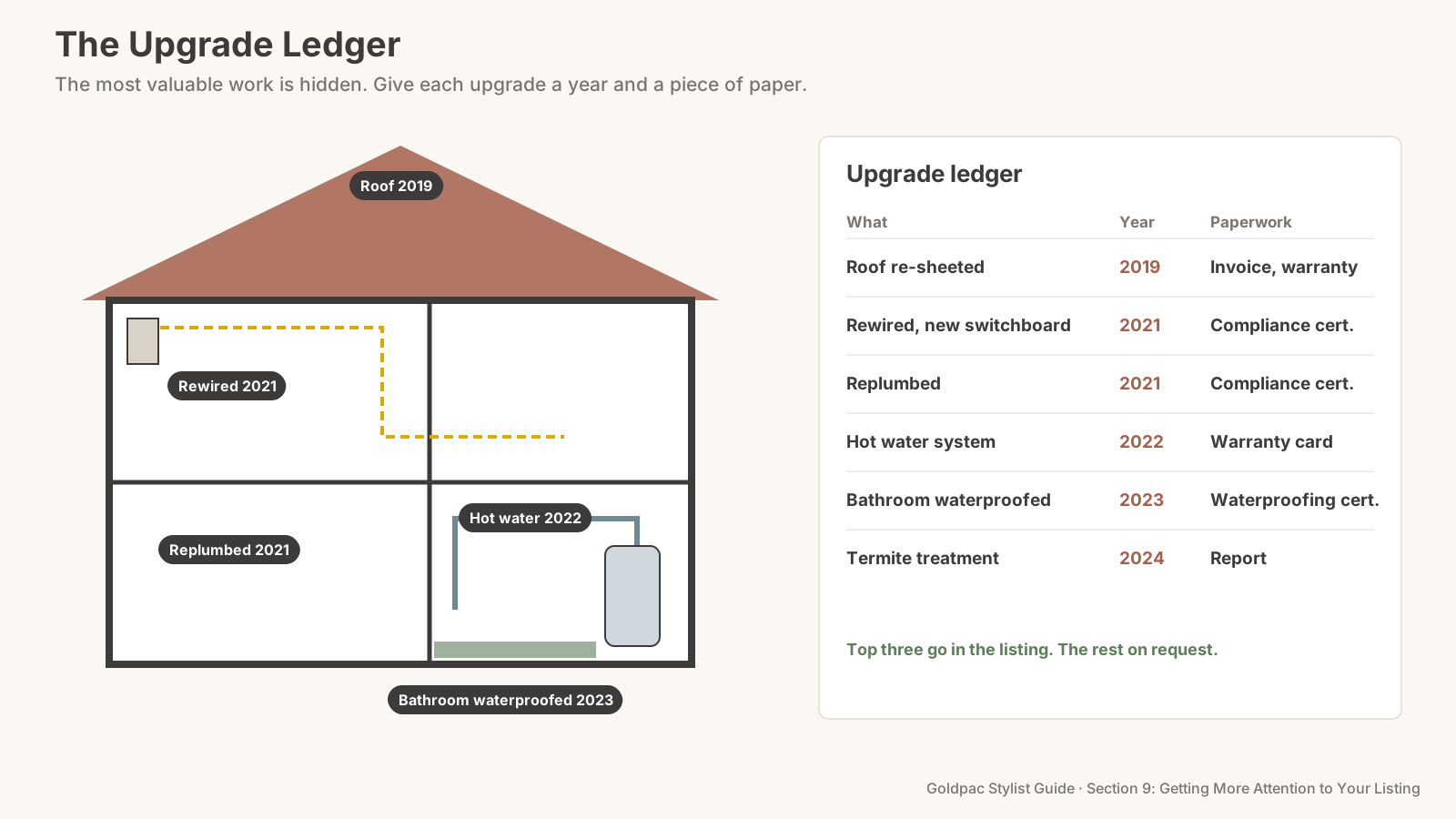
The Upgrade Ledger
A one-page list, kept with the contract and summarised in the listing.
- Walk the house with a pen. Room by room, then the roof space, the meter box and under the house if you can get there.
- Write one line per upgrade: what, when, who did it (licensed trade), and what paperwork exists.
- Find the paperwork. Compliance certificates, invoices, warranties, council approvals. Scan them into one folder.
- Pick the top three for the listing copy. "Rewired 2021. New roof 2019. Both bathrooms waterproofed and renovated 2023."
- Give the full ledger to your agent to share with buyers who ask, and to your conveyancer.
The Upgrade Ledger: one line per hidden upgrade with its year and paperwork, the top three in the listing copy, the full page on request.
Building history: when the past is a feature
History sells when it's specific.
- The era. "1912 Federation semi" tells a buyer about ceiling heights, joinery and character. "Character home" tells them nothing.
- Original features kept. Fireplaces, leadlight windows, pressed-metal ceilings, timber floors. Name them.
- The story, if it's true and documented. The architect, the builder, a past use of the building. Only if you can show where it comes from.
Heritage listing is a fact to disclose, not a decoration. It can attract buyers who love character and deter buyers who want to extend. Let your agent and conveyancer handle how it's described.
Why this works
Specific years make a listing more believable. "Recently renovated" is a phrase every listing uses. "New roof 2019" is a fact a buyer can check, and checked facts build trust in the rest of the listing.
Paperwork shortens negotiations. A buyer's building inspector who finds a new switchboard with a certificate has nothing to flag. A switchboard with no paperwork becomes a line in the report and a reason to ask for a lower price.
Where styling meets the ledger
Upgrades and presentation work together. A rewired home still looks old if the light switches are yellowed and the fittings dated (Rule #215). A waterproofed bathroom still worries buyers if the grout is dark and the silicone mouldy. The visible finish has to match the invisible work, or buyers won't believe the listing.
Claim only what you can prove
"Fully renovated." "Rewired." "New plumbing." Each one invites a question: when, by whom, where's the certificate?
If the answer is "a mate did it on a weekend", leave it out of the listing and talk to your conveyancer. Unlicensed or unapproved work can create problems at contract stage. Claim only what the paperwork supports.
The blind spot: you stopped noticing your own improvements
The roof you replaced eight years ago doesn't feel new to you. It's just the roof. The rewiring before the kids were born is ancient history in your family. But to a buyer, a roof from 2018 is a roof they don't expect to pay for any time soon.
What if…
You bought the home with upgrades already done. Check your purchase documents and ask the previous agent or vendor. Councils can also hold records of approved work.
There's no paperwork for older work. Mention it carefully ("roof replaced in the 2000s, per previous owner") or leave it out. Never invent a date.
The building is strata. List the building's recent works too: facade, lift, waterproofing, painting. Buyers ask about the building as much as the unit.
FAQ
Do statutory warranties pass to a new owner in NSW? Generally yes: under the Home Building Act 1989, later owners can rely on the statutory warranties for whatever remains of the warranty period (PBL Law Group). Ask your conveyancer how they apply to the work done on your home.
Hidden upgrades need a visible finish to be believed. For an empty home, Goldpac stages it with our own furniture so the rooms look as sound as the paperwork says they are: send us the address and a fixed styling quote lands within two hours, through our home staging page. Living there? A Photo Ready Consultation tells you which small visible fixes matter most, in a written plan within 48 hours of the visit. See current prices.
Keep reading: Rule #215: Replace old fixtures: taps, knobs, handles (the visible fittings that match the hidden work) · Rule #208: Fix visible issues: cracks, scratches, squeaky doors (fixing the visible issues first) · Rule #242: Be honest about strata levies and council rates (being upfront about holding costs) · Rule #253: Buyers fear unknown costs, so keep the home turnkey-ready (why buyers fear the costs they can't see)
◀ Previous: Rule #239: Offer flexible private viewing times · Section 9 guide: how to sell faster · Next: Rule #241: Add lifestyle phrases like “breakfast on the balcony” ▶
Part of the Goldpac Stylist Guide: 90+ home staging rules from Goldpac's Sydney styling team.