
Stylist Guide › Section 10: Buyer Psychology › Rule #253
What does a dripping tap cost a seller? Not the washer. The doubt.
The rule in one minute. Buyers can't price what they can't see, so they assume the worst. Every visible fault (a dripping tap, a sticking door, a cracked tile) makes them wonder what else is wrong and quietly lowers what they'll offer. Make the home feel turnkey-ready: fix the small faults buyers can see and touch, gather the paperwork for the big things they can't, and leave nothing that says "project". Work through it in three passes: 10 minutes, 1 hour, 1 weekend.
Why unknown costs scare buyers more than known ones
- A known cost has a number. Buyers can budget for "the carpet needs replacing".
- An unknown cost has no ceiling. "Why is that ceiling stained?" could mean a small fix or a new roof.
- Buyers fill the gap with the worst case. A small mystery gets priced like a big problem, because nobody wants to be the buyer who underestimated.
- One fault suggests more. A home with three small things wrong reads as a home nobody has looked after, and buyers start hunting for the fourth.
How do you make a house feel move-in ready for buyers?
Fix everything a buyer can see, touch or test in an inspection, and document everything they can't. Turnkey doesn't mean renovated. It means a buyer can picture moving in on settlement day without a list of jobs.
The Fix Ladder
10 minutes: make the list
- Walk the home as a fussy buyer. Turn every tap, flick every switch, open every door, drawer and window, flush every toilet.
- Write down anything that drips, sticks, squeaks, flickers, wobbles or doesn't work. One line each.
- Gather what you already have: recent reports, certificates and warranties for roof, wiring, hot water and appliances (Rule #240).
1 hour: the small fixes
- Replace every blown globe with matching warm bulbs (Rule #224).
- Tighten, oil and adjust: loose handles, squeaky hinges, sticking sliding doors, wobbly towel rails.
- Re-seal the obvious: a bead of fresh silicone around a mouldy shower base or a grubby kitchen sink.
- Book the trades for anything that needs a licensed plumber or electrician: dripping taps you can't fix with a washer, faulty power points, a running toilet.
1 weekend: the visible condition
- Touch up paint on scuffed walls, skirting and door frames.
- Clean or re-grout discoloured tile joints in wet areas.
- Fix the outside: loose fence palings, a broken gate latch, a cracked paver on the path, gutters cleaned.
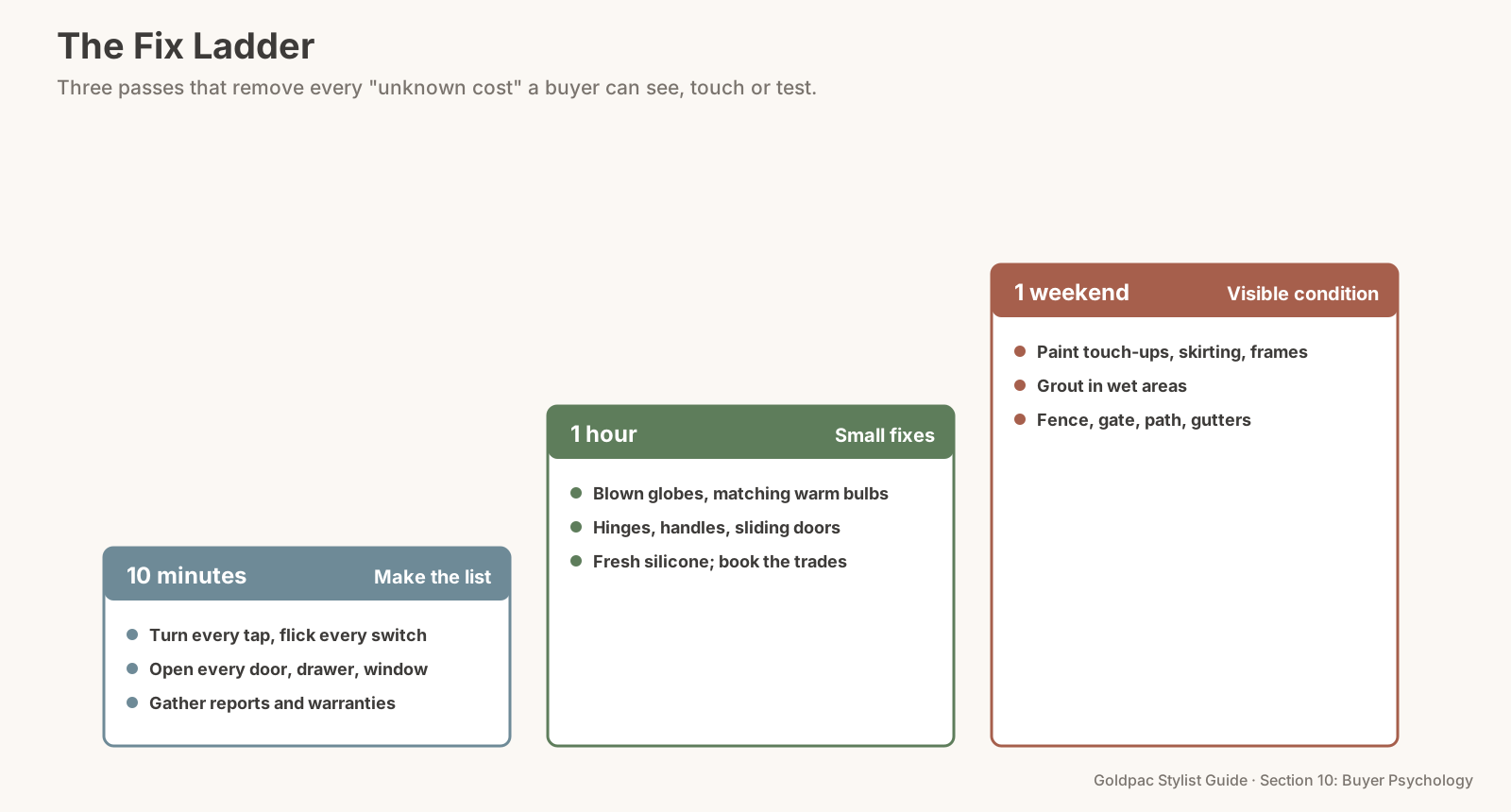
The Fix Ladder: a 10-minute fault list, a 1-hour round of small fixes, and a weekend on visible condition, so nothing in the home says "unknown cost".
The second-order effect: small fixes protect the big numbers
A building inspector's report reads differently in a well-kept home. Buyers usually commission a building and pest inspection before exchange. In a home full of small faults, every minor item on the report looks like part of a pattern, and buyers use the list to renegotiate. In a home where the small things are done, the same report reads as a clean bill of health with a few notes. Some sellers commission their own pre-sale building and pest report so buyers can see the condition upfront; ask your agent whether it suits your campaign.
"Buyers will renovate anyway. Why bother?"
Because buyers who plan to renovate still price the home as it stands. They subtract every visible fault from their offer, usually generously, and then plan the renovation on top. Fixing a sticking door takes you twenty minutes; it can cost you much more in a buyer's head.
There's a line, though. Fix what's broken and clean what's dirty. Don't start a kitchen renovation for the sale unless your agent advises it; that's a different decision.
The blind spot: you've learned the workarounds
Every home has its tricks. Jiggle the toilet handle. Lift the bedroom door as you close it. Don't use the left burner. Turn the shower tap past the click. You do these things without thinking, so the faults have disappeared for you.
Buyers don't know the tricks. They meet each fault for the first time, and each one is a small question mark. Ask someone who doesn't live with you to do the 10-minute walk and write their own list.
What if…
There's no time before the photos. Do the 1-hour fixes first; they're the ones buyers touch at inspections. Paint and grout can follow before the first open home.
There's a big known problem (an old roof, a cracked wall, a failing deck). Get a quote or report and have it ready for buyers who ask. A known problem with a written number is far less frightening than a mystery.
A tenant is in place. Repairs are the landlord's job and need proper notice; organise them through the property manager before the campaign starts.
FAQ
What should I fix before selling my house? Everything buyers see, touch or test at an inspection: taps, doors, switches, globes, handles, sealant, visible cracks and scuffs. Leave major renovations unless your agent recommends them.
Is a pre-sale building inspection worth it? It can be, especially for older homes. It shows buyers the condition upfront and lets you fix small items before they appear in a buyer's report. Ask your agent.
Should I fix cosmetic issues or leave them for the buyer? Fix the cheap, visible ones: paint touch-ups, sealant, grout, globes. Buyers usually overestimate what small cosmetic fixes cost.
A home that feels ready raises fewer questions. For an empty home, Goldpac stages with our own furniture once the small fixes are done, so buyers see a home they could move into tomorrow: send us the address and a fixed styling quote lands within two hours, through our home staging page. Living there? A Photo Ready Consultation includes a room-by-room list of what to fix before the photos, in a written plan within 48 hours of the visit. See current prices.
Keep reading: Rule #240: Mention building history and recent upgrades (paperwork for the hidden upgrades) · Rule #208: Fix visible issues: cracks, scratches, squeaky doors (fixing visible issues) · Rule #259: Buyers judge everything, even what isn't included (deciding what stays before the photos)
◀ Previous: Rule #252: Natural light builds trust · Section 10 contents · Next: Rule #254: Avoid hovering during viewings ▶
Part of the Goldpac Stylist Guide: 90+ home staging rules from Goldpac's Sydney styling team.