
Stylist Guide › Section 10: Buyer Psychology › Rule #252
Four directions, four kinds of light, and one of them sells Sydney homes better than the others. In Australia the sun sits to the north, so north-facing rooms get the most daylight through the year, and living areas ideally face within about 15° west to 20° east of north (YourHome, Australian Government, 2020). Buyers know it, ask about it, and trust what they can see in it.
The rule in one minute. Natural light builds trust because it lets buyers see the home clearly: the condition of the walls, the size of the rooms, the absence of damp. Dim rooms make buyers suspect what they can't see. Know each room's direction and best hour, clear every obstacle between the window and the room, and hold open homes when your main living area is at its brightest. North gets the most sun in Australia; east gets the morning, west the afternoon.
Why light reads as honesty
Light shows condition. In a bright room, buyers can see that the walls are clean, the floors are sound and the ceiling has no stains. They don't have to take anything on trust because they can check it with their own eyes. That's the quiet power of daylight: it makes the home transparent.
Dimness invites suspicion. In a dark room, buyers can't tell. Is that a shadow or a stain? Is the corner dark because of the light or because of damp? Uncertainty is uncomfortable, and uncomfortable buyers lower their offers or move on. A dim room doesn't hide problems from buyers; it makes them imagine problems that may not exist.
Light also changes how big a room feels. A bright room's edges are visible; a dim room's corners fade, and the room reads smaller than its square metres.
Which direction gets the best natural light in Sydney?
North, for most of the day and most of the year. In the southern hemisphere, north-facing windows catch the sun across the middle of the day, with the most sun in winter when it sits lower. East-facing rooms get bright morning light; west-facing rooms get strong afternoon and evening sun, which can be harsh in summer; south-facing rooms get soft, even light with little direct sun.
The numbers to know for your home
Numbers panel. 4 orientations to note: north (most sun, best midday), east (bright mornings), west (strong afternoons), south (soft, even light) · about 15° west to 20° east of north: the ideal range for living areas in Australia · 100%: how far blinds and curtains should open in daytime inspections · 0: objects on windowsills · 1 open home time chosen for the main living area's best hour
The Daylight Audit
Walk the home with a compass app and a notebook, one room at a time. It takes about 30 minutes and changes how you set up every inspection.
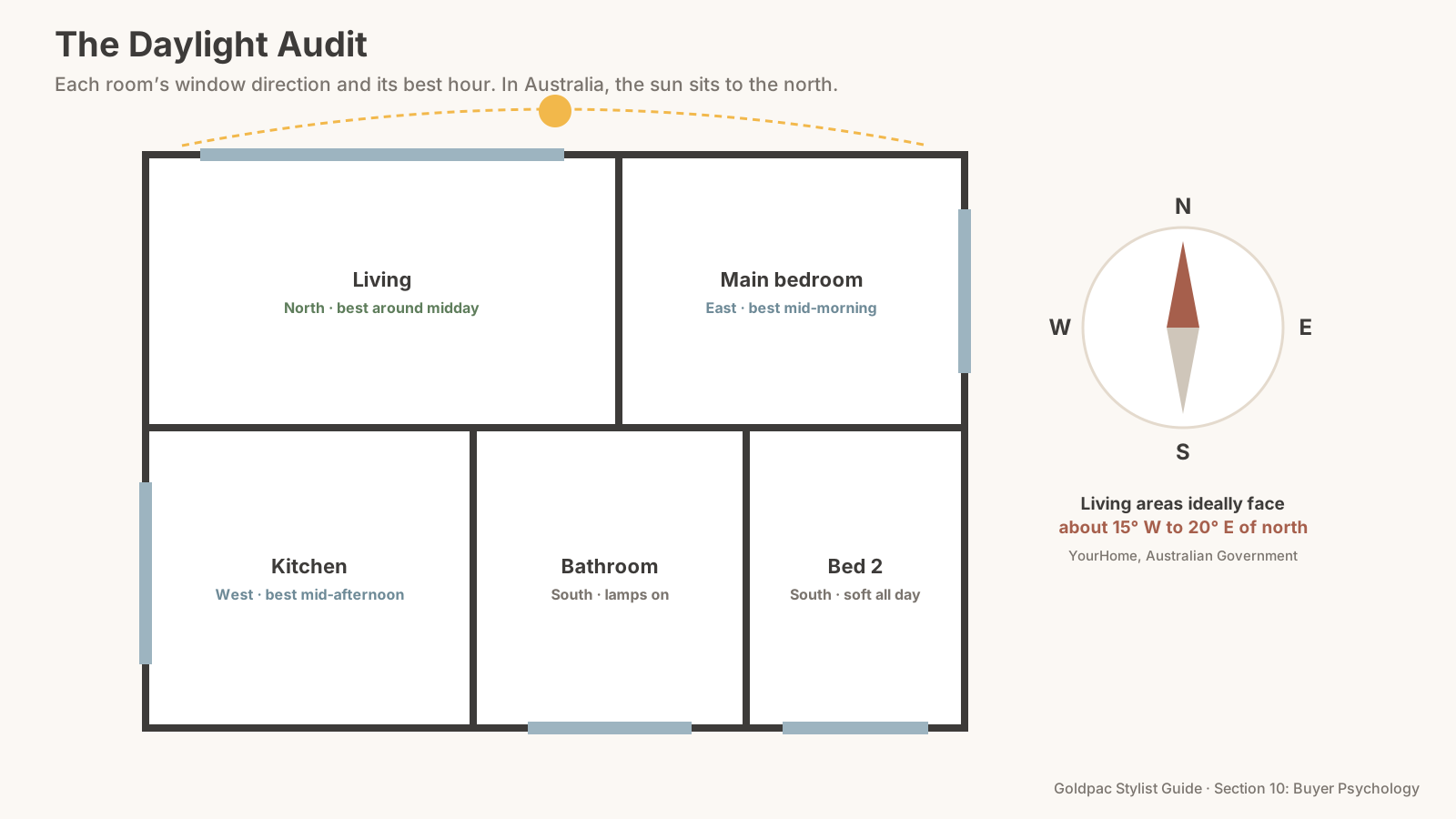
- Note each room's window direction. A phone compass is enough. Living room north-east, main bedroom west, kitchen south, and so on.
- Write down each room's best hour. North rooms: around midday. East rooms: mid-morning. West rooms: mid-afternoon. South rooms: any time, but they need lamps on.
- List the obstacles. Blinds that won't fully open, heavy curtains, shrubs against the glass, furniture in front of windows, dirty glass, things on sills.
- Clear them. Blinds and curtains fully open or removed, shrubs trimmed back from the glass, nothing on sills, glass cleaned inside and out (Rule #212), furniture moved clear of windows (Rule #6).
- Choose the inspection time for the main living area's best hour, and suggest it to your agent.
The Daylight Audit: each room's direction, its best hour and its obstacles, cleared before photos, with open homes timed to the living area's brightest hour.
On the morning of the open home
Light needs a last check, because it changes with the weather. A home set up perfectly on a sunny Thursday can look flat on an overcast Saturday. Thirty minutes before buyers arrive, walk the home once more for light only.
- Every blind and curtain fully open, including the ones in rooms you don't use.
- Every lamp on in south-facing rooms and hallways, and in any room if the day is grey.
- Doors between rooms open, so light from the brightest rooms reaches the darker ones.
- Shower screens and mirrors wiped, because they bounce light and show smears in it.
None of this takes long. All of it shows.
"Our home just isn't a sunny home"
Then you show the light it does have, at its best. A south-facing living room still has soft, even daylight; it just needs the curtains fully open, pale linens and lamps on as support. Lamps can't replace daylight, but warm lamps make a dim room feel inviting rather than gloomy (Rule #224).
What you never do is hide the orientation. Buyers check with their phones, and the ones who care about north-facing living will find out. A listing that shows a south-facing room honestly and beautifully earns more trust than one that tries to fake sun.
The second-order effect: light changes how buyers move
Buyers drift toward light. At an open home, they cluster in the brightest room, linger there and talk there. Dark rooms get a quick look from the doorway. So the brightest room effectively becomes the heart of the inspection; make sure it's the room you most want them to fall for, and that it's styled for it.
The blind spot: you live at the wrong hours
Most owners are home in the early morning and the evening, the two times of day when light is weakest. You may never have seen your living room at noon on a weekday. You know the house as a lamp-lit place at 7 pm, and that's not the home buyers will see on a Saturday morning.
Take one weekday off, or ask a neighbour, and look at each room at its best hour. Some rooms will surprise you; some will need a lamp you didn't know they needed.
What if…
The best light is at a time the agent can't do. Take the photos at that hour, and hold at least one inspection then, even a private one.
Neighbours overlook a big window. Sheer curtains keep privacy and let most of the light through. Heavy curtains open fully in daytime.
There's a large tree outside the main window. Trim what you can with permission, then let the green outlook be the feature. Filtered green light is a selling point when the room is otherwise bright and clean.
FAQ
Does natural light increase house value? It makes buyers more confident in what they see, and in Australia, north-facing living areas are widely sought after. Show the light your home has at its best hour, and never fake orientation in photos or copy.
Daylight shows condition, and condition earns trust. For an empty home, Goldpac stages with light, pale pieces placed clear of every window, so the rooms read as bright as they really are: send us the address and a fixed styling quote lands within two hours, through our home staging page. Living there? A Photo Ready Consultation includes a room-by-room light plan, in writing within 48 hours of the visit. See current prices.
Keep reading: Rule #212: Clean all windows: more light equals better impressions (clean windows inside and out) · Rule #6: Do not block windows with bulky furniture (keeping furniture clear of windows)
◀ Previous: Rule #251: Buyers remember feelings, not finishes · Section 10 contents · Next: Rule #253: Buyers fear unknown costs, so keep the home turnkey-ready ▶
Part of the Goldpac Stylist Guide: 90+ home staging rules from Goldpac's Sydney styling team.