
Stylist Guide › Section 9: Getting More Attention to Your Listing › Rule #242
Will leaving the strata levies out of the listing get more buyers through the door? For a week, maybe. Then it costs you the ones who were going to buy.
The rule in one minute. State strata levies and council rates plainly in the listing or the first reply to an enquiry, per quarter, with what they cover. Buyers find them anyway, from the strata certificate and the contract, and a cost they discover late feels like something you hid. Honest holding costs filter out buyers who can't afford them early and keep the ones who can.
The myth: "Don't scare them off with the costs"
It sounds sensible. High levies look bad. Council rates are boring. Get them in the door first. Let the home do the selling.
It feels right because the open home is where buyers fall in love. Costs can wait.
Why it backfires
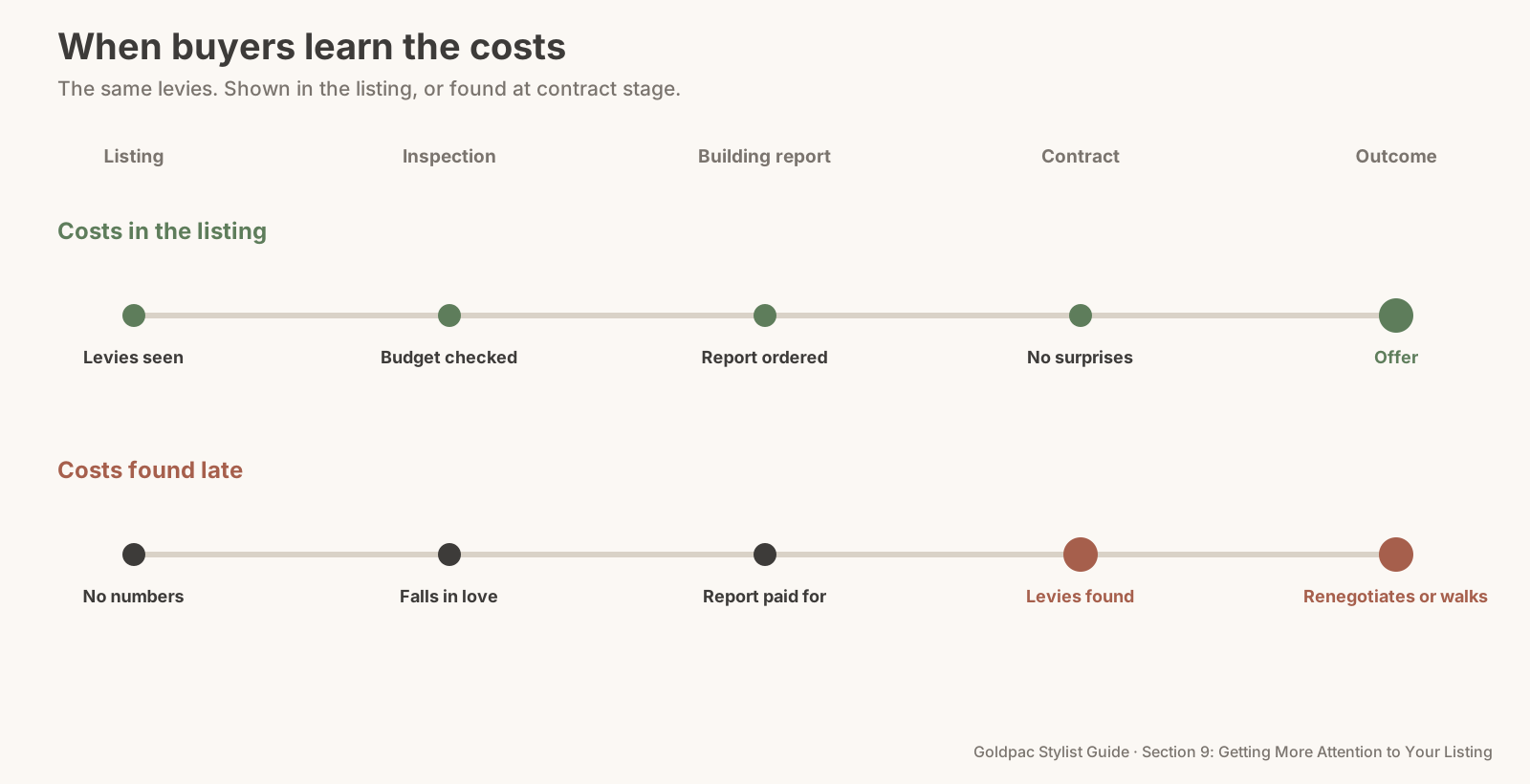
Buyers find out anyway. In NSW, a buyer's conveyancer will usually request a strata information certificate (a "Section 184 certificate"), which sets out the levies and the scheme's finances (NSW Government). The number will reach them. The only question is when.
Late is the worst time. A buyer who learns the levies at contract stage has already paid for a building report, booked a second inspection and told their parents. Now they're recalculating. Some renegotiate. Some walk. Either way, weeks of your campaign are gone.
Hiding reads as a warning. A listing that gives every detail except the costs makes careful buyers wonder why. Silence about a number makes the number seem bigger than it is.
The second-order effect: the wrong buyers fill the open home. Buyers whose budget can't carry the levies come, fall in love, and drop out. Buyers who could carry them easily assume they're high and don't come at all. Hiding the number works against you from both ends.
How should strata levies be shown in a listing?
Per quarter, split into the admin fund and the capital works fund, with council and water rates beside them. Strata levies in NSW are usually paid quarterly, so quarterly figures are what buyers recognise and compare (NSW Government).
The Outgoings Line
One line in the listing. One page on request.
- Get the current figures from your strata manager and the latest council and water notices.
- Write them per quarter. Admin fund, capital works fund, council rates, water rates.
- Say what the levies cover. Building insurance, cleaning, gardens, lift, pool, gym. A higher levy with a pool and a lift is a different story from a high levy with nothing.
- Flag anything coming. A special levy approved or likely, major works planned. Ask your strata manager.
- Put the strata documents in the agent's hands before launch: recent minutes, the capital works plan and the by-laws.
The Outgoings Line: strata levies (admin and capital works), council and water rates, all per quarter, with what the levies cover, in one line of the listing.
Where the levies sit in the story
High levies usually pay for something. Show it.
- A pool in the levies? Style the pool area and photograph it.
- A gym? Mention it in the lifestyle copy (Rule #241).
- A well-funded capital works fund? That's a selling point. It means fewer surprises for the next owner.
- Recent building works? List them, with years (Rule #240).
A buyer who sees what the money buys stops reading the number as a cost and starts reading it as a service.
The blind spot: the levies are normal to you
You've paid them for years. They're just a line on the bank statement every quarter. You don't think of them as high or low, just as what living there costs.
A buyer coming from a house, or from a building with no lift, sees them fresh. Give them the context you've stopped noticing: what's included, and what they'd pay for separately in a house.
What if…
The levies really are high. Show them anyway, with what they cover. Then let the price and the presentation do their work. Buyers can compare honestly only when they have the numbers.
A special levy is coming. Tell your agent and conveyancer early. Disclose it in the way they advise. It will appear in the strata documents; surprise is the only thing you can avoid.
It's a house, not a unit. There are no strata levies, but there are council rates, water rates and sometimes a community or neighbourhood association fee. List them the same way: per quarter, in one line. A house buyer budgets as carefully as a unit buyer, and the absence of strata costs is itself a selling point worth making plain.
FAQ
Do council rates need to be in a house listing too? It's good practice. Buyers budget for them, and a quarterly figure saves them a phone call. Your agent can confirm the current amount from your latest rates notice.
Who provides the strata information certificate in NSW? The owners corporation, usually through the strata managing agent. The buyer's conveyancer normally requests it before exchange.
High levies sell better when buyers can see what they pay for. For an empty unit, Goldpac stages it with our own furniture so the photos match a well-run building: send us the address and a fixed styling quote lands within two hours, through our home staging page. Living there? A Photo Ready Consultation gives you a written room-by-room plan within 48 hours of the visit. See current prices.
Keep reading: Rule #240: Mention building history and recent upgrades (listing the building's recent works) · Rule #241: Add lifestyle phrases like “breakfast on the balcony” (showing what the levies pay for)
◀ Previous: Rule #241: Add lifestyle phrases like “breakfast on the balcony” · Section 9 guide: how to sell faster · Next: Rule #243: Include floor space in m², not just room count ▶
Part of the Goldpac Stylist Guide: 90+ home staging rules from Goldpac's Sydney styling team.