
Stylist Guide › Section 9: Getting More Attention to Your Listing › Rule #243
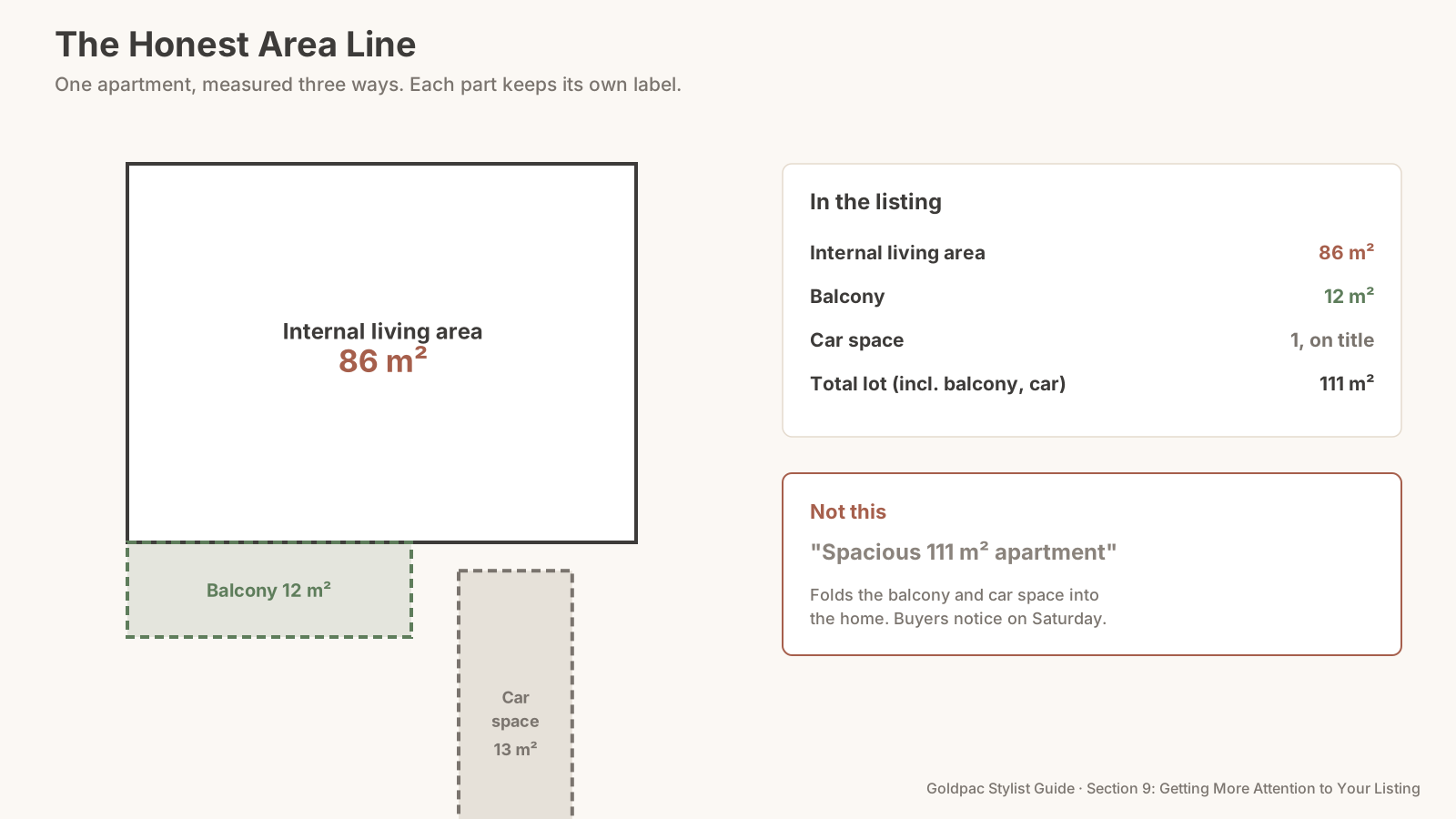
86 square metres or 111? It can be the same apartment. The first number is the space you live in; the second adds the balcony and the car space. Both are true. Only one of them should be called "internal".
The rule in one minute. Room count says how many rooms there are; floor area says how much home there is. Give the internal living area in square metres, plus the balcony, courtyard or car space listed separately, and a total that says what it includes. Two "two-bedroom units" can differ by a whole room's worth of space. Buyers comparing listings need the number, and an honest label on it.
The numbers behind the rule
- 1 number buyers can compare: internal living area in m². Rooms vary; square metres don't.
- 3 labels that keep it honest: internal, outdoor (balcony, courtyard, terrace), car space or storage.
- About 13 m²: the area of a typical single car space of about 2.4 by 5.4 metres. Fold it into an "internal" figure and the apartment grows by a room it doesn't have.
- 3.1 m²: the floor a queen bed covers (about 153 by 203 cm). Useful for picturing what a 10 m² bedroom really holds.
- 0 rounding up. If the plan says 86.4, write 86.
Why room count isn't enough
"Two bedrooms" is a category, not a size. A two-bedroom unit in a 1970s walk-up and a two-bedroom unit in a new tower can be very different homes. One may have a separate dining room and a laundry; the other may have a kitchen along one wall and a laundry in a cupboard.
Buyers already compare by area, whether the listing helps or not. They look at the floor plan, count rooms against each other, guess the sizes from photos. A listing that gives the number saves them the guessing and gives you credit for space you'd otherwise lose to a wide-angle doubt.
The second-order effect: area changes which listings yours is compared with. Without a number, your 95 m² two-bedder gets lumped in with 70 m² two-bedders and judged against their prices. With the number, it gets compared with homes its own size.
How do you calculate the floor area of a house or unit for a listing?
Use a measured floor plan or the strata plan, and label each part separately. For a unit, the registered strata plan shows the lot's area, and it may include balconies and car spaces as part of the lot. A floor plan drawn by the photographer or a measurer usually shows the internal area. Ask your agent which document each number comes from.
The Honest Area Line
- Internal living area: inside the walls of the home. This is the headline number.
- Outdoor area: balcony, courtyard, terrace, listed separately.
- Car space and storage: listed separately, or as "parking for one car" if no area is given.
- Total: only with a label that says what it includes.
- Room sizes on the plan, in metres, so buyers can see where the area goes (Rule #237).
The Honest Area Line: internal living area first, outdoor and parking listed separately, any total labelled with what it includes, and nothing rounded up.
"Buyers don't care about numbers. They care about how it feels."
They care about both, at different moments. The number gets the listing shortlisted; the feeling gets the offer. A buyer filtering a long list late at night is reading numbers. A buyer standing in your living room on Saturday is reading light and space.
Trouble starts when the two disagree. A listing that inflates the number makes the room feel smaller when buyers arrive, because it's smaller than they expected.
Where staging comes in
An empty room looks smaller than its square metres. Without furniture there's no scale: the eye can't tell 12 m² from 9 m². With a bed, two bedside tables and a rug, the buyer sees that the room holds a full bedroom with space to walk around it.
That's why we stage to show capacity. A dining table for six in the dining area, a three-seat sofa and an armchair in the living room, a desk in the study nook. The listing gives the number; the styling shows what the number means.
The blind spot: you've never measured your own home
You know your home by its rooms: three bedrooms, two bathrooms, a big kitchen. You probably don't know its area, because you've never needed to. It didn't come up when you bought it, or it did once, in a document you filed.
Buyers don't know your rooms. They know numbers. Find the strata plan or ask for a measured floor plan before the listing is written.
What if…
It's a house on its own land. Give both: the land size and the internal floor area. They answer different questions, and buyers want both.
The home has an unapproved extension. Ask your agent and conveyancer how to describe it. Don't count it in an "internal" figure without advice.
The strata plan includes the car space in the lot area. That's fine, as long as the listing says so. "Lot area 111 m² including balcony and car space" is honest. "111 m² apartment" isn't.
FAQ
Should balconies be included in an apartment's floor area? List them separately. Buyers value outdoor space, but they compare apartments by internal area, and a total that mixes the two without saying so can mislead.
Square metres get you shortlisted; furniture shows what they hold. For an empty home, Goldpac stages each room to show its real capacity, with our own furniture: send us the address and a fixed styling quote lands within two hours, through our home staging page. Living there? A Photo Ready Consultation shows you how to make each room read its true size, in a written plan within 48 hours of the visit. See current prices.
Keep reading: Rule #237: Use infographics: floor plans and suburb data (room sizes on the floor plan) · Rule #10: Say no to oversized couches in small living rooms (furniture sized for the room)
◀ Previous: Rule #242: Be honest about strata levies and council rates · Section 9 guide: how to sell faster · Next: Rule #244: Remove photos with closed curtains or poor light ▶
Part of the Goldpac Stylist Guide: 90+ home staging rules from Goldpac's Sydney styling team.