
Stylist Guide › Section 9: Getting More Attention to Your Listing › Rule #241
"What do we say about the balcony?"
"Balcony, eight square metres, north-facing."
"True. And what do you actually do out there on a Sunday?"
"…Breakfast. Every week, if it's not raining."
"Then that's the sentence."
The rule in one minute. Lifestyle phrases turn a feature into a moment a buyer can picture: "breakfast in the morning sun on the north-facing balcony" instead of "balcony, 8 m²". Use one per key room, keep each tied to a real feature and a real time of day, and make sure the photos and the open home show that moment set up and ready. A lifestyle phrase without a matching photo is just a nice sentence.
The same balcony, two ways
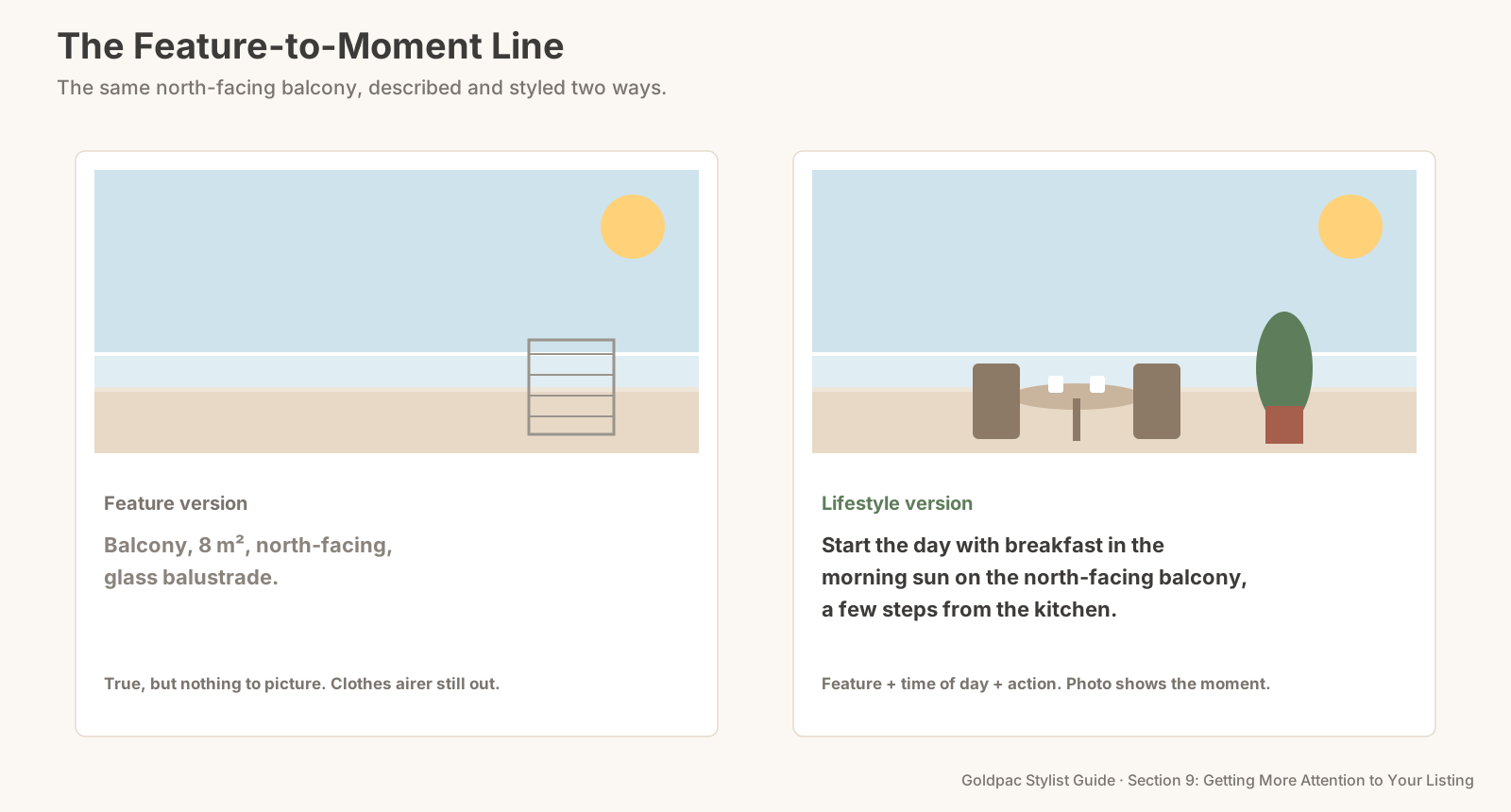
The feature version lists what's there: "North-facing balcony, 8 m², glass balustrade, accessed from living area."
The lifestyle version tells the buyer what they'll do with it: "Start the day with breakfast in the morning sun on the north-facing balcony, a few steps from the kitchen."
| Feature version | Lifestyle version | |
|---|---|---|
| What it gives the buyer | Facts to compare | A moment to imagine |
| What it answers | "What's there?" | "What would my Sunday look like?" |
| Risk | Reads like every other listing | Reads as cheesy if it's vague or untrue |
| What it needs from the photos | A clear shot of the space | The space set up for that moment |
The verdict: use both. The facts belong in the features list, where buyers search and compare (Rule #229). The lifestyle phrase belongs in the description, where buyers decide how they feel. Each does a job the other can't.
How do you write lifestyle copy for a real estate listing?
Start from a real feature, add a time of day, and describe one thing a person does there. Feature, time, action: three parts, one sentence. It's the most reliable way to keep lifestyle copy specific, and specific is what stops it sounding like a brochure.
The Feature-to-Moment Line works like this:
- Pick the feature. North-facing balcony. Level backyard. Kitchen island. Window seat. Fireplace.
- Add the time it shines. Morning sun, a summer evening, a winter night, school pick-up time.
- Add one action. Breakfast, a glass of wine, kids kicking a ball, reading, homework at the bench.
- Read it aloud. If it could describe any home in Sydney, it's too vague. Add the detail that makes it yours: "a few steps from the kitchen", "under the jacaranda".
The Feature-to-Moment Line: one real feature, one time of day, one action, in a single sentence, for each key room, and never more than five in a listing.
Examples that work
- Backyard: "A level lawn big enough for a game of cricket after school, in full view of the kitchen window."
- Kitchen: "An island bench that seats four for homework while dinner's on."
- Living room: "A gas fireplace for winter nights, with the dining table close enough to keep the conversation going."
- Main bedroom: "Wake up to filtered morning light and a view of the tree canopy."
- Study nook: "A quiet desk by the window for working from home without losing the spare bedroom."
Each phrase sits on a fact the buyer can check at the inspection: the lawn is level, the island seats four, the fireplace works.
"Isn't that a bit cheesy?"
It's cheesy when it's generic. "An entertainer's delight." "Perfect for the growing family." "Your private oasis awaits." Those phrases appear on thousands of listings and describe none of them.
It's convincing when it's specific and true. A buyer who reads "breakfast in the morning sun on the north-facing balcony" and then stands on that balcony at 9 am on a Saturday, in the sun, believes the rest of the listing more.
Why the photo has to match
A lifestyle phrase tells the buyer where to look. At the open home, buyers who read "breakfast on the balcony" walk straight to the balcony and stand there, imagining it. If the balcony has a clothes airer and a dead plant, the sentence turns against you.
That's the second-order effect most sellers miss: the copy and the styling are one job. The balcony needs a small table, two chairs and perhaps a plant, set as if breakfast is about to happen, in the photos and on the day. A bistro set with a table about 60 cm across and two chairs fits on most Sydney balconies with room to walk past it. The kitchen island needs stools tucked in at the counter. The fireplace needs a styled mantel and a rug in front of it. Copy makes the promise; staging makes it visible.
Put the moment under the photo, too
Many buyers scroll the photos and never read the description. If the portal or brochure allows captions, give the key photos the same moment in a few words: "Breakfast spot, morning sun" under the balcony, "Homework at the island" under the kitchen. A caption catches the buyer at the exact second they're looking at the room it describes.
Keep captions shorter than the description lines, and never caption a photo with a moment it doesn't show. "Entertaining deck" under a bare deck with a hose reel undoes the work. The styled photo and the caption should say the same thing, one in pictures and one in words.
The blind spot: you stopped using the room the way buyers will
The balcony may have become where the washing dries. The backyard may be where the trampoline lives. The fireplace hasn't been lit in three winters. You still remember the breakfasts and the long summer evenings, but they're no longer what the room looks like.
Buyers only see the room as it is now. Before writing the phrase, set the room up for the moment once, even just for the photos, and check that it still works.
What if…
The balcony is too small for a table. Write a smaller moment: "a spot for your morning coffee". One chair and a side table will prove it.
There's no outdoor space at all. Find the moment indoors: a window seat, a sunny corner of the living room, a kitchen bench with a view.
You're not sure what buyers would do there. Ask your agent who usually buys in your street. A young couple and a downsizing couple will picture different moments in the same courtyard.
FAQ
How many lifestyle phrases should a listing have? One per key room, and no more than about five in total. More than that and the description starts to read like an advertisement rather than a home.
Should the headline use a lifestyle phrase too? The headline does a different job: one feature, one feeling, one place (Rule #227). Lifestyle moments work best in the description, where there's room to describe them properly.
Can lifestyle phrases be misleading? They can if the feature isn't real. Every lifestyle phrase should rest on something a buyer can check at the inspection: the sun, the size, the view or the feature itself.
A lifestyle phrase only works if the room shows the moment. For an empty home, Goldpac stages each key room around one clear moment, from breakfast on the balcony to homework at the bench: send us the address and a fixed styling quote lands within two hours, through our home staging page. Selling with your own furniture? With Photo Ready Styling, our stylist styles your home with your own pieces before the photos. See current prices.
Keep reading: Rule #227: Use an emotional headline, not “2-bed unit” (the headline: one feature, one feeling, one place) · Rule #229: Add the keywords buyers search for: renovated, parking, pet-friendly (the plain search words for the features list) · Rule #245: List why the property beats similar ones (the three differences that set your home apart) · Rule #257: Furniture shows how to use awkward spaces (giving awkward corners a job)
◀ Previous: Rule #240: Mention building history and recent upgrades · Section 9 guide: how to sell faster · Next: Rule #242: Be honest about strata levies and council rates ▶
Part of the Goldpac Stylist Guide: 90+ home staging rules from Goldpac's Sydney styling team.