
Stylist Guide › Section 9: Getting More Attention to Your Listing › Rule #245
Buyers never judge your home on its own. They judge it against the last one they saw.
The rule in one minute. Most buyers inspect several homes in a weekend and then compare them over dinner. Give them three concrete reasons your home is the better choice than similar listings nearby (more light, a bigger yard, a study, a quieter street, a newer kitchen), write them as checkable facts in the listing, and make each one visible in the photos and at the open home. Never name or criticise other properties.
Saturday, 1 pm: the buyer's walk
It's a familiar shape. A couple has three open homes booked for the morning, all within a few streets of each other, all within their budget, all three-bedroom houses.
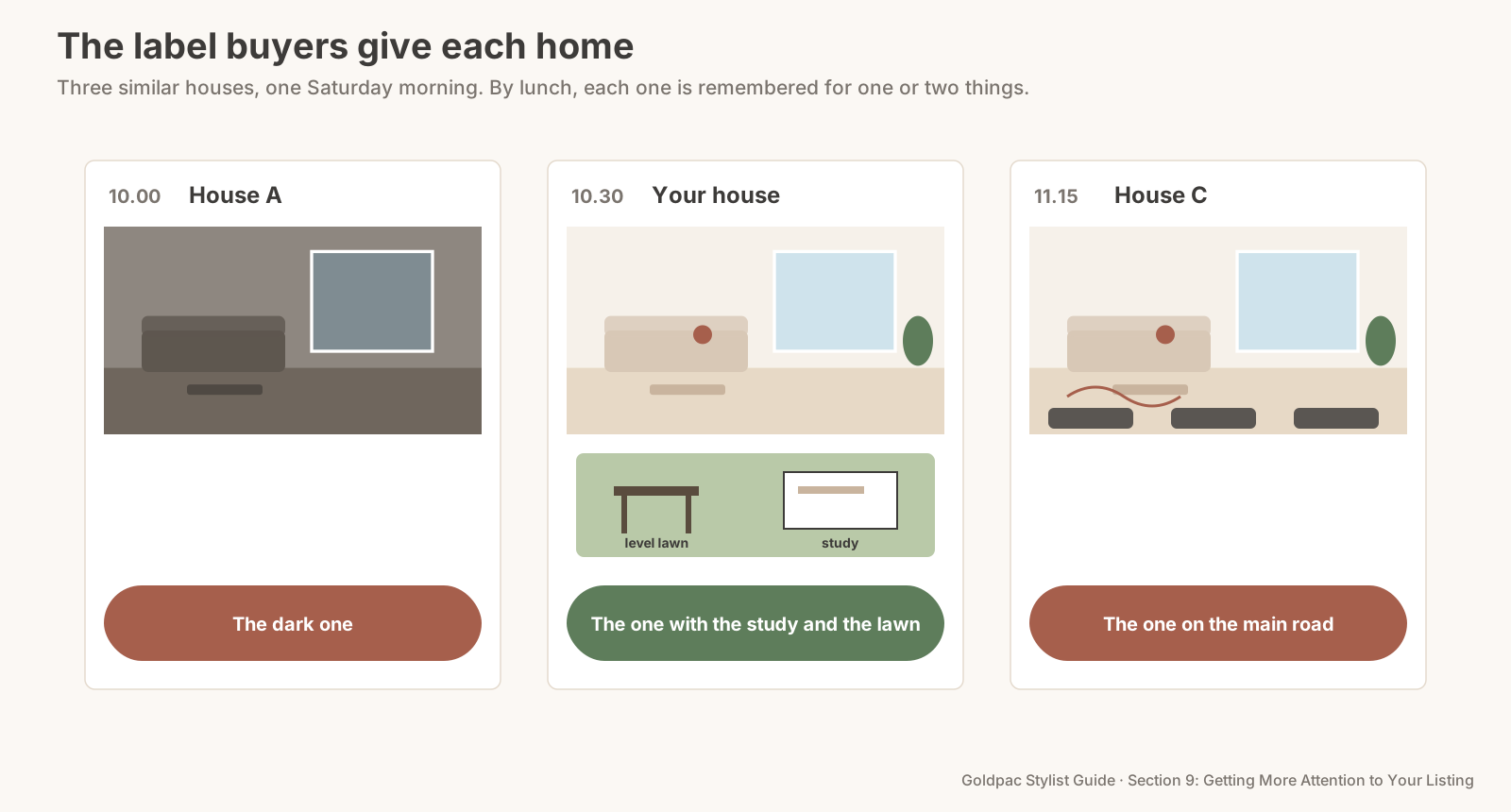
10.00, the first house. Freshly painted, a nice kitchen, a small backyard. "It's fine," she says. "Bit dark at the back."
10.30, the second house: yours. They walk in. The living room is bright. There's a desk set up in the small third bedroom. Out the back, a table and chairs on a level lawn.
"Oh, this is nice," he says. "Is this the one with the study?"
11.15, the third house. Bigger, but on a busy road. "Lovely kitchen," she says, "but the noise."
1.00, lunch. They talk it through. Nobody remembers the paint colours or the tap fittings. They remember one or two things about each house: the dark one, the one with the study and the lawn, the one on the main road.
Every home gets a label in a buyer's head. Your job is to choose yours.
How do you make your house stand out from similar listings?
Find three real advantages over the homes buyers will compare you with, and show each one twice: in words in the listing and in the room at the open home. Three is enough to be memorable and few enough to be believed.
The Three Differences
- Find the competition. Look at the current listings within about a kilometre and in your price range. Your agent knows which ones buyers are inspecting alongside yours. Go to one or two of their open homes yourself.
- List what yours has that they don't. Light, space, land, a study, parking, a renovated bathroom, a quieter street, a better outlook, lower holding costs, no strata.
- Pick the three that matter most to the buyers your agent expects. A family cares about the yard and the study; a downsizer cares about single level and low maintenance.
- Write each one as a checkable fact. "North-facing rear living", "third bedroom set up as a study with built-in desk", "level 600 m² block", "two-minute walk to the park". No comparisons, no other addresses.
- Make each one visible. Style the room that carries each difference so buyers can't miss it, and ask the agent to mention all three at the door.
The Three Differences: three checkable advantages over the homes your buyers are comparing, written as facts in the listing and staged so they're obvious in the room.
From difference to listing to room
| The difference | How the listing says it | How the room proves it |
|---|---|---|
| A real study | "Third bedroom set up as a study, with built-in desk" | Desk, chair, lamp and a shelf, door open |
| A level lawn | "Level 600 m² block with a flat rear lawn" | Outdoor table and chairs on the grass, lawn mown the day before |
| Morning light | "North-east rear living, sun until midday" | Blinds up, sofa facing the windows, open home before noon |
| Low upkeep | "Freestanding, no strata, new roof 2021" | Clean gutters and paths, the upgrade list on the bench |
| Quiet | "No-through road, rear bedrooms" | Windows open during the open home so buyers can hear it |
Each row is one difference said twice: once in words a buyer can repeat, once in a room a buyer can stand in.
Why it works
Buyers remember homes by one or two features. After a morning of open homes, details blur; labels stick. If you don't give your home a label, buyers will give it one, and it may be "the one with the small second bedroom".
Facts make comparison easy. A buyer who can say "this one has the study and the level lawn" to their partner has an argument for your home. A buyer who can only say "it felt nice" has nothing to bring to the conversation.
"Isn't it a bit tacky to compare yourself with the neighbours?"
It would be, if you named them. The listing never mentions other homes. It simply states your advantages clearly, and buyers do the comparing themselves. Every claim has to be true, too: comparative or exaggerated advertising can mislead, and buyers will check.
"So we don't say 'bigger than the house next door'?"
"No. You say 'level 600 m² block'. They'll work out the rest."
Where staging does the work
A difference that isn't staged doesn't exist on the day. The third bedroom that could be a study looks like a box room until there's a desk in it. The level lawn looks like a patch of grass until there's an outdoor table on it. The north-facing living room only feels sunny if the blinds are open and the furniture faces the light (Rule #6).
That's why it pays to tell your stylist which three things your home does better before the styling starts. The whole plan can then be built around those three.
The blind spot: you haven't seen the competition
You know your own home in detail, but you probably haven't been through a comparable home in your suburb for years. You don't know that the house around the corner has a renovated kitchen and a pool, or that yours is the only one in the street with off-street parking.
Spend one Saturday morning at two or three open homes near you. You'll come back knowing exactly what makes yours different, and what doesn't.
What if…
Your home is the smaller or older one. Then the advantages are different, not absent: a lower price point, a bigger block, original features, potential to renovate, a quieter street, no strata. Lead with what's genuinely yours.
There's nothing comparable listed right now. Use recent sales your agent shows you. Buyers compare with what they've seen in the last few months, not just this weekend.
FAQ
Should a real estate listing compare the property with others? Not by name. State your home's advantages as plain facts and let buyers compare. Every claim must be accurate and checkable.
How many selling points should a listing focus on? Three main ones. More than that blurs the message; fewer can leave buyers without enough reasons to choose your home over the others they've seen.
A difference only counts if buyers can see it. For an empty home, Goldpac stages each room around the advantages that set it apart, with our own furniture: send us the address and a fixed styling quote lands within two hours, through our home staging page. Living there? A Photo Ready Consultation finds the three things your home does best and plans each room around them, in writing within 48 hours of the visit. See current prices.
Keep reading: Rule #241: Add lifestyle phrases like “breakfast on the balcony” (turning each difference into a moment) · Rule #6: Do not block windows with bulky furniture (letting the light reach the room)
◀ Previous: Rule #244: Remove photos with closed curtains or poor light · Section 9 guide: how to sell faster · Next: Rule #246: Build a mini-site for premium listings ▶
Part of the Goldpac Stylist Guide: 90+ home staging rules from Goldpac's Sydney styling team.