
Stylist Guide › Section 6: Styling Logic & Emotional Design › Rule #162
Is it disrespectful to pack away religious or political items while your home is for sale?
The rule in one minute. Before photos and inspections, gently pack away items that express a political view or a religious practice (posters, flags, election signs, statues, shrines, prayer spaces, scripture on walls), the same way you'd pack family photos. It isn't about hiding who you are; it's about letting every buyer picture their own life in the home. Handle treasured objects with care, set them up again on the first night in your next home, and treat fixtures and anything you'd rather keep up as your own decision.
Your questions, our answers
This is one of the more personal parts of preparing a home, so it's worth being clear about why it matters and how to do it with care.
"Why does it matter to buyers?"
"It's just part of our home."
It is, and that's exactly the point. A buyer is trying to imagine their own life in the rooms. Strong personal symbols, whatever they are, remind them that someone else lives there. That's true of family photos and trophies too (Rule #152 covers personal items).
Beliefs are especially personal. A buyer who shares them may feel at home; a buyer who doesn't may feel like a guest, or switch off. Neither reaction has anything to do with the house.
And photos last. Listing photos stay online for a long time and are seen by thousands of people you'll never meet. Many sellers simply prefer not to share their beliefs that widely.
What should you remove for an open home?
Anything that states a political view or shows a religious practice: posters, flags, banners, election signs on the fence, bumper stickers on the garage fridge, religious statues and images, shrines and altars, scripture or prayer text on walls, and dedicated prayer spaces set up in a shared room. Pack them carefully for the campaign, or keep them in one private room that won't be photographed.
"Isn't that asking us to hide who we are?"
No. It's asking the house to be a little more neutral for a few weeks. You're not removing your beliefs; you're giving buyers a blank page. It's the same reason you'd put away a team flag, a collection or the kids' art. Everything comes back when you move.
"What about things that are fixed or part of our practice?"
That's your call, and it's a reasonable one either way. A small fixture on a door frame, a symbol built into the house, or a practice you'd rather not pause are yours to keep. The aim is to avoid strong, room-defining displays in photos, not to ask anyone to stop living by their faith.
Where's the line between decor and a statement?
A useful test: does the object ask the viewer to agree with something? A beautiful old textile, a carved timber bowl or a landscape print is decor; it can come from anywhere and still read as simply lovely. A flag, a slogan, a figure placed for devotion or a framed passage of scripture is a statement, however beautifully made.
Cultural objects aren't the same as statements. A handwoven rug or a ceramic vase from your family's home country can stay if it works as decor. The aim is a calm, neutral backdrop, not a home with no history.
Scale matters as much as content. One small object on a bookshelf rarely registers in a photo. A wall, a corner or a whole shelf given over to it defines the room, and that's what the listing photos will show.
The Gentle Pack
- Walk each room and note any item that states a belief or a political view.
- Choose a box and a place for each: a labelled, padded box for treasured objects, stored somewhere safe and dry.
- Pack the visible items before the photographer arrives.
- If a space is used for prayer or practice, consider styling it for the photos as what the listing will call it: a study, a guest room or a sitting room.
- Check outside: fences, letterboxes, cars in the driveway, garage doors.
- Unpack first in your new home. It's a good first night ritual.
For a typical three-bedroom home, allow about an hour and one or two padded boxes; it's usually a smaller job than sellers expect.
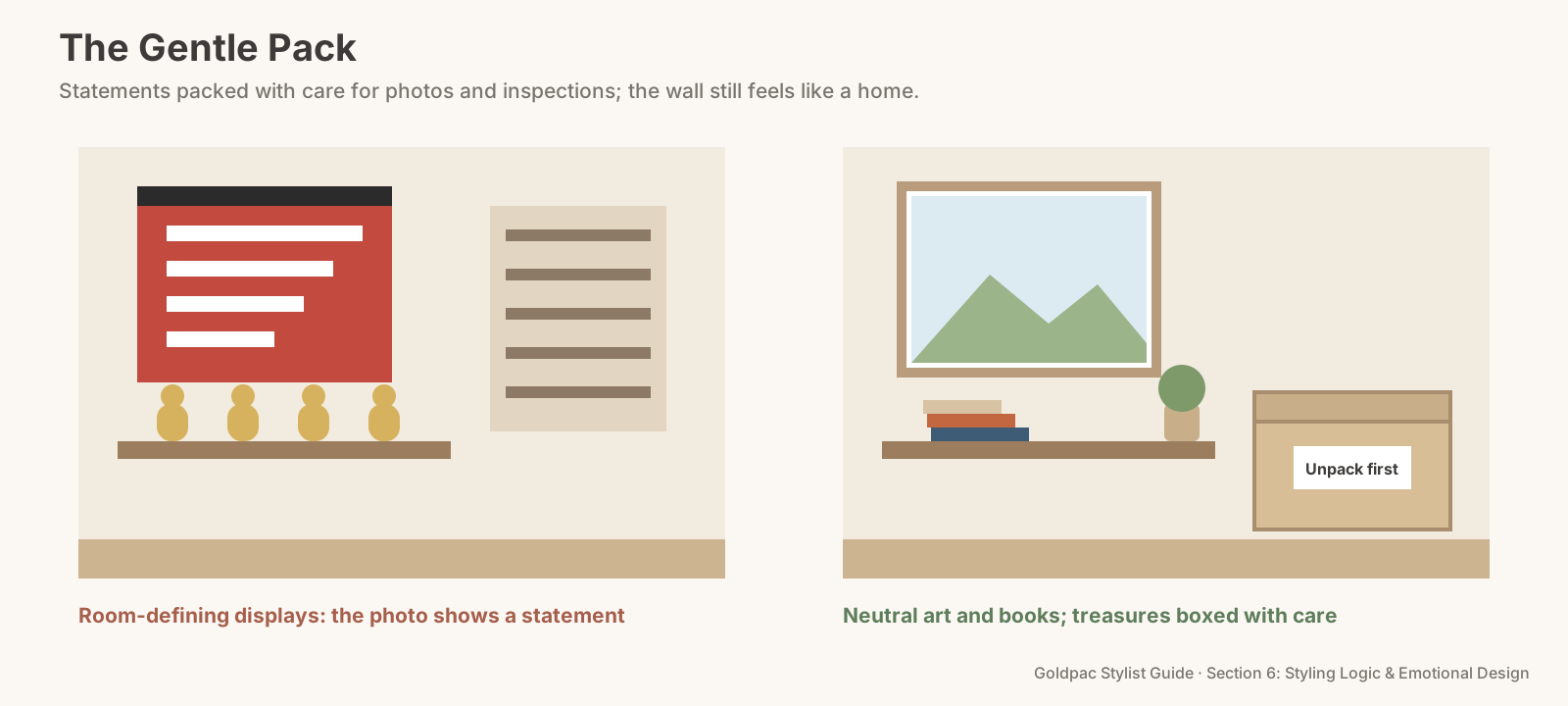
The Gentle Pack: political and religious displays packed with care before photos and inspections, prayer spaces styled as the room the listing describes, and everything unpacked first in the next home.
What to say at home
Families don't always agree on this. A gentle way to put it:
"We're not putting anything away forever. For the next few weeks, the house needs to look like it could be anyone's. These are the first things we'll unpack in the new place."
If this, then that
- If you rent the home to tenants: you can't pack their belongings. Ask your agent to request, respectfully and in writing, that items are put away for photos.
- If an item is too large or fixed to move: leave it, and keep the photo angles on the rest of the room.
- If you're unsure whether something counts: ask yourself whether a stranger would read it as a statement. If yes, pack it.
- If the item is outdoors, on a fence, a window or a car: take it down before the photographer arrives; street-front and drone shots catch it too.
- If your agent has a strong view on your local market: take their advice; they know the buyers.
The blind spot: it's part of the furniture of your life
You see these objects every day, often several times a day. They're part of your routine and your sense of home, so they don't register as statements at all.
To a buyer, they're the most personal things in the room. That gap is why this step feels strange to sellers and obvious to stylists.
What if…
Packing these items doesn't feel right to you. Then don't. Keep them in one room, close that door for photos, and let the agent know. The rest of the home can still be staged neutrally.
You'll be home during the campaign and pray at set times. Keep your practice exactly as it is; only the photographed display changes. A prayer mat rolled into a basket or a cupboard between uses keeps the room ready for an inspection without asking anything of your routine.
FAQ
Should I remove religious items when selling my house? It's usually helpful to pack strong religious displays for photos and inspections, so every buyer can picture themselves in the home. Fixtures and anything you'd rather keep up are your own choice.
Do political signs affect house sales? They can distract buyers and narrow appeal. Take down signs, flags and posters, including on fences and windows, before photos.
Is it okay to keep a small personal item on display? Yes. One or two small, private items rarely matter. The aim is to avoid room-defining displays in photos.
Some parts of preparing a home are personal, and it helps to have a calm, outside eye. For empty homes and agent listings, Goldpac stages with our own neutral furniture and art: send us the address and a fixed styling quote lands within two hours, through our home staging page. Living there? A Photo Ready Consultation walks every room with you and leaves a written plan within 48 hours of the visit. See current prices.
Keep reading: Rule #152: Remove personal items: photos, trophies and mail (packing away personal items) · Rule #151: Style a neutral story any buyer can imagine living in (the neutral story) · Rule #190: Don't use religious objects as decor (religious objects used as decor)
◀ Previous: Rule #161: Every styled object should add to the story · Section 6 contents · Next: Rule #163: Keep children's rooms simple and calm ▶
Part of the Goldpac Stylist Guide: 300+ home staging rules from Goldpac's Sydney styling team.