
Stylist Guide › Section 6: Styling Logic & Emotional Design › Rule #167
"What do you see from here?"
"The bed."
"Look again."
"…The laundry basket. The back of the TV. And a cable."
The rule in one minute. Make the view from every doorway photogenic, because doorways are where buyers stop, where photographers stand and where first impressions form. From each door, the first thing in sight should be the room's best feature or a styled focal point, with nothing ugly in the line of view: no backs of furniture, no bins, no cables, no laundry. Stand in every doorway with your phone and fix what the camera sees first.
Why the doorway view matters more than the room
Doorways are where buyers pause. At an inspection, people stop at the threshold of every room for a second or two, take it in and decide whether to step further in. That pause is the room's first impression.
Doorways are where photographers shoot from. Most listing photos of bedrooms, bathrooms and studies are taken from in or near the doorway, because it's the widest view of the room. What you see from the doorway is, very often, the photo.
The view runs through the house. From the front door you can usually see into a hallway and a living room; from the living room, into the kitchen and out to the garden. Every doorway frames the next room, so a good doorway view sells two rooms at once.
What should you see from a doorway when staging a house?
The room's best feature or a styled focal point: a made bed, a window with a view, a sofa facing you, a dining table set simply, a hero corner. Never the back of a piece of furniture, a bin, a laundry basket, a cable or a closed, cluttered corner. If the best feature isn't visible from the door, move the furniture until it is.
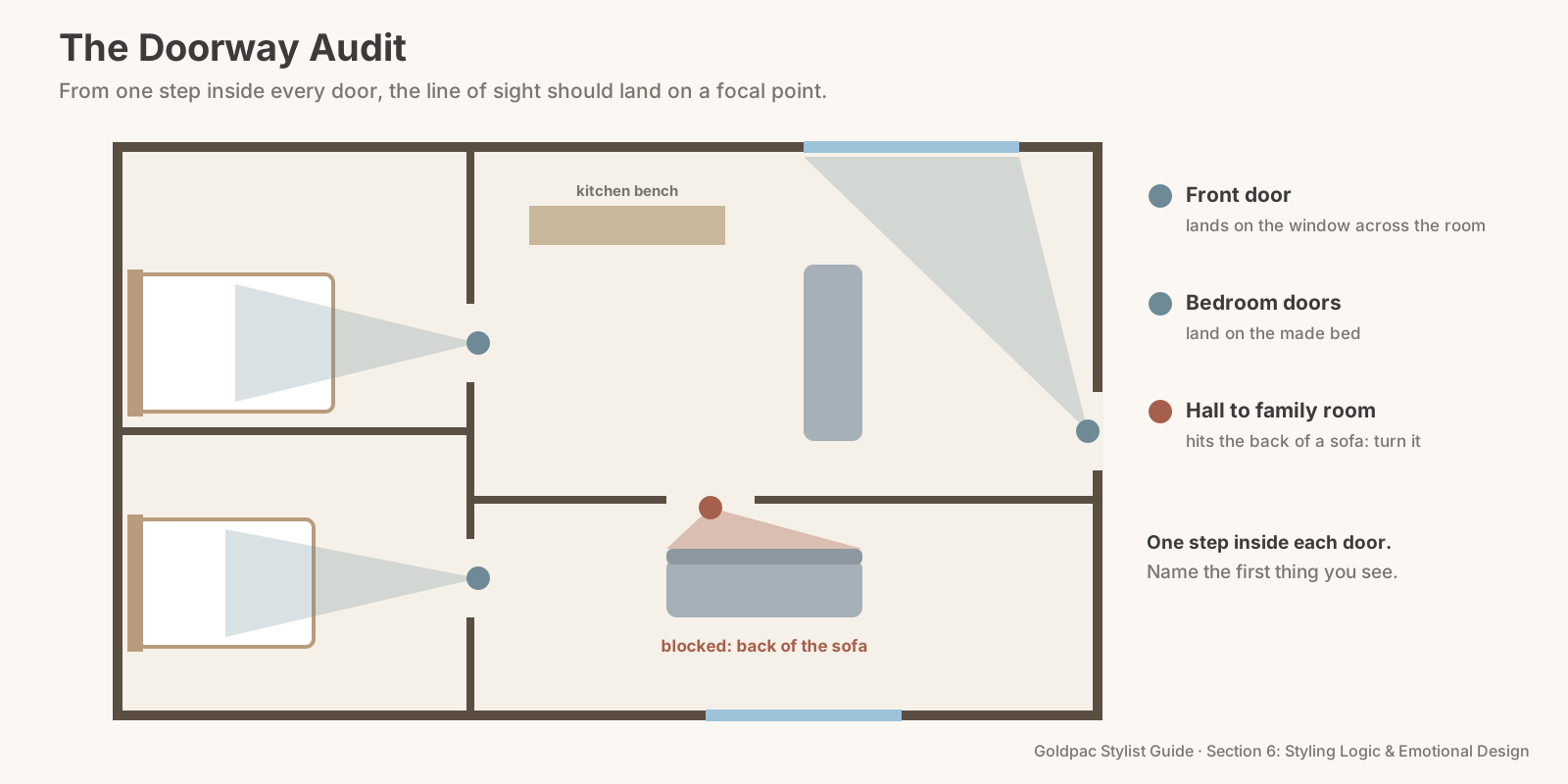
The Doorway Audit
Work through every door in the house, in the order a buyer would walk. Front door first, then each room off the hallway, then the living areas, then the back door looking out. In each doorway, run the same six checks.
- Stand where a buyer would stop, one step inside the threshold, at your normal eye height.
- Name the first thing you see. If it isn't the room's best feature, ask why. Usually a piece of furniture is facing the wrong way, or something is blocking the view.
- Turn furniture to face the door, or side-on. A sofa with its back to the doorway blocks the room and says "keep out". A bed with its foot to the door and the bedhead on the far wall says "come in".
- Clear the line of sight. Anything between the door and the focal point that interrupts the view goes: a chair in the path, a pile of shoes, a laundry basket, a bin.
- Look at the edges. The corners of the view are where the camera catches cables, power boards, the corner of the ironing board and the side of the fridge.
- Check the far wall. Whatever is on it is the backdrop of the photo. One piece of art, a window or a clean wall reads best.
The Doorway Audit: one step inside every door, name the first thing you see, turn the furniture to face you, and clear the line of sight to the room's best feature.
Room by room, the usual fixes
Bedrooms. The bed should face the door, with the bedhead on the far wall. If the layout forces the bed side-on, make the side of the bed beautiful: a throw falling over the edge, bedside lamp on, bedside table clear.
Living rooms. The back of the sofa is one of the most common doorway blockers, especially in open plan units where the sofa divides the living area from the entry. Angle it, float it so its side faces the door, or add a console behind it with a lamp so the back looks finished.
Bathrooms. The toilet is often the first thing visible from the door. A closed lid, a clean cistern with nothing on it, and a plant or towel on the vanity to draw the eye away.
Kitchens. From the living room, the kitchen view should land on the island or bench, not the fridge door covered in notes (Rule #166 covers styling the kitchen for hosting).
Studies and spare rooms. The desk should face into the room or toward the window, not with a chair back and a monitor's cables facing the door.
The phone-camera test
Hold your phone at chest height in each doorway, in landscape, and take one photo with the standard lens (or 0.5 if that's what your agent's photographer uses for small rooms). Look at the photo, not the room. The camera notices what your eyes skip: the cable under the TV, the gap between the wardrobe and the wall, the pile of mail on the dining table. Fix it, take the photo again, and keep both so you can see the difference.
Why your eyes skip what the camera sees
Your brain edits the view for you. When you walk into a room you know, you look at what you came for: the light switch, the bed, the kettle. Everything else is filtered out as known and safe.
Buyers have no filter. Neither does a camera. That's why the Doorway Audit uses the phone as a second pair of eyes, and why the same check works for buyers scrolling the listing later (Rule #170 covers the photo test for every room).
The blind spot: you never use the doorway as a viewpoint
You walk through doorways; you don't stand in them. In your daily life, a doorway is a place you pass at speed, usually carrying something. You have probably never stood in your own bedroom doorway and simply looked.
Buyers and photographers do nothing else there. Spend one minute in each doorway this week. It's the fastest audit in home staging.
If this, then that
- If the best feature is behind the door (a window on the same wall as the door), place the strongest piece of furniture opposite the door and let the window show in a second photo.
- If two doorways open into the same room, style for the one buyers use first, usually from the hallway or entry.
- If a door blocks the view when open, prop it fully open against the wall, or ask the photographer to shoot from inside the room.
- If you can't move a large piece, soften it: a throw on the back of the sofa, a lamp beside the wardrobe, art on the side of a fridge enclosure.
What if…
It's a studio or an open plan unit with no internal doors. The front door is the one doorway that matters. Stand there and make sure the view lands on the window, the sofa or the dining table, not the bed or the kitchen sink.
The hallway is long and narrow. Make the end of the hallway the focal point: one piece of art or a console with a lamp at the far end, so the eye travels the whole way.
FAQ
Where do photographers stand when taking listing photos? Usually in or near the doorway, or in a corner, to get the widest view of the room. That's why the doorway view often becomes the listing photo.
Should a bed face the door when staging? Ideally, yes, with the bedhead on the wall opposite the door. It gives the most generous first view of the room.
What is the first thing buyers should see when they enter a room? The room's best feature or a styled focal point, such as a made bed, a window with a view or a sofa facing them.
Every room has a best view, and it's usually the one from the door. For empty homes and agent listings, Goldpac places our furniture so every doorway lands on a focal point: send us the address and a fixed styling quote lands within two hours, through our home staging page. Living there? A Photo Ready Consultation walks every doorway with you and leaves a written plan within 48 hours of the visit. See current prices.
Keep reading: Rule #166: Style the kitchen for hosting (a kitchen styled for hosting) · Rule #158: Give every room a clear purpose (one purpose per room) · Rule #189: Don't block doors with decor (keeping every door swing clear)
◀ Previous: Rule #166: Style the kitchen for hosting · Section 6 contents · Next: Rule #168: Style shelves from eye level down ▶
Part of the Goldpac Stylist Guide: 220+ home staging rules from Goldpac's Sydney styling team.