
Stylist Guide › Section 10: Buyer Psychology › Rule #265
"Why does this room feel so calm?"
"Look at it. Two lamps. Two chairs. One round table. Nothing sharp."
"That's it?"
"That's it."
The rule in one minute. Calm rooms share two things: balance and softness. Symmetry (matching pairs either side of a centre line) gives the eye an easy order to read, and soft, rounded shapes feel safer than sharp ones: in a 2006 study, people liked everyday objects with curved contours more than the same objects with sharp angles. For a sale, build each main room around one centre line and swap a few hard edges for round or soft ones.
The same living room, two ways
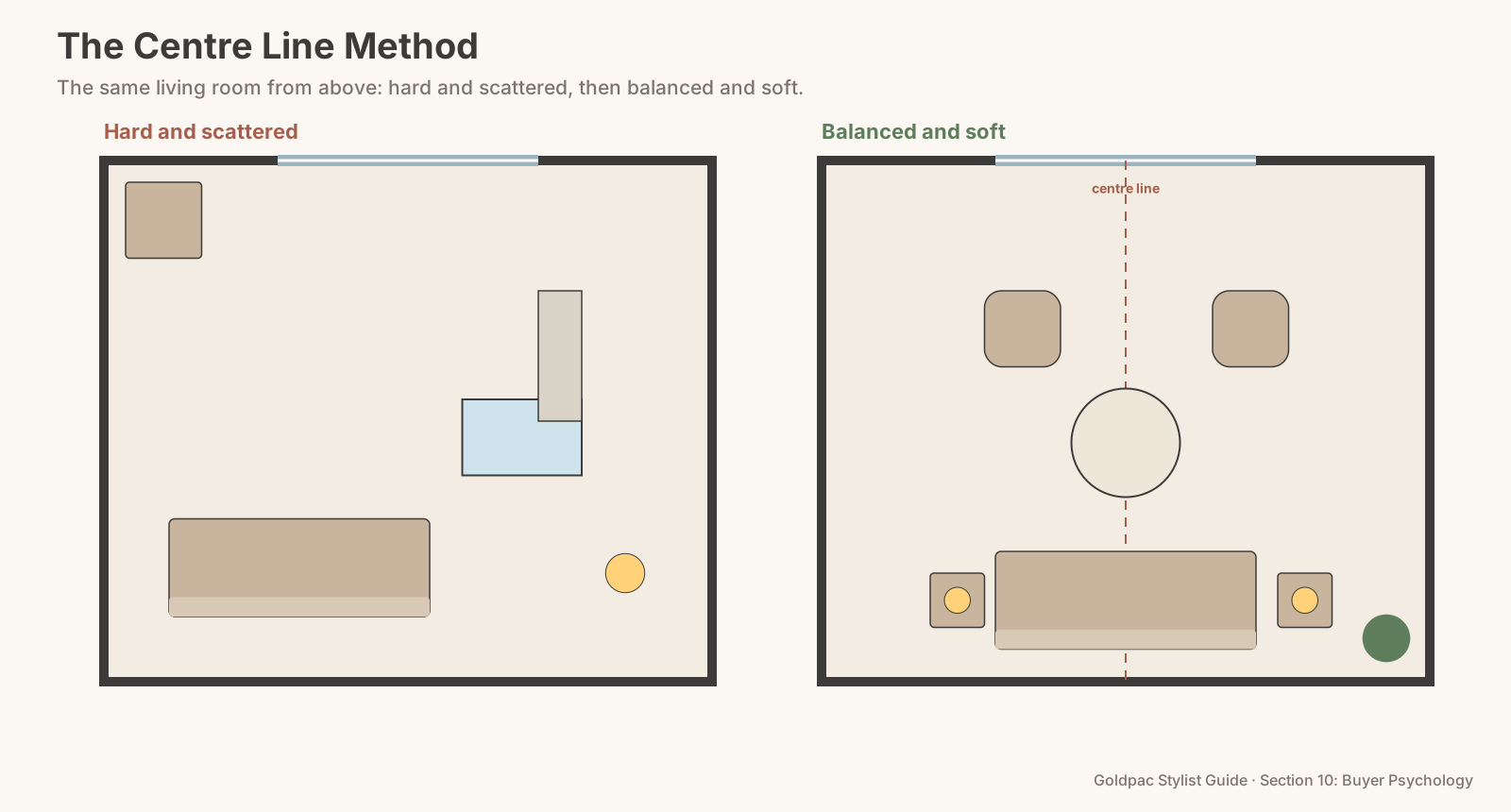
Version A: hard and scattered. A square glass coffee table with sharp corners. One lamp on the left. An armchair pushed into a corner. A rectangular mirror hung off-centre. Cushions in four colours.
Version B: balanced and soft. A round timber coffee table. Matching lamps on matching side tables, either side of the sofa. Two armchairs facing the sofa, set at equal distances. A round mirror centred over the console. Two pairs of cushions in two colours, a wool throw, a leafy plant.
| Hard and scattered | Balanced and soft | |
|---|---|---|
| Where the eye goes | Everywhere at once | To the centre, then the window |
| Edges | Sharp corners at knee height | Rounded table, soft fabrics |
| Pairs | None | Lamps, side tables, chairs, cushions |
| How it feels | Busy, slightly tense | Settled, easy to sit in |
| How it photographs | Lopsided | Ordered, calm |
The verdict: version B. Same room, similar budget. One feels like a waiting room. The other feels like somewhere to stay.
Why balance calms
The eye looks for order.
A centre line gives it one. A sofa centred on a window. A bed centred on a wall. A console centred under a mirror. The eye finds the line in a second and relaxes.
Pairs confirm it. Two lamps. Two bedside tables. Two chairs. Pairs say "this was planned". Planned reads as cared for. (Rule #3 covers symmetry as a layout tool.)
Too much balance can feel stiff. One soft break (a plant to one side, a throw over one arm) keeps the room human.
Why softness calms
Sharp shapes read as a warning. Psychologists Moshe Bar and Maital Neta found that people liked everyday objects with curved contours more than the same objects with sharp, angular ones, and suggested sharp features carry a faint sense of threat (Bar and Neta, Psychological Science, 2006).
In a home, sharp means corners at knee height. Glass tables, angular chairs, hard metal edges. Nothing dangerous. Just a little less inviting.
Soft means round and textured. A round table. A curved armchair. A wool throw. Linen curtains. A round mirror. Leaves.
How do you make a room feel calm for buyers?
Give it one centre line, put pairs either side, and soften the hard edges. That's the whole method. Balance tells the eye where to rest; softness tells the body it can.
The Centre Line Method
- Find each room's centre line. The window, the bed wall, the fireplace, the sofa wall.
- Centre the anchor piece on it. Sofa, bed, console, dining table.
- Add pairs either side: lamps, side tables, chairs, cushions, artworks.
- Swap one or two hard edges for soft ones. Round coffee table, round mirror, upholstered chair.
- Add one deliberate break. A plant, a throw, a basket off to one side.
- Check from the doorway. Can you see the line? Does anything sharp jump out?
The Centre Line Method: one centre line, the anchor piece on it, pairs either side, one or two hard edges made soft, and one deliberate break to keep it human.
"Symmetry is old-fashioned."
Strict, mirror-image symmetry everywhere can be. That's not the point. One centre line per room is enough. Modern rooms use it constantly: the bed between two pendants, the sofa facing the window, the dining table under one light. The rest of the room can be relaxed.
The blind spot: you arrange for use, not for looking
Your lamp is on the left because the power point is on the left. The armchair is in the corner because that's where you read. The glass table came with the apartment.
All sensible. None of it is arranged to be looked at.
Buyers only look. Stand in the doorway and arrange for that.
What if…
The room has no obvious centre. Make one: a rug defines it, and the furniture gathers around the rug.
Everything is built in and angular (a modern kitchen, a glass balustrade). Add softness that moves in: a round bowl, a linen tea towel, a plant, stools with rounded seats.
You can't buy matching pairs. Pair by colour and height instead of exact match. Two different lamps with the same shade colour still read as a pair.
FAQ
Does symmetry help sell a house? It helps rooms feel calm and organised, which makes them easier for buyers to read in photos and at inspections. One centre line per room with pairs either side is usually enough.
Are round coffee tables better for staging? Often, yes. Round tables soften a room, are easier to walk around and photograph well. In small rooms they also save space.
How many matching pairs should a room have? Two or three is plenty: lamps, side tables or chairs. Too many pairs make a room feel stiff.
Calm rooms are built from pairs, centres and soft edges, which is what home staging does. For an empty home, Goldpac stages with our own balanced, soft-edged pieces, so every room settles in the first second: send us the address and a fixed styling quote lands within two hours, through our home staging page. Living there? A Photo Ready Consultation finds each room's centre line and tells you what to move, in a written plan within 48 hours of the visit. See current prices.
Keep reading: Rule #3: Arrange with symmetry for calm and clarity (symmetry as a layout tool) · Rule #262: Minimalism feels trustworthy (the Rule of Small Numbers)
◀ Previous: Rule #264: Keep personal beliefs out of the decor · Section 10 contents · Next: Rule #266: The goal isn't to impress, it's to connect ▶
Part of the Goldpac Stylist Guide: 220+ home staging rules from Goldpac's Sydney styling team.