
Stylist Guide › Section 10: Buyer Psychology › Rule #261
Do people buy homes with their heads or their hearts? Both. In that order: heart first, head second.
The rule in one minute. Most home decisions are made with feelings and then checked with facts. Buyers shortlist the homes that feel right, then use price, size and reports to confirm or veto the choice. So a sale needs both: a home that feels right the moment buyers walk in, and facts that are easy to check once they want it. Stage for the feeling; document for the check.
The myth: "Buyers are rational. Show them the numbers."
It sounds sensible.
A home is the biggest purchase most people make. Surely they compare spreadsheets.
Square metres. Price per square metre. Bedrooms. Distance to the station.
The best value wins.
It feels right because that's how buyers talk. They say "we're looking for three bedrooms under a certain price, near a good school." Nobody says "we're looking for a home that makes us feel calm."
Why it backfires
Buyers don't decide the way they talk.
They walk into ten homes that tick every box. They make offers on one or two.
What separates those one or two? Usually not a number. Something about the light. The kitchen where they could see themselves. The garden where the kids ran straight outside.
Feelings aren't the opposite of good decisions. Neuroscientist Antonio Damasio studied patients whose brain injuries had cut off their emotions while leaving their logic intact. They could list every pro and con. They struggled to choose anything (FutureLearn summary of Damasio's work). Feeling is part of how people decide.
So the facts don't make the choice. They confirm it. Buyers who love a home look for reasons it's a good decision. Buyers who don't love it look for reasons to walk away. The same building report reads very differently to each.
How do emotions affect home buying decisions?
Emotions pick the shortlist; facts confirm the choice. Buyers tend to fall for a home first, then check that the numbers, the reports and the location support the decision. A home that wins the feeling but fails the check loses the buyer. A home that passes the check but never wins the feeling rarely gets an offer at all.
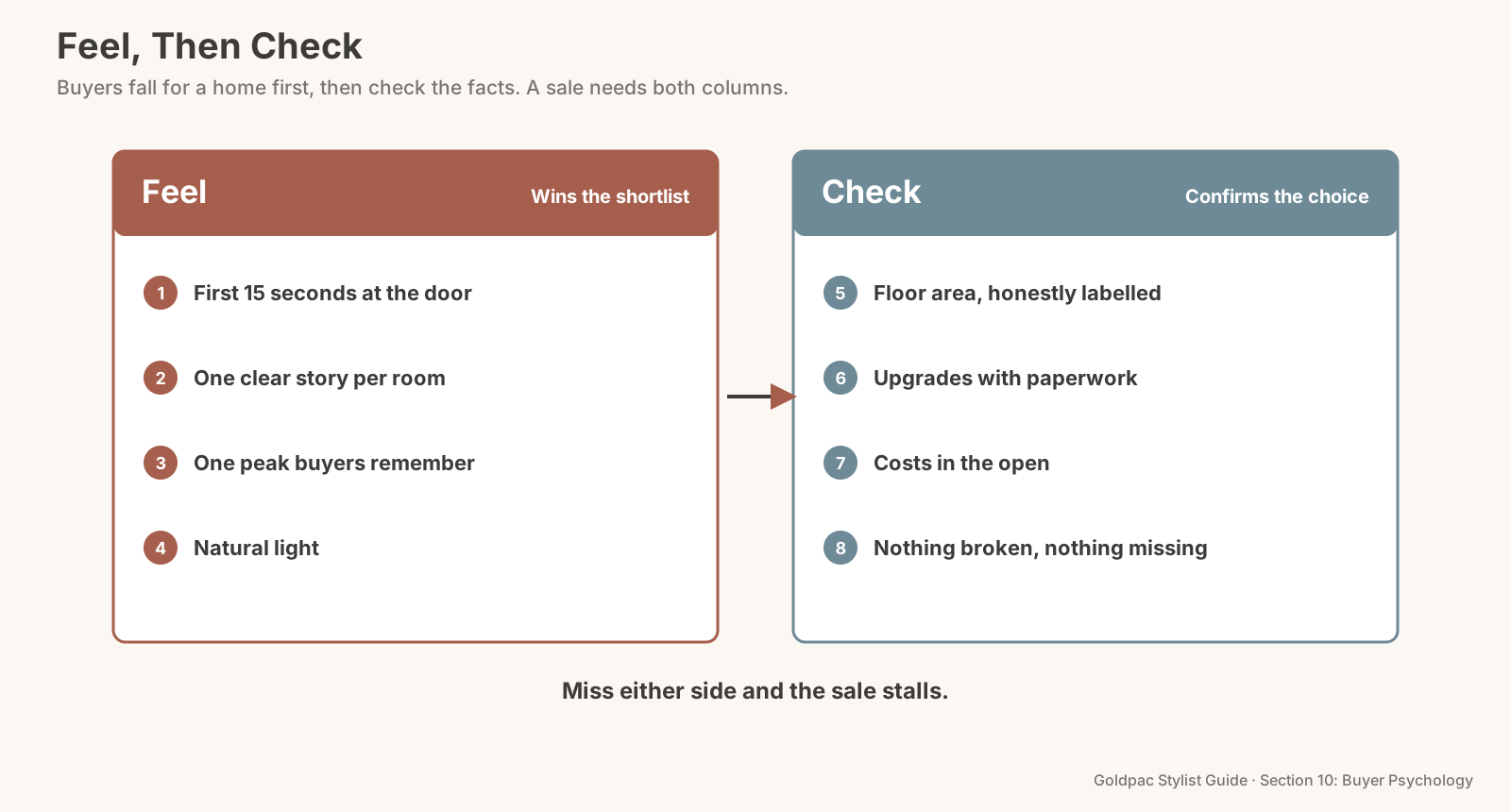
Feel, Then Check
Two jobs. One sale.
The feel side
- Win the first 15 seconds at the door (Rule #247).
- Give every room one clear story (Rule #250).
- Create one peak buyers will remember (Rule #251).
- Let in the light (Rule #252).
The check side
- Floor area, honestly labelled (Rule #243).
- Upgrades with paperwork (Rule #240).
- Costs in the open (Rule #242).
- Nothing broken, nothing missing (Rule #253).
Feel, Then Check: four moves to win the feeling, four to pass the check. Miss either side and the sale stalls.
What it looks like at an open home
Watch buyers who have fallen for a home. They slow down. They open cupboards. They measure. They ask about the strata report, the roof, the neighbours.
That's the check starting. It's a good sign.
Buyers who haven't fallen for it ask nothing. They walk through, thank the agent and leave.
Couples and families decide together
Most homes are bought by more than one person. They rarely fall for the same thing.
One loves the kitchen. One loves the yard. One worries about the commute. One worries about the roof.
Give each of them something to love and something to trust. That's why the feel side and the check side both matter. A styled home gives the household a shared feeling; clear facts give the cautious one their yes.
The blind spot: you sold yourself with feelings too
Remember when you bought this home? You probably had a list. Then you walked in and something happened: the light, the garden, the street. The list came out afterwards, to check you weren't being silly.
You know that feeling. You've just forgotten it applies to your buyers too.
What if…
Your home wins on facts, not feelings. Great value, plain rooms. Then styling matters even more: give buyers a reason to feel something, or the value never gets a second look.
Your home wins on feelings, not facts. Charming but small, or older services. Get the facts ready and honest: measured plans, reports, quotes. Let the feeling carry them past the check.
FAQ
Do buyers make emotional decisions when buying a house? Mostly, yes: buyers tend to fall for a home first and then check that the facts support the decision. Both the feeling and the facts have to hold up for an offer to go ahead.
Feelings choose the home; styling creates the feeling. For an empty home, Goldpac stages with our own furniture so buyers walk into a home they can feel, with facts you've prepared to back it up: send us the address and a fixed styling quote lands within two hours, through our home staging page. Living there? A Photo Ready Consultation covers both sides, room by room, in a written plan within 48 hours of the visit. See current prices.
Keep reading: Rule #251: Buyers remember feelings, not finishes (buyers remember feelings, not finishes) · Rule #247: The first 15 seconds shape the whole impression, so nail the entrance (the first 15 seconds)
◀ Previous: Rule #260: Make it feel ready to move in · Section 10 guide: home staging psychology · Next: Rule #262: Minimalism feels trustworthy ▶
Part of the Goldpac Stylist Guide: 300+ home staging rules from Goldpac's Sydney styling team.