
Stylist Guide › Sections 4 and 5: Accessories and Textiles
What does a styled room have that yours doesn't? Usually, fewer things. Then a few better ones, placed with a reason: one large artwork instead of nine small frames, a throw that echoes the art, a tray where the loose bits used to be, curtains that finally reach the floor. Accessories and textiles are the last 10% of staging, and they're the 10% buyers touch.
The guide in one minute. To style a house for sale, edit first, then layer, group and finish. Clear each surface and keep about three objects; hang one large artwork with its centre at 145–150 cm; layer every bed in three; size rugs so the furniture sits on them; repeat one accent colour three times. Then steam, de-tag and reset before every inspection.
How do you style a house for sale?
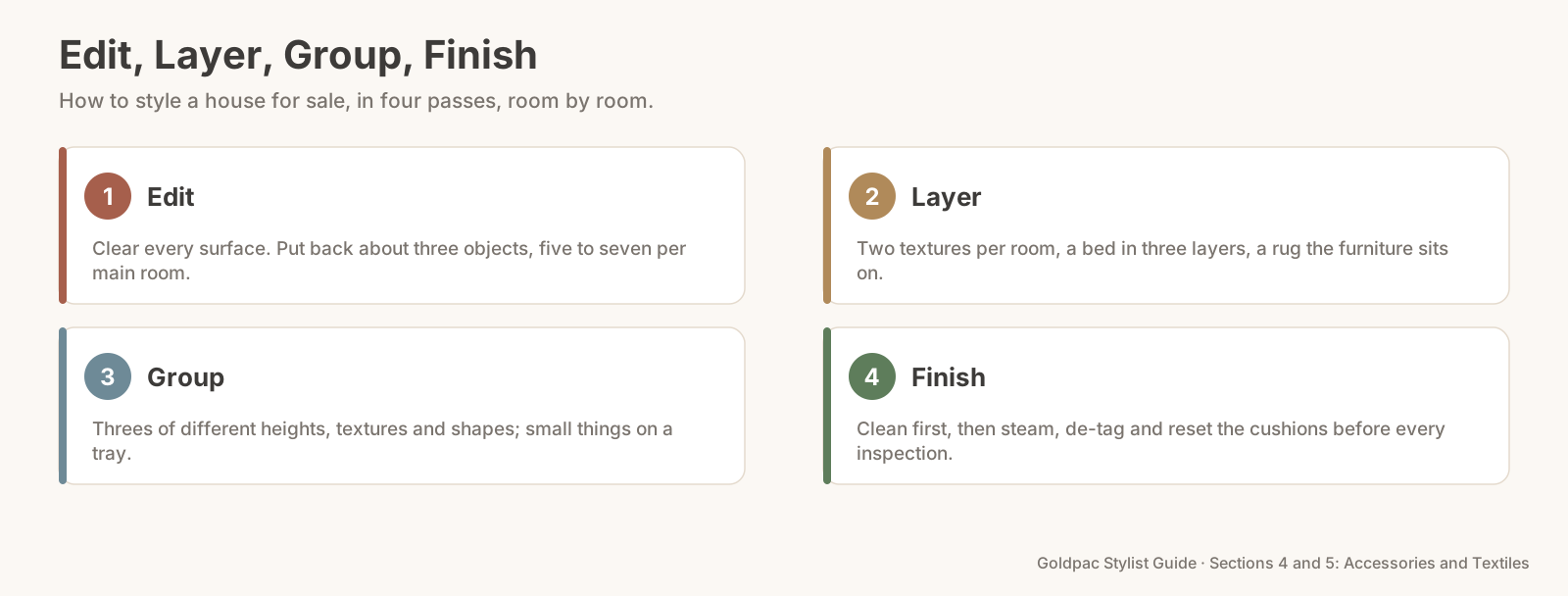
Style it in four passes, in this order: edit, layer, group, finish. Most people start with the fun part, buying new cushions, and end up adding to a room that needed subtracting. Styling for a sale works the other way round. The room gets quieter first, then softer, then more deliberate, then flawless.
Two kinds of evidence sit behind that order. First, clutter is expensive for the eye: in brain-imaging work at Princeton, objects in view at the same time competed for the visual system's limited attention (McMains and Kastner, Journal of Neuroscience, 2011). Fewer objects means each one actually gets seen. Second, softness sells in a very literal way. In four studies on touch and ownership, merely touching an object increased people's feeling that it was theirs, and with it what they'd pay; when touch wasn't possible, imagining ownership did the same, and an unpleasant touch had the opposite effect (Peck and Shu, Journal of Consumer Research, 2009). Buyers run a hand along the throw on the sofa and the quilt on the bed. Make sure what they touch feels good.
The rooms where this matters most are the ones buyers judge hardest. In the NAR's 2025 Profile of Home Staging, buyers' agents named the living room (37%), main bedroom (34%) and kitchen (23%) as the most important rooms to stage. Start there.
Edit, Layer, Group, Finish
The four passes are the method behind all 60 rules in Sections 4 and 5. Do them room by room, living room first.
- Edit. Clear every surface completely, then put back only what earns its place: about three objects per surface and five to seven accessories in a main room (Rule #91). Pack word art, souvenirs, matching sets and anything personal.
- Layer. Give each room at least two textures, one flat and one with depth (Rule #122), dress the bed in three layers (Rule #125) and size the rug so the furniture sits on it (Rule #126).
- Group. Gather what's left into deliberate groups of three: one tall, one medium, one low, in different textures and shapes (Rule #109), on a tray where the items are small (Rule #97).
- Finish. Clean before you style (Rule #148), steam curtains and linen, remove every tag, and reset the cushions before every inspection (Rule #143).
Edit, Layer, Group, Finish: clear each surface to about three objects, layer two textures and a three-part bed, group what's left in threes of different heights, then steam, de-tag and reset before every inspection.
Section 4: accessories and styling, rule by rule
Section 4 has 30 rules. They group into five jobs.
Edit: fewer, larger, calmer
- Rule #91: Use fewer accessories for more impact. About three objects per surface, five to seven in a main room.
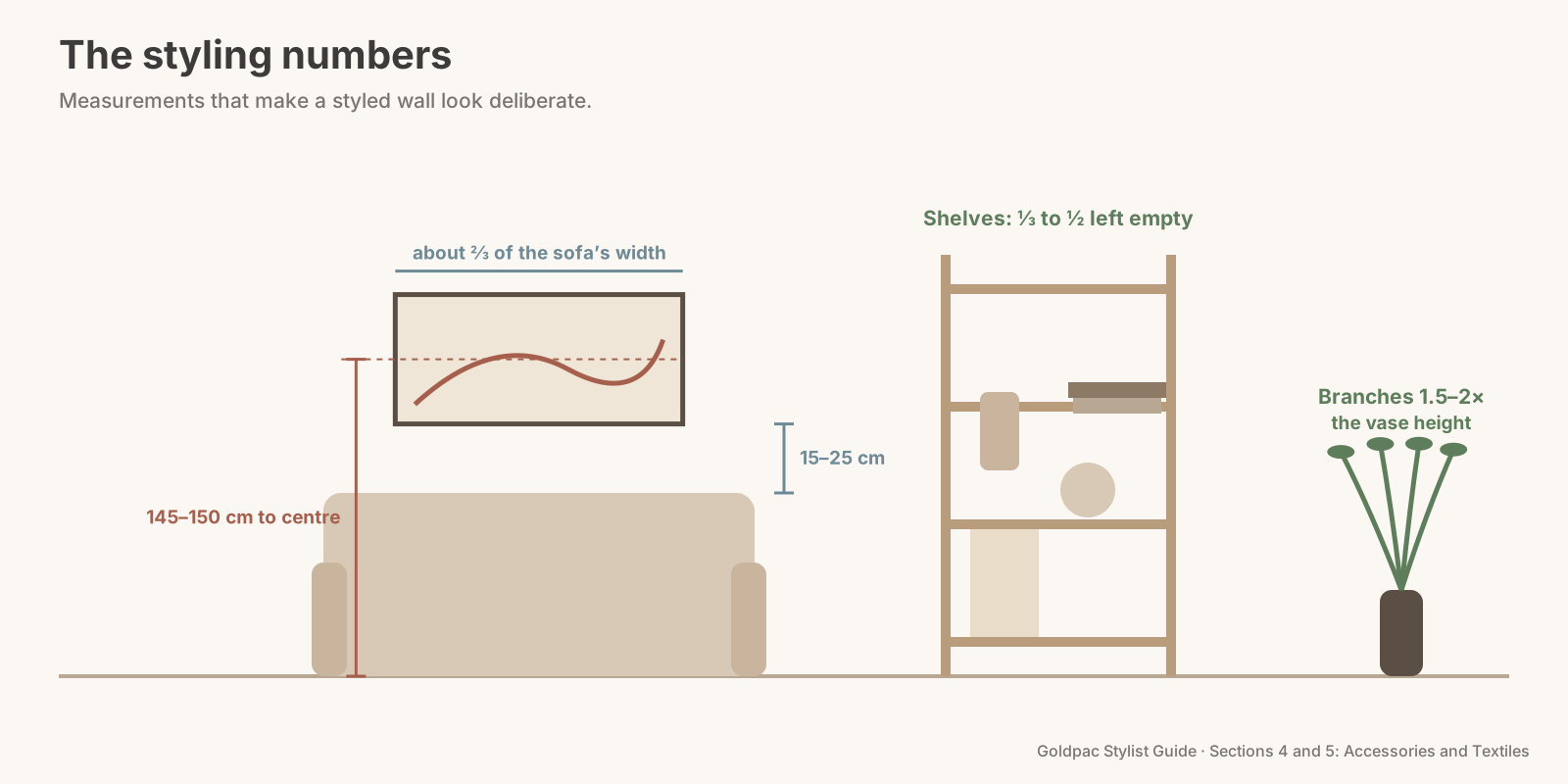
- Rule #96: Leave empty space on shelves. A third to a half of every styled shelf clear.
- Rule #98: Skip decorative lettering and word art. People read text automatically; it pulls the eye off the room.
- Rule #114: Avoid too many matching accessories. One matched pair per room at most.
- Rule #116: Keep travel souvenirs and cultural pieces to one. Neutral only, and packed with care for the next home.
- Rule #108: One neutral personal touch is enough. A hardcover on the bedside, a straw hat by the back door.
- Rule #93: Style with neutral or design-themed books. Books are read at inspections; choose calm covers.
Art and mirrors
- Rule #92: Choose one large artwork over a gallery wall. About two-thirds the width of the furniture below.
- Rule #103: Hang artwork at eye level. Centre at about 145 to 150 cm on an open wall, 15 to 25 cm above furniture.
- Rule #99: Choose art by colour palette, not theme. Repeat two or three colours already in the room.
- Rule #107: Let the artwork echo the textiles. One accent from the art in two textiles, at least 1.5 m apart.
- Rule #118: Match frame finishes across a room. Sizes can vary; the finish shouldn't.
- Rule #112: Use a mirror as the statement on a narrow wall. Half to two-thirds of the wall's width; check what it reflects.
Groupings that look chosen
- Rule #109: Mix height, texture and shape in every grouping. One tall, one medium, one low; smooth, rough and soft.
- Rule #100: Vary heights in decorative groupings. The tallest about twice the height of the shortest.
- Rule #101: Bowls, vases and candles: the reliable styling set. Three to four of each, in two or three sizes, style a whole home.
- Rule #97: Use trays to gather small items. One tray per surface, two or three items.
- Rule #102: Use a tray to style the coffee table. A third to a half of the tabletop, three things on it.
- Rule #117: Ground small decor so it doesn't look scattered. Nothing under about 15 cm stands alone.
- Rule #113: Angle decor to create movement. Turn one object per grouping 10 to 15 degrees.
- Rule #119: Stack books by tone and size. Two to four books, largest at the bottom, dust jackets off.
- Rule #110: Give the kitchen bench one focal piece. One statement on the island; the back benches stay clear.
Greenery, branches and scent
- Rule #95: Greenery must be real or convincingly realistic. Real, or premium faux that passes a close look from 30 cm in daylight.
- Rule #104: Use plants to add height. One tall plant, its top at about two-thirds of the ceiling height.
- Rule #120: Choose tall branches over small flowers. Branches rising 1.5 to 2 times the vase's height.
- Rule #111: Use scented candles sparingly. Unscented, unlit at inspections.
Finishes and the long campaign
- Rule #106: Stick to one metal finish per room. Let the fittings you can't change choose it.
- Rule #115: Use clear glass accessories in small spaces. Glass styles a surface without blocking light.
- Rule #105: Rotate accessories through a long campaign. Season-free photos, then three small swaps every couple of weeks.
- Rule #94: Style cushions in coordinated, odd-numbered groups. Three on a three-seater, five on a large modular.
How do you use textiles when staging a home?
Use textiles to add softness, depth and finish, never pattern and noise. Two textures per room, plain bedding in three layers, rugs big enough for the furniture, curtains that reach the floor, and everything pressed. Textiles are the largest soft surfaces in most photos, so a single wrong one, such as a shiny bedspread or a short curtain, can take over a whole room.
Plants follow the same logic of "some, not everywhere". In a 2025 study, 304 adults rated images of living rooms and bedrooms: rooms with greenery were rated as more restorative and more positive than rooms without it, but plants built into the furniture made rooms feel more chaotic and less coherent than simple potted greenery (Bellini et al., Frontiers in Psychology, 2025). For a sale, that's one or two good plants in pots, not a jungle.
Section 5: textiles, rule by rule
Section 5 has 30 rules. They group into five jobs.
Windows
- Rule #121: Hang curtains all the way to the floor. Rod 10 to 15 cm above the frame, hem within 1 cm of the floor.
- Rule #128: Match curtains and blinds to the wall colour. Within a shade or two, so the window looks bigger.
- Rule #132: Line sheer curtains or pair them with blinds. Soft light by day, privacy by night.
- Rule #133: Use blackout blinds in bedrooms, open for the photos. A selling point the agent should mention.
- Rule #146: Steam curtains before the photo shoot. The day before, top to bottom, then let them settle.
- Rule #145: Replace lace curtains unless the home is period style. Restrained lace can suit a Federation or Victorian home.
Beds
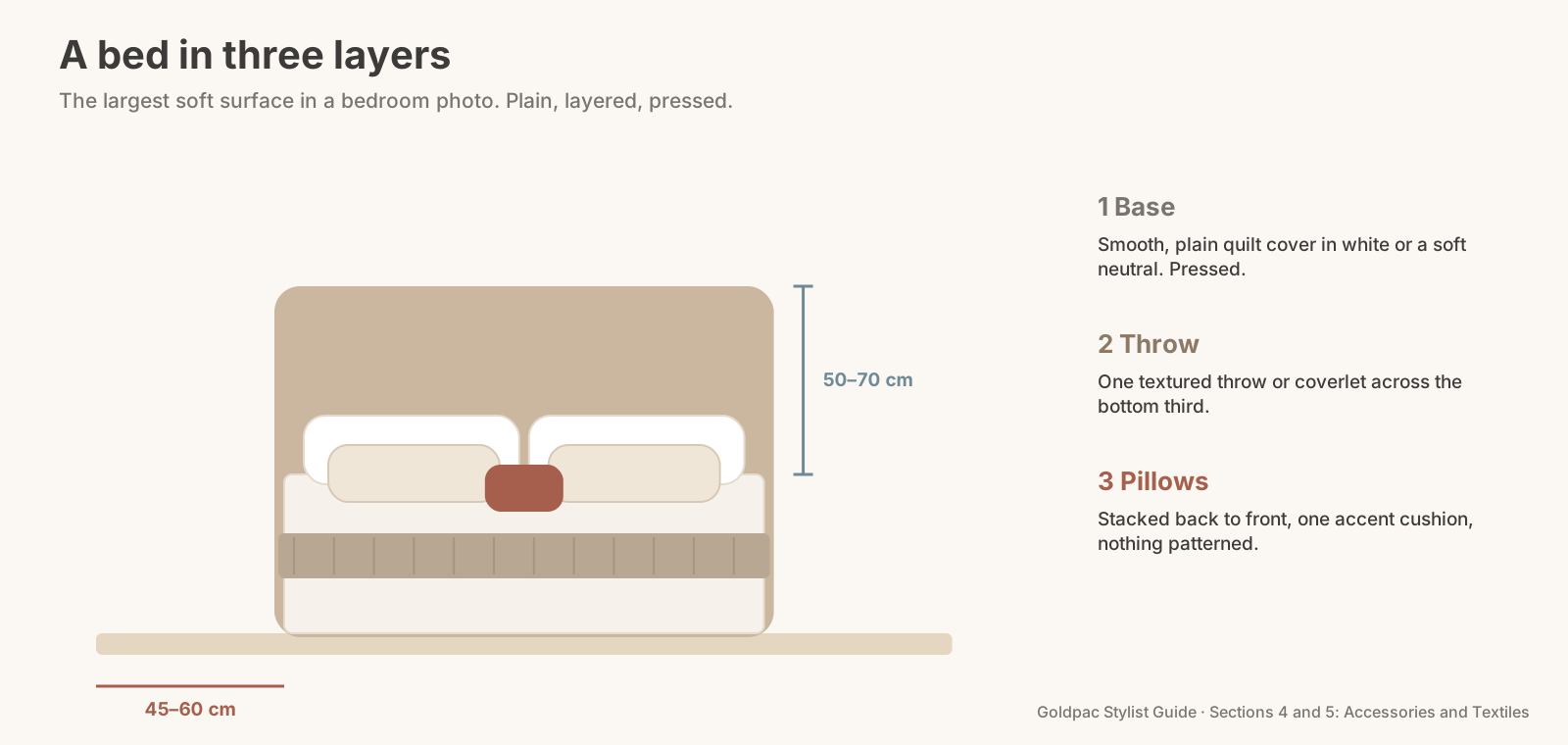
- Rule #125: Layer the bed: quilt, pillows and one throw. Three layers give depth; one reads as a slab.
- Rule #129: Choose plain bedding, never patterned or branded. Texture is fine; pattern and logos are not.
- Rule #138: Choose neutral bed covers over coloured ones. Colour in one cushion or one throw.
- Rule #134: Keep bed linen crisp and pressed. Wash two days ahead; a spare pressed set per bed.
- Rule #144: Choose an upholstered headboard for the main bedroom. About 50 to 70 cm above the mattress.
- Rule #142: Make the bed valance sit straight and even. Hem within 1 cm of the floor, or no valance at all.
Sofas and living rooms
- Rule #122: Mix at least two textures in every room. Velvet with linen, cotton with wool.
- Rule #124: Choose cushions with full, generous inserts. An insert about 5 cm bigger than the cover.
- Rule #143: Reset cushions so they never slump. About 30 seconds per sofa before every inspection.
- Rule #130: Anchor a room with one statement throw. One throw; three look like a laundry pile.
- Rule #150: Pair knitted textures with smooth surfaces. One knit per room, on the smoothest surface.
- Rule #149: Use velvet sparingly, as an accent. About one velvet piece per room.
- Rule #141: Choose double-sided throws for quick changes. A lighter side for summer, a warmer side for winter.
- Rule #123: Skip shiny polyester and obvious synthetics. If it shines like plastic in window light, it goes.
- Rule #136: Skip fringe and tassel-heavy textiles. A short, simple fringe on one throw is fine.
- Rule #137: Add floor cushions only in casual living zones. Two large ones, 60 to 80 cm, in a rumpus or reading nook.
Rugs
- Rule #126: Size the rug so the furniture sits on it. Under a dining table, 60 to 70 cm past the edges.
- Rule #131: Layer rugs only when the room is big enough. 30 to 50 cm of the base showing on every side.
- Rule #139: Contrast the rug's texture with the furniture. A smooth sofa wants a textured rug, and the reverse.
Bathrooms, dining and the clean-first rule
- Rule #127: Choose plump white towels, neatly folded. One bath towel and one hand towel, folded in thirds.
- Rule #135: Match the towels in every bathroom. Same colour, same fold, same count.
- Rule #147: Keep bath mats out of the photos, matched for inspections. One plain mat over the bath edge if the family needs it.
- Rule #140: Dress the dining table with fabric napkins. Two or four places, not a banquet.
- Rule #148: Clean every surface before styling textiles. Dust from the top down, vacuum, wipe, then lay out the fabric.
Real Sydney campaigns: the last 10% at work
These are Goldpac jobs published in Real Results. Each shows one of the four passes doing the heavy lifting.
Earlwood: the agent asked for less
For a freshly renovated semi on Ann Street, the brief was one word. The long wall of new white storage got one framed abstract in terracotta and ochre and a short, low run of objects: a stacked ceramic, a black wire bowl, two books, a trailing plant, a black vase of bare branches. Most of the storage was left bare, because it reads bigger empty. That's the edit pass at full strength (Rule #91, Rule #96).
Little Bay and Maroubra: one big piece, one tight group
In a double-height Little Bay living room, one large artwork, a pale lattice of white strokes, picks up the grid of the steel window frame across the room, and the console below holds two white vases with dried stems, a black sculptural piece, a low bowl and a couple of books (Rule #92, Rule #101). In Maroubra, a low oak console carries a loose group of ceramics and a tall vase of bare branches under a large abstract that ties the palette together (Rule #120).
Ultimo: a library wall that reads as capacity
Two walls of built-in shelving in an Ultimo loft were a gift and a risk: full, they read as clutter and someone else's books; empty, as a storage unit. The stylist spaced a handful of art books, black ceramics, a brass sculpture and small plants mostly at eye level and left the rest open, so the wall now reads as room for your things (Rule #96, Rule #93).
Kurraba Point and Toongabbie: textiles that do the explaining
In a Kurraba Point studio, the carpet and ceiling were staying, so the palette was built to belong to them: cream, ochre and rust cushions, a rust-striped runner across a white textured quilt, warm timber bedsides with pleated lamps. Finishes that could have read tired read warm, and the studio sold in 14 days against a 39-day suburb unit median. In a Toongabbie family home, the smallest bedroom's bed went centred under the wall air conditioner rather than pushed to a side wall, with two narrow bedside tables, white ceramic lamps, a sage and white waffle cover and a striped runner at the foot (Rule #125).
Chatswood and Ultimo: echoes that tie rooms together
In a Chatswood one-bedroom, a blue-check throw on the bed ties the bedroom back to the living area, and matching ribbed ceramics at the basin pick up the canisters by the cooktop (Rule #107). In an Ultimo penthouse, navy velvet cushions on white linen pick up the blue outside the windows, so room and view read as one palette (Rule #149).
North Parramatta: three bedrooms, three palettes
Three bedrooms with the same tile, white walls and ceiling fan blur together in a listing. In a North Parramatta townhouse, each got its own textile story: one in blues with a quilted coverlet and a studded linen headboard, one in sand and rust with oatmeal linen and a waffle-knit throw, one in sand and stone. Nobody scrolling the photos mistakes one bedroom for another.
Gordon: real, because of the light
On a Gordon install, the stylist swapped the dining centrepiece three times before landing on real grapes, because in that north light the green read cooler against the marble than any faux stem did. Premium faux greenery works for most of a campaign (Rule #95); the fruit bowl is where real usually wins.
What does the research say, and where does it stop?
| Finding | Source | What it means for staging |
|---|---|---|
| Objects in view compete for attention | McMains and Kastner, 2011 | Edit first; fewer objects get seen |
| Touching an object increases the feeling of owning it; unpleasant touch lowers value | Peck and Shu, 2009 | Soft, clean, pleasant textiles where hands go |
| Greenery made rooms feel more restorative; built-in greenery felt more chaotic than potted | Bellini et al., 2025 | One or two potted plants per room |
| Living room 37%, main bedroom 34%, kitchen 23% named most important to stage | NAR, 2025 | Style these three first |
| Gallery hanging height: centre at about 145 cm, 15–25 cm above furniture | Olive et Oriel | Art at eye level, not near the ceiling |
The research on accessories is thinner than on light or layout, and most of it comes from shops, offices and labs. That's why these rules lean on measurements you can check with a tape: centimetres, counts and gaps.
If you only have one weekend, which rules matter most?
Saturday: edit and layer
- Clear every surface in the living room, main bedroom and kitchen, and put back about three things each (Rule #91).
- Take down word art, small frames and souvenirs (Rule #98, Rule #116).
- Plain white or neutral bedding in three layers on every bed (Rule #125, Rule #129).
- White towels, matched, folded in thirds (Rule #127).
Sunday: group and finish
- One tray on the coffee table and one on the bathroom vanity (Rule #102, Rule #97).
- One tall plant or branch arrangement in the living room (Rule #104, Rule #120).
- Clean, then steam the curtains and press the pillowcases (Rule #148, Rule #146, Rule #134).
- Cut every tag and reset every cushion (Rule #200, Rule #143).
The blind spot: everything on your shelves has a story
The objects in your home aren't decor to you. The bowl is from your honeymoon, the frame holds your daughter's first drawing, the cushions were a gift from your mother. That's exactly why editing your own home is so hard: every object comes with a reason to stay, and none of those reasons are visible to a buyer.
A buyer sees only the object, and only for a second. A shelf of meaningful things reads to them as a full shelf. The kindest way through is to pack, not to discard: one box per room, labelled, treated as the first boxes for your next home. Edited rooms are calmer to live in during the campaign too.
If you can't decide what stays, ask someone who's never been inside to choose three things per surface. See Rule #267: You can't see your own home: get a fresh pair of eyes.
What if the rules don't fit your situation?
You're living in the home with kids. Keep the edit to the photo rooms, and set up a lidded tub per room for the daily reset. The full lived-in system is in Selling Your House While Living in It.
You have pets. Choose throws and cushions you can wash and keep on rotation, and keep pet beds and blankets out of the photo rooms (Rule #202).
You have no accessories at all. Buy fewer, larger pieces in neutral ceramic, glass, timber and linen. Three bowls, three vases and a few candles style a whole home (Rule #101).
The campaign is long. Shoot season-free, then rotate the throw, the flowers and the fruit every couple of weeks (Rule #105).
The home is empty. Accessories without furniture look lost. Empty homes need furniture, textiles and styling together, which is the job of full or partial home staging.
FAQ
How many decor items should be in a room when staging? About three objects per surface and five to seven accessories in a main living room, with a third to a half of every shelf left clear. Fewer, larger pieces read as designed; many small ones read as clutter.
Should I buy new bedding and towels to sell my house? Often, yes, if yours are patterned, coloured or tired. Plain white or soft neutral bedding in three layers, and plump white towels matched across every bathroom, photograph as fresh and well kept.
Are fake plants OK for home staging? Premium faux greenery is fine if it passes a close look from 30 cm in daylight, and it stays perfect for the whole campaign. Cheap, dusty or plastic-looking fakes, and fake fruit, should go.
The last 10% of styling is the hardest to do in your own home, because every object has a story. With Photo Ready Styling, our stylist styles your home with your own furniture before the photos. Or start with a Photo Ready Consultation: a stylist walks your home and leaves a written room-by-room plan within 48 hours of the visit. For an empty home or an agent listing, Goldpac stages it with our own furniture and textiles: send us the address and a fixed styling quote lands within two hours, through our home staging page. See current prices · Real Results
Keep reading: Best Colours and Lighting to Sell a House (Sections 2 and 3) · Home Staging Psychology: How Buyers Decide (Sections 6, 7 and 10) · Furniture Placement for Home Staging (Section 1)
◀ Stylist Guide home · Start the section: Rule #91: Use fewer accessories for more impact ▶
Part of the Goldpac Stylist Guide: 300+ home staging rules from Goldpac's Sydney styling team.