
Stylist Guide › Section 4: Accessories & Styling › Rule #116
"That mask is from our honeymoon in Bali. It has to go?"
"Into a box for now. The ceramic bowl from the same trip can stay."
"What's the difference?"
"The bowl could belong to anyone. The mask belongs to you."
The rule in one minute. Keep travel souvenirs and cultural pieces to one, and only if it's neutral: a handmade bowl, a woven basket, a plain textile with no symbols, words or flags. Masks, carved figures, flags, religious symbols and collections of souvenirs tell buyers whose home this is. Pack them carefully for the campaign; they'll come back out in your next home.
Two ways to style the same bookshelf
| The travel shelf | The one-souvenir shelf | |
|---|---|---|
| What's on it | A carved mask, two elephant figures, a pennant, a carved head, a snow globe, a row of shot glasses, a plate from Santorini | A large handmade ceramic bowl, books by tone, one plant, plenty of empty shelf |
| What it says | "We travel, and this is our life" | "Someone with taste lives here" |
| What buyers do | Look at the objects and the owners' story | Look at the shelf and imagine their own things |
| In the photo | Busy, colourful, personal | Calm, warm, neutral |
Verdict: the second shelf, every time. The first is a lovely record of a life, which is exactly why it should come with you rather than stay for the sale.
Why souvenirs and cultural pieces get packed
- They're stories, and buyers want room for their own. A souvenir points to a specific trip by specific people. Buyers start looking at your life instead of picturing theirs.
- Collections read as clutter. Ten small objects from ten places, however meaningful, become a crowd of small things in a listing photo (Rule #91 covers fewer, larger accessories).
- Symbols carry meaning for buyers too. Religious, cultural and national symbols can mean very different things to different people. A home for sale works best when it doesn't ask any buyer to agree with anything (Rule #264 covers keeping personal beliefs out of the decor).
- It's about the sale, not the culture. This isn't a judgement on anyone's heritage or faith. The same rule applies to a footy jersey, a family crest or a framed flag from any country.
Should you remove religious and cultural items when selling a house?
Yes, pack religious symbols, cultural artefacts, flags and souvenir collections for the campaign, and keep at most one neutral piece, such as a handmade bowl, a woven basket or a plain textile with no symbols or words, so the home feels warm without telling buyers who lives there. Pack them with care, labelled, and unpack them first in the new home.
The One-Souvenir Rule
- Gather everything from travels and heritage that's on display: masks, figures, plates, flags, prints, magnets, collections, religious items.
- Pack anything with a face, a symbol, a word or a flag. These belong to your story.
- Pack every collection. Shot glasses, snow globes, spoons, ornaments: a collection is personal by definition.
- Choose one neutral piece for the whole home, or one per main room at most: a handmade ceramic bowl, a woven basket, a plain linen or kilim-style textile without symbols.
- Give it room. One beautiful object on a shelf or console, with space around it, looks deliberate.
- Ask the buyer test: could this object belong to anyone who walks in? If yes, it stays (Rule #108 covers one neutral personal touch).
The One-Souvenir Rule: pack every souvenir with a face, symbol, word or flag, pack every collection, and keep one neutral handmade piece per main room at most, with space around it.
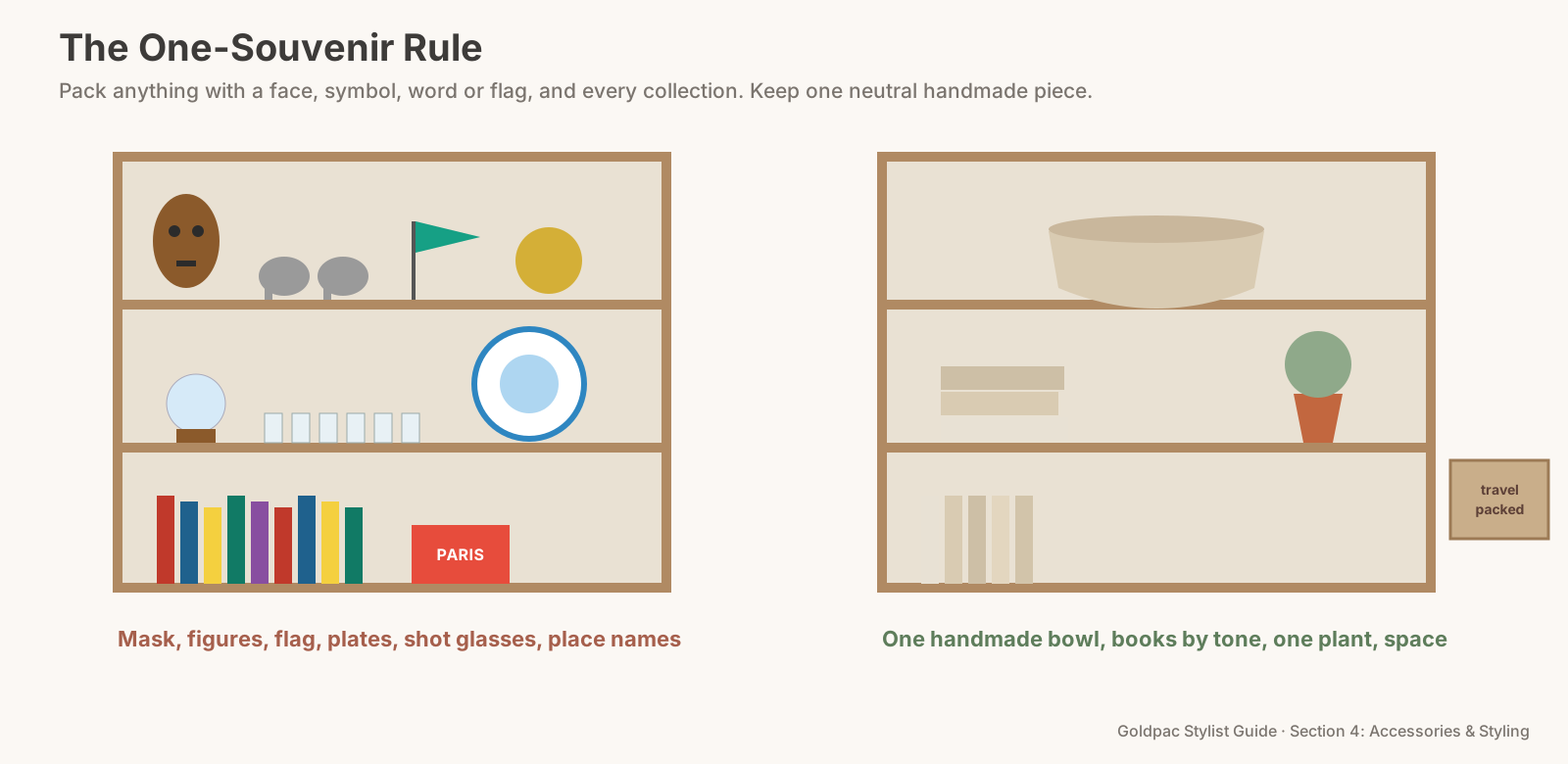
What stays and what goes
- Goes: masks, carved figures, idols and religious statues, flags, maps with pins, souvenir plates, fridge magnets, snow globes, shot glasses, framed tickets, place-name signs.
- Can stay, one only: a handmade bowl, a woven basket, a plain rug or throw with no symbols, a simple carved timber board, a ceramic vase without text or imagery.
- Always goes: anything with words, slogans or place names, which buyers read before anything else (Rule #98 covers decorative lettering).
What to say at home
Souvenirs and cultural pieces often matter most to older family members or to the person who brought them home. A respectful conversation helps.
Script block "These are going in the special box, not the storage box. We'll wrap them properly and they'll be the first things we unpack. For the next few weeks, the house needs to feel like it could be anyone's, so the buyers can picture themselves here. Which one piece would you like to stay out?"
Let them choose the one piece. It's easier to pack ten things when you've chosen the one that stays.
Packing them properly
Treat this box differently from the rest. Souvenirs and heritage pieces are often fragile and impossible to replace. Wrap each piece separately in tissue or a soft cloth, then bubble wrap for anything carved or ceramic.
Label by person, not by room. "Mum's pieces", "the Bali box". It makes unpacking feel like a homecoming rather than a chore.
Keep the box somewhere dry and safe, not in a garage that floods or a hot roof space. Textiles and timber carvings can be damaged by heat and damp over a long campaign.
Photograph the display before you pack it. If you loved how the shelf looked, you can recreate it exactly in the new home.
The blind spot: these objects are part of the furniture
Souvenirs settle in. The mask has hung by the front door for twelve years. The elephants have always been on the bookshelf. You no longer see them as objects; they're part of the house.
To a buyer, they're the first things they notice, because they're unusual. Walk through each photographed room and list every object from a trip or with a cultural or religious meaning. The list is usually longer than people expect.
What if…
The home itself has a cultural design feature, like a built-in shrine niche or a feature screen. Leave the architecture; style the niche with a plant or a simple vase rather than leaving it empty or keeping religious items in it.
A family member isn't comfortable packing a religious item. Leave it in their own room and plan the photos around that room with the agent. Respect matters more than perfect styling.
You collect art from your travels. Framed art is different from souvenirs when it's neutral: a landscape, an abstract or a botanical print can stay, as long as it has no text, flags or recognisable landmarks with names. Choose by colour, not by memory (Rule #99 covers choosing art by colour palette).
It's a tenanted sale. Ask the agent to raise it with the tenant gently. You can't require it, but many tenants are happy to help with the photographed rooms when asked early.
FAQ
Should I remove religious items before an open home? Yes, from the shared and photographed rooms. Pack them carefully for the campaign, or keep them in a private room that won't be photographed.
Can I keep one souvenir on display? Yes, if it's neutral: a handmade bowl, a basket or a plain textile with no faces, symbols, words or flags.
One beautiful object can stay; the story comes with you. Rather have someone help choose? With Photo Ready Styling, our stylist styles your home with your own furniture and accessories before the photos. For empty homes and agent listings, Goldpac stages with our own neutral furniture and accessories: send us the address and a fixed styling quote lands within two hours, through our home staging page. See current prices.
Keep reading: Rule #264: Keep personal beliefs out of the decor (keeping personal beliefs out of the decor) · Rule #108: One neutral personal touch is enough (one neutral personal touch)
◀ Previous: Rule #115: Use clear glass accessories in small spaces · Section 4 contents · Next: Rule #117: Ground small decor so it doesn't look scattered ▶
Part of the Goldpac Stylist Guide: 220+ home staging rules from Goldpac's Sydney styling team.