
Stylist Guide › Section 4: Accessories & Styling › Rule #115
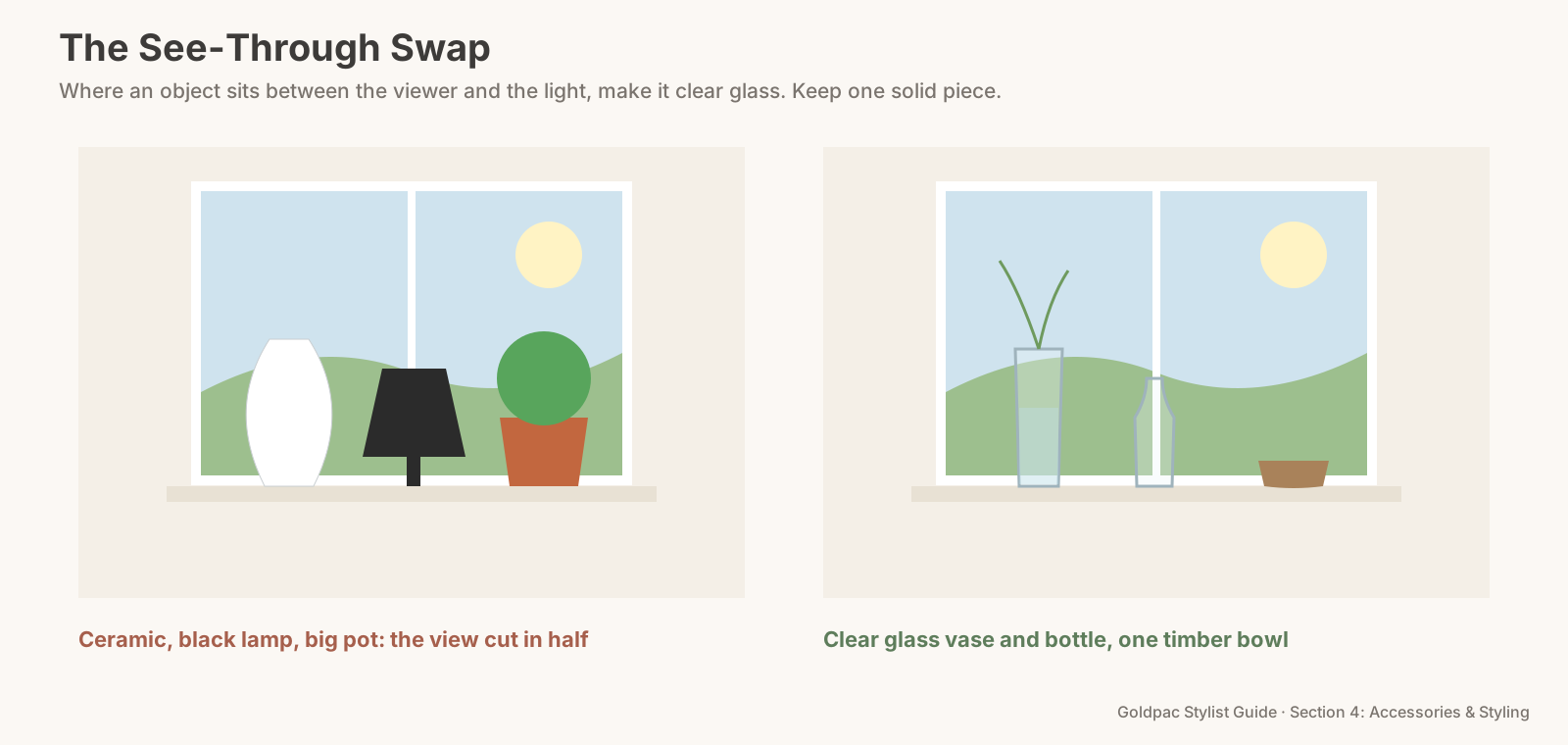
A studio apartment, 35 square metres. On the windowsill: a chunky white ceramic vase, a black lamp and a terracotta pot. Three nice things, and together they cut the view in half.
The rule in one minute. Use transparent accessories in small spaces. A clear glass vase, bottle or lamp base styles a surface without blocking light or sightlines, so a small room keeps its depth. Use glass in front of windows, on narrow surfaces and in the main line of sight, and keep it spotless.
Why glass works in small rooms
Small rooms are judged on how far you can see. In a compact unit, a bathroom or a narrow entry, the eye measures the space by how far it travels before something stops it. Every solid object in the way shortens that distance.
Clear objects don't stop the eye. A glass vase in front of a window lets the light and the view through. A ceramic one of the same size blocks both. The room feels a little deeper, even though nothing has moved.
Glass catches light. A clear vase with water and a few stems sparkles in daylight. In photos, it adds brightness to the very spot where a solid object would add a dark shape.
It keeps decor without adding weight. Small spaces still need some styling, or they feel bare. Transparent pieces let you style the surface while keeping its visual weight close to zero.
What accessories make a small room look bigger?
Clear glass accessories (vases, bottles, carafes, lamp bases and small trays) placed in front of windows and along the main sightlines make a small room look bigger, because they add decor without blocking light or depth. Pair them with one or two solid pieces elsewhere so the room doesn't look sparse, and keep every glass surface clean and smear-free.
The See-Through Swap
The rule is simple: where an object sits between the viewer and the light, make it clear.
Start at the windows. Any vase, pot or ornament on a windowsill or on a surface in front of a window gets swapped for glass, or removed.
Then the sightlines. Stand in the doorway of each small room and look at the far wall. Anything solid standing in that view, on a console, a kitchen bench or a bathroom shelf, is a candidate for glass.
Then the narrow surfaces. Bathroom vanities, slim hall tables and bedside shelves in small bedrooms. A clear bottle or bud vase keeps them styled without making them look crowded.
Keep one or two solid pieces. A room made entirely of glass looks like a shop window. A timber bowl or a stack of books gives the eye something to rest on (Rule #109 covers mixing height, texture and shape).
The See-Through Swap: in every small room, swap the solid accessories that sit in front of a window or in the main line of sight for clear glass, keep one or two solid pieces to rest the eye, and keep every piece of glass spotless.
Mistake and fix
Mistake: coloured or frosted glass in a small room. Fix: clear only. Tinted and frosted glass read as solid objects in photos.
Mistake: cloudy water and a green line inside the vase. Fix: fresh water before every inspection, and wash the vase weekly. Clear glass shows everything (Rule #178 covers keeping greenery real and fresh).
Mistake: ten small glass bottles along a windowsill. Fix: one or two larger pieces. Many small glass objects sparkle like clutter.
Mistake: fingerprints on a glass lamp base. Fix: wipe glass with a lint-free cloth on photo day and before each inspection.
Check it through your phone
Take a photo of the small room from its doorway, the way the photographer will. Look at the window area in the photo. Can you see through the objects on the sill to the view? Look at the glass pieces: any smear, fingerprint or water line shows up clearly in a sharp listing photo, often more than it does in person.
"Won't glass look cheap?"
Not if it's simple and heavy. Thick, plain glass in classic shapes (a cylinder, a bottle, a carafe) looks considered. Thin, ornate or novelty glass looks cheap in any room.
And not if it's clean. Glass looks expensive when it sparkles and cheap when it's dull. A minute with a cloth before each inspection does more than any upgrade.
The blind spot: you stopped seeing the windowsill
Windowsills collect things. A plant that needed sun, a vase someone gave you, a candle that was in the way somewhere else. Over months, the sill becomes a shelf, and you stop noticing that it blocks the view.
Buyers in a small home look straight at the windows, because the light and the view are what the space has to offer. Clear the sill first, then put back only what lets the light through.
What if…
The small space is a bathroom with no window. Glass still helps: a clear soap bottle and a glass tumbler keep the vanity light. Pair them with one white towel and a small green stem.
You have small children or a dog with a busy tail. Use heavy glass that won't tip easily, keep it back from edges, or use clear acrylic for the lowest surfaces.
FAQ
Do glass accessories make a room look bigger? They can, because they add styling without blocking light or sightlines. Use them in front of windows and along the main view.
What should go on a windowsill when selling? Very little: one clear glass vase or bottle with a few fresh stems, or nothing at all.
Is clear acrylic as good as glass? For low or high-traffic surfaces, yes, if it's clear and unscratched. Glass reads as better quality on display surfaces.
Clear objects let a small room show its depth. Rather have someone decide what stays on the sill? With Photo Ready Styling, our stylist styles your home with your own furniture and accessories before the photos, small rooms included. For empty homes and agent listings, Goldpac stages with our own furniture and accessories: send us the address and a fixed styling quote lands within two hours, through our home staging page. See current prices.
Keep reading: Rule #96: Leave empty space on shelves (leaving empty space on shelves) · Rule #68: Use mirrors to double the light (using mirrors to double the light)
◀ Previous: Rule #114: Avoid too many matching accessories · Section 4 contents · Next: Rule #116: Keep travel souvenirs and cultural pieces to one ▶
Part of the Goldpac Stylist Guide: 300+ home staging rules from Goldpac's Sydney styling team.