
Stylist Guide › Section 4: Accessories & Styling › Rule #109
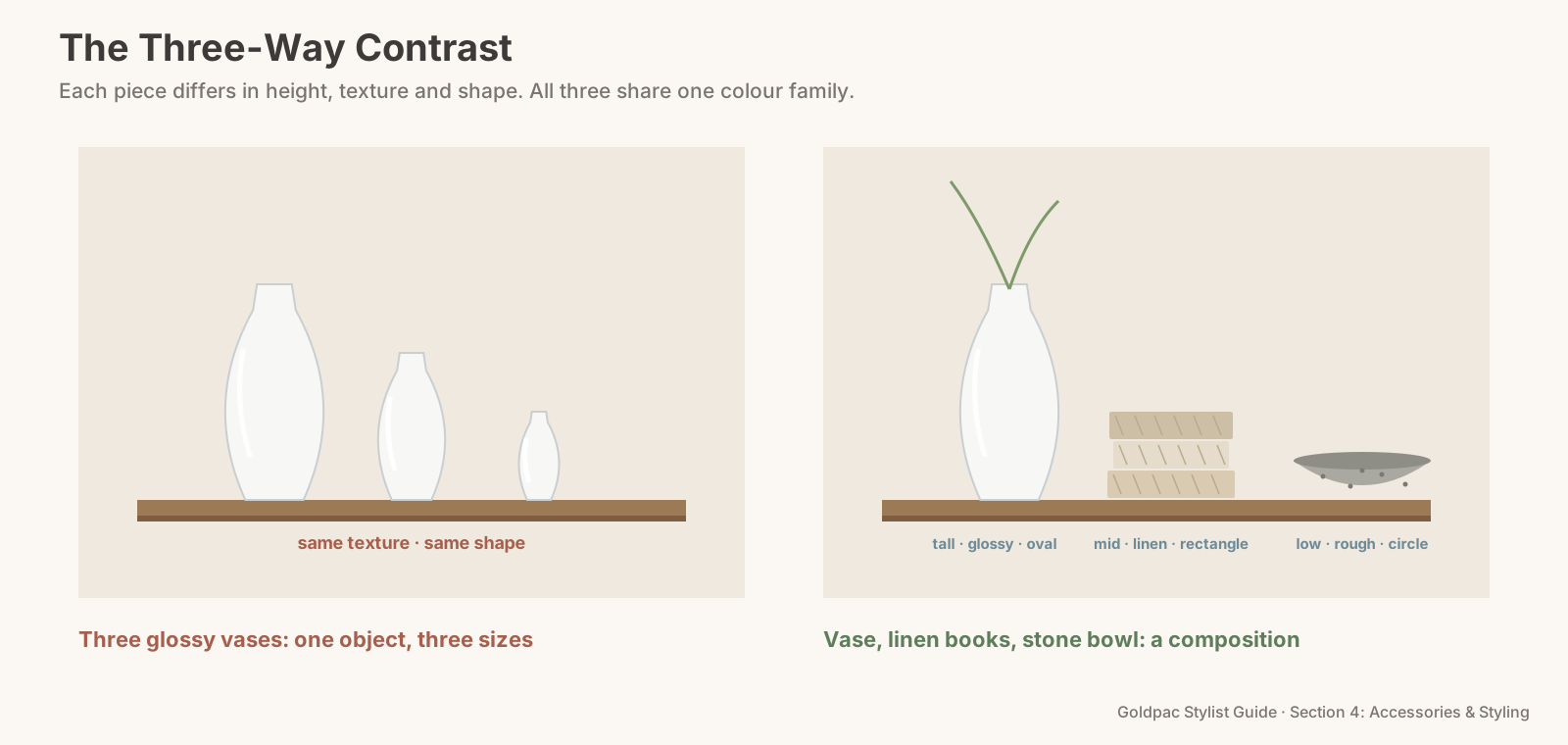
Three white ceramic vases in three sizes isn't a styled grouping. It's a set.
The rule in one minute. Use the three-item styling rule: every grouping of three should differ in height, texture and shape. One tall, one medium, one low; one smooth, one rough, one soft or woven; one round, one linear, one organic. Keep the colour family tight so the contrast reads as intentional. In a neutral staged home, texture and shape do the work colour can't.
The same shelf, two ways
| Matching trio | Three-way contrast | |
|---|---|---|
| Objects | Three white glazed vases, 15, 25 and 35 cm | Tall glazed vase, a stack of linen-bound books, a round stone bowl |
| Height | Varied | Varied |
| Texture | All smooth and shiny | Glossy, matte cloth, rough stone |
| Shape | All the same curve | Tall oval, rectangle, low circle |
| Colour | White | White, oatmeal, grey: one family |
| In the photo | Reads as one object in three sizes | Reads as a composition |
Verdict: height alone isn't enough. The matching trio has varied heights and still looks like it came in one box. The contrast trio gives the eye three different things to read.
What is the three-item styling rule?
The three-item styling rule groups three objects that differ in height, texture and shape (one tall, one medium and one low; one smooth, one rough and one soft; one round, one linear and one organic) while sharing one colour family, so the grouping looks composed rather than matched. Height is covered in detail in Rule #100.
Why each contrast matters
- Height moves the eye up and down. Without it, the eye slides along a flat line.
- Texture catches light differently. Gloss reflects, matte absorbs, rough surfaces throw small shadows. In a photo, that difference is what makes objects look real and touchable.
- Shape gives each object its own outline. Three curves blur into one shape at photo size. A curve, a rectangle and an irregular form stay distinct.
- One shared colour holds it together. Contrast in three directions plus contrast in colour looks busy. Keep the colours close (Rule #38 covers using the same colour in different textures).
The second-order point: neutral homes need texture
Staged homes are deliberately neutral. Whites, creams, timber, stone, soft greys. That calm is what buyers respond to, but it removes colour as a tool for interest.
Texture and shape take colour's place. A linen cushion against a bouclé sofa. A rough stone bowl beside a glossy vase. A round mirror over a rectangular console. These contrasts keep a neutral room from looking flat, especially in listing photos, where wide-angle lenses and bright exposures already soften detail.
The Three-Way Contrast
- Choose the tall piece first: a vase with branches, a lamp, a leaning frame.
- Add a different texture at medium height: books, a timber box, a woven basket, a candle on a stand.
- Add a different shape, low: a round bowl, a sculptural object, a smooth stone.
- Check each pair: no two pieces should share both texture and shape.
- Check the colour: all three in one family, such as white, oatmeal and grey, or timber, cream and black.
- Group them close, slightly overlapping, with the tallest at the back.
The Three-Way Contrast: three objects in every grouping, each different in height, texture and shape, all in one colour family, grouped close with the tallest at the back.
Numbers panel Items per grouping: 3 · Heights: 3 · Textures: at least 2, ideally 3 · Shapes: at least 2, ideally 3 · Colour families: 1 · Groupings per surface: 1
Check it through your phone
Take a photo of the grouping, then switch it to black and white. Colour disappears and texture and shape are all that's left. If the three objects blur into the same grey shape, swap one for something rougher, softer or differently shaped.
"Won't mixing textures look messy?"
- Not when the colour stays put. Messy comes from contrast in every direction at once: colour, pattern, texture and shape all shouting.
- Three objects is the limit. Five textures on one surface is busy. Three is a composition.
- Natural materials mix easily. Stone, timber, linen, ceramic and glass have been sitting together on shelves for centuries. They rarely clash.
The blind spot: you buy what you like, again and again
Most people have a favourite material. Ceramic collectors own ceramics. Glass lovers own glass. Every piece was a good choice, but together they all share one texture.
You don't notice, because each piece looks different to you: you remember where each came from. In a photo, they read as one material in several sizes. Mix in something from another room: a stack of books, a timber board, a basket.
What if…
You only own a few accessories. Borrow textures from elsewhere: a linen napkin folded under a candle, a timber chopping board leaned at the back, a stone from the garden.
It's a bathroom. Glass, stone and cotton: a clear glass bottle, a stone dish and a rolled cotton hand towel.
FAQ
What is the rule of three in home staging? Group accessories in threes that differ in height, texture and shape but share one colour family, so each grouping looks composed.
Three objects, three kinds of contrast, one colour: that's a grouping that photographs well. Rather have someone build the groupings for you? With Photo Ready Styling, our stylist styles your home with your own furniture and accessories before the photos. For empty homes and agent listings, Goldpac stages with our own furniture and accessories: send us the address and a fixed styling quote lands within two hours, through our home staging page. See current prices.
Keep reading: Rule #94: Style cushions in coordinated, odd-numbered groups (cushions in coordinated, odd-numbered groups) · Rule #101: Bowls, vases and candles: the reliable styling set (the bowls, vases and candles kit)
◀ Previous: Rule #108: One neutral personal touch is enough · Section 4 contents · Next: Rule #110: Give the kitchen bench one focal piece ▶
Part of the Goldpac Stylist Guide: 300+ home staging rules from Goldpac's Sydney styling team.