
Stylist Guide › Section 4: Accessories & Styling › Rule #110
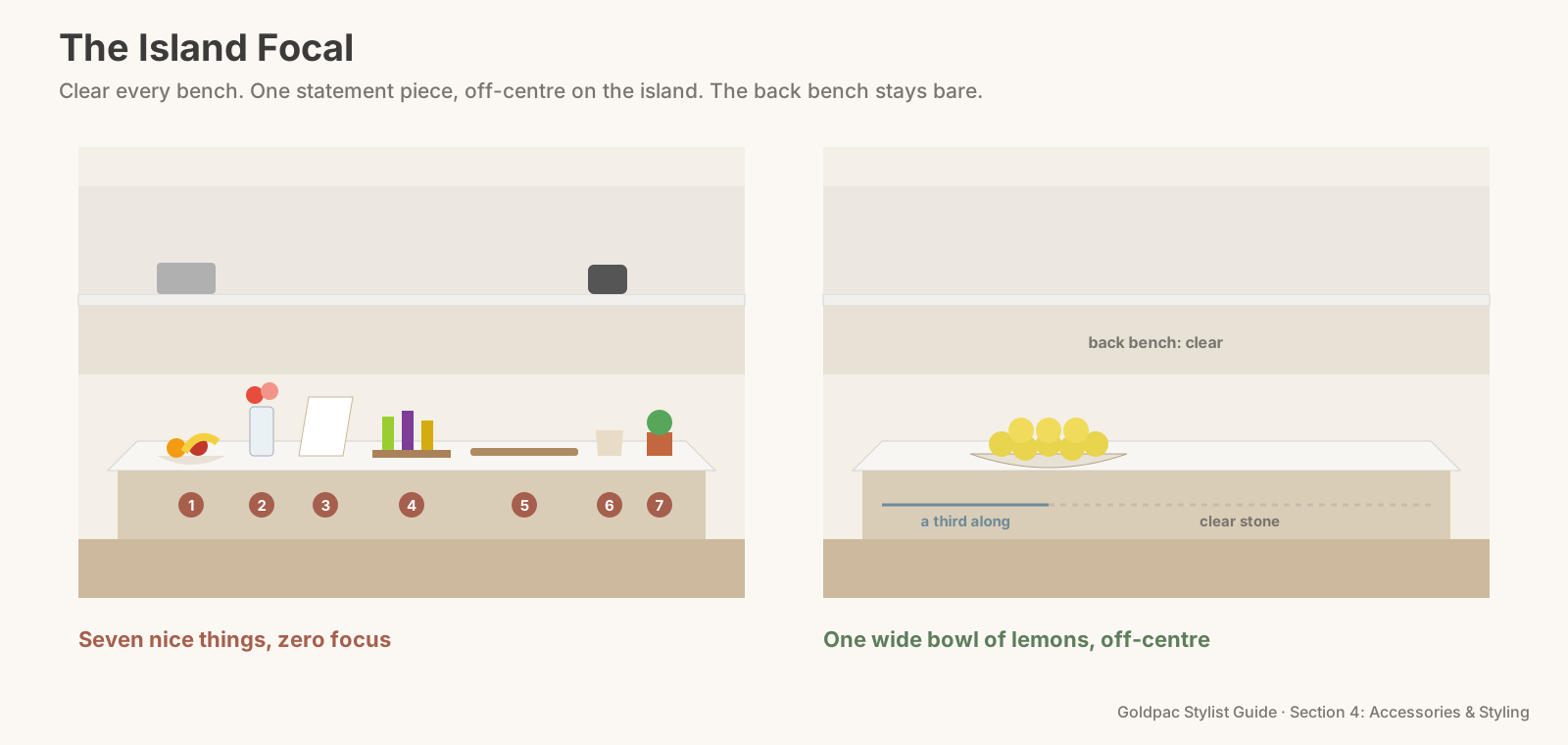
An island bench, 2.4 m of pale stone. On it: a bowl of mixed fruit, a vase of tulips, a cookbook on a stand, a tray of oils, a timber board, a salt pig and a small potted herb. Seven nice things. Zero focus.
The rule in one minute. Clear the kitchen counters except one focal piece. One large statement on the island, such as a wide bowl of a single fruit or a tall vase of branches, gives the kitchen photo a centre. The back benches stay clear. The stone, the space and the light become the feature, and the focal piece just points at them.
The autopsy: seven nice things
Each object is fine. The fruit is fresh. The tulips are pretty. The board is good timber. Nobody would call any one of them clutter.
Together, they hide the bench. The stone is the most expensive surface in the room, and buyers can see only gaps of it between objects.
The bench looks shorter. Seven objects break a 2.4 m run into seven short stretches. One object leaves it long.
The photo has no centre. The eye jumps from bowl to vase to stand to tray. Nothing leads. Nothing rests.
What it costs
Space. Buyers judge bench space with their eyes. A covered bench reads as less bench.
Finish. Buyers paying for stone want to see stone. Objects make them guess.
Attention. Seven objects compete with the kitchen for the photo. The kitchen should win.
What does "one focal piece" mean on a kitchen bench?
One focal piece means a single statement object, or one tight grouping that reads as a single object, placed on the island or main bench, with every other surface clear. A wide bowl of one fruit, 35 to 45 cm across, or a tall vase of branches, 60 to 90 cm with the vase, both work. On a long island of 3 m or more, the focal piece can be a tight group of three (Rule #281 covers three things on a bench when you're living there).
The Island Focal: the 10-minute fix
- Clear every bench. Island, back bench, splashback ledge, window sill.
- Wipe and dry the stone, including the edges.
- Choose one statement: a wide bowl of lemons, limes or green apples, or a tall vase of branches. One fruit, one colour.
- Place it off-centre, about a third of the way along the island from the end nearest the living area.
- Leave the back bench clear. No appliances, no knife block, no utensil jar.
- Check from the kitchen entry. One object, then stone.
The Island Focal: every bench cleared, then one statement piece, a wide bowl of one fruit or a tall vase of branches, placed off-centre on the island, with the back bench left bare.
Mistake and fix
Mistake: a mixed fruit bowl with bananas, oranges and apples. Fix: one fruit, one colour. Lemons or green apples read as fresh and calm. Real, never fake (Rule #178 covers no fake fruit).
Mistake: a focal piece in the dead centre of the island. Fix: off-centre. Centred objects split the bench into two halves. Off-centre lets the longer side run.
Mistake: a small bowl on a big island. Fix: scale up. On an island over 2 m, a bowl under 30 cm wide looks forgotten. Go wider, or go taller with branches.
Mistake: the kettle and toaster left out "because they're nice". Fix: put them away. If an appliance is truly beautiful, it can be the focal piece, but then nothing else goes on the bench.
Time & effort First clear and setup: about 10 minutes. Before each inspection: 2 minutes to remove what's crept back and wipe the stone. Fresh fruit: replace every few days.
"But an empty kitchen looks cold"
An empty kitchen does. A kitchen with one generous, living focal piece doesn't. A wide bowl of lemons says fresh, sunny and cared for. Seven small things say busy.
Warmth comes from scale, not quantity. One large, simple piece reads as generous. Many small ones read as clutter, however good each one is (Rule #157 covers not over-styling kitchens and bathrooms).
The blind spot: you use every one of those objects
Everything on your bench earns its place. The board is used daily, the oils are within reach, the herb is for cooking. Clearing it feels like making the kitchen harder to use.
For the campaign, the cupboard is the new bench. Most kitchens have space for a "campaign shelf" where daily items live between inspections, ready to come out after each one and go back before the next (Rule #184 covers clearing every kitchen surface).
What if…
There's no island, just a galley bench. The focal piece goes at the end furthest from the sink, against the wall. Everything else is cleared.
The kitchen has open shelves. Treat them as part of the bench. Clear them to a few matching plates or bowls in one colour, stacked neatly, and leave at least half of each shelf empty. The focal piece on the bench still leads.
The kitchen is tiny. One small focal piece, or none: a clean, empty bench in a small kitchen often looks bigger and better than any object.
FAQ
What should be on kitchen benches when selling? One focal piece on the main bench or island, such as a wide bowl of one fruit or a tall vase of branches, and nothing else.
Should appliances be put away for photos? Yes. Kettles, toasters, coffee machines and knife blocks go in a cupboard for the photos and inspections.
One focal piece, then stone: the kitchen sells itself. Rather hand over the clearing and setting? With Photo Ready Styling, our stylist styles your home with your own furniture and pieces before the photos, kitchen included. For empty homes and agent listings, Goldpac stages kitchens with our own focal pieces: send us the address and a fixed styling quote lands within two hours, through our home staging page. See current prices.
Keep reading: Rule #281: Three things on a kitchen bench, no more (three things on a kitchen bench, no more) · Rule #184: Avoid visual clutter on kitchen benches (no visual clutter on kitchen benches)
◀ Previous: Rule #109: Mix height, texture and shape in every grouping · Section 4 contents · Next: Rule #111: Use scented candles sparingly ▶
Part of the Goldpac Stylist Guide: 300+ home staging rules from Goldpac's Sydney styling team.