
Stylist Guide › Section 4: Accessories & Styling › Rule #91
Every accessory you remove makes the ones that stay look more deliberate.
The rule in one minute. Use fewer accessories for more impact. A room with twenty small objects reads as clutter; the same room with five well-chosen pieces reads as designed, and each piece gets noticed. As a starting point, aim for no more than three objects per surface and roughly five to seven accessories in a main room, then choose bigger, better pieces rather than more of them. Impact comes from contrast with space, not from quantity.
Why fewer works
One vase is a choice.
Six vases are a collection.
Twenty objects are a shop.
Buyers came for the room.
Space is what makes an object visible. A ceramic bowl on a clear sideboard is the first thing you see; the same bowl among eleven other objects disappears. Every extra accessory dilutes the ones you've chosen well.
Photos punish quantity. Listing photos are wide, sharp and often viewed small. Many small objects become texture, then noise, then clutter.
Fewer pieces make rooms look larger. Clear surfaces and walls let the eye travel, so the room reads as more generous than its square metres.
The second-order effect is trust. A room with fewer, better things looks cared for and confident. Over-dressed rooms make buyers wonder what the styling is compensating for.
How many accessories should be in a room when staging?
Usually five to seven accessories in a main living room, with no more than three objects on any one surface and plenty of clear space around each grouping. Bedrooms and bathrooms need fewer: two or three each. Choose larger pieces over many small ones.
The Less, Larger Edit
- Count what's out. Every decorative object in the room, including candles, frames, vases and ornaments. Write the number down.
- Clear every surface completely. Put it all on the dining table or the bed.
- Choose the anchors: one large piece for each main surface (a big bowl, a tall vase, a lamp, a stack of large books).
- Add a partner or two, not a crowd. No more than three objects per surface, varied in height.
- Leave at least one surface empty. A clear side table or bench is part of the design.
- Count again. Aim for the five-to-seven range in a living room, two or three in a bedroom.
The Less, Larger Edit: count every accessory, clear every surface, put back one large anchor per surface with at most two partners, leave one surface empty, and land at five to seven pieces in a living room.
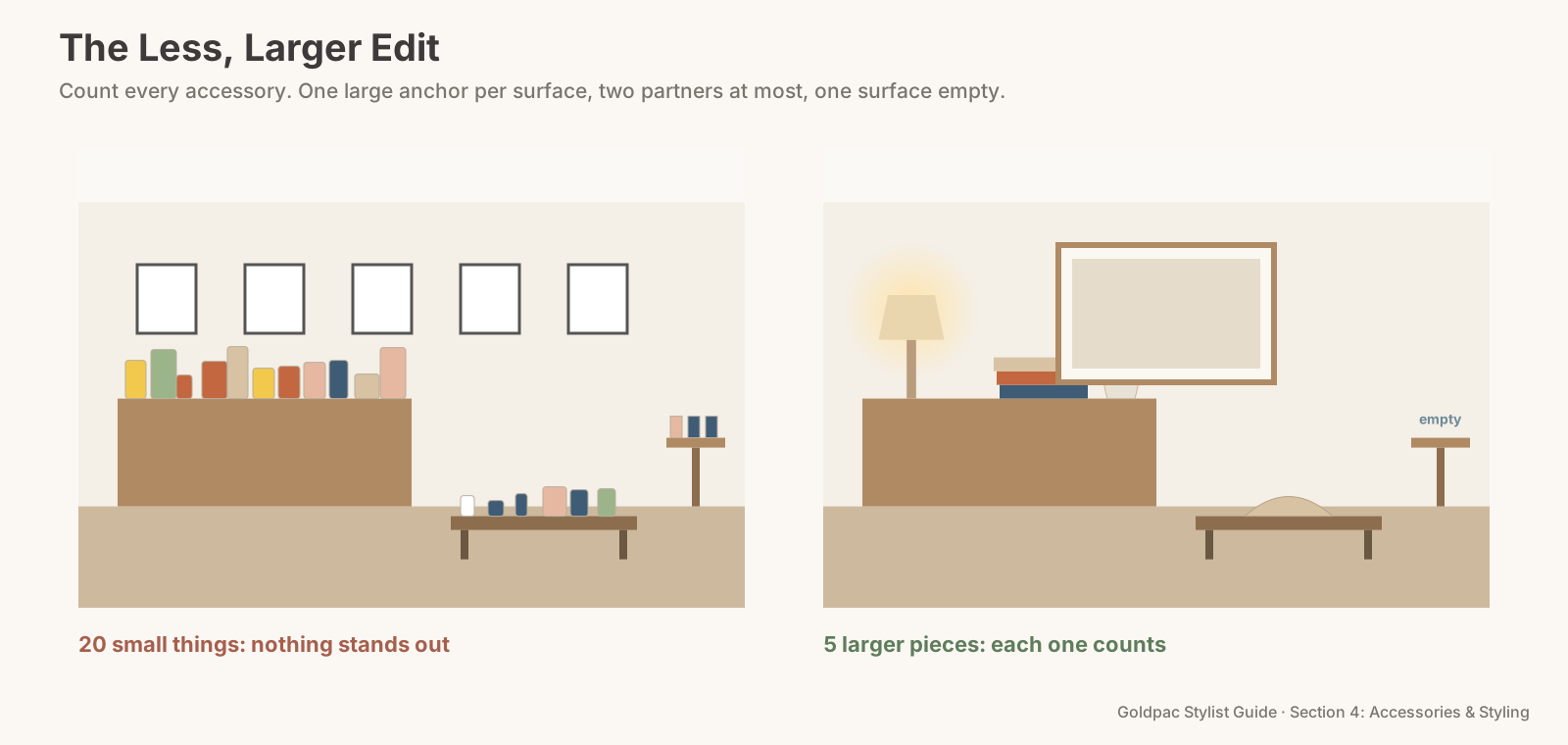
Numbers panel Main living room: 5 to 7 accessories · bedroom: 2 or 3 · bathroom: 2 or 3 · per surface: 3 at most · surfaces left empty: at least 1 · bigger, not more
Start with the surfaces the camera sees
Not every surface matters equally. The photographer will shoot the living room, kitchen and main bedroom from the doorway and a far corner, so the surfaces facing those spots carry most of the weight.
- The coffee table: one large bowl or a tray with two or three items, nothing more.
- The sideboard or media unit: a lamp, a stack of books and one vase, set to one side.
- The kitchen bench: three deliberate items at most, everything else away (Rule #184 covers kitchen surfaces).
- Bedside tables: a lamp and one small thing each.
- Window sills and the top of the fridge: empty.
Edit these first. The rest of the house follows the same logic.
Pack-away list
Into the box: small ornaments, groups of candles, small frames, souvenirs, figurines, decorative boxes, bowls of objects, extra vases, coasters, remote caddies.
Stays out: one large lamp, one large bowl or vase per surface, a stack of good books, one plant, one artwork per wall.
The blind spot: you see each piece, not the total
Every accessory went in for a reason, one at a time. A candle to finish the sideboard, a frame for a photo you love, a bowl from a holiday. Judged individually, each one deserves its place.
A buyer judges the total in a single glance. Counting is the fastest way to see what they see.
What if…
The room looks bare once the small pieces go. Go larger, not more: one bigger vase, a larger artwork, a substantial plant. Scale fills a room in a way quantity never does. The lived-in version of this rule starts with the furniture itself (Rule #287 covers removing one piece from every room).
FAQ
Does less decor make a room look bigger? Yes. Fewer accessories leave more clear surface and wall, which lets the eye travel and makes the room read as larger in person and in photos.
What accessories are best for staging? Larger, simple pieces: a big ceramic bowl, a tall vase with branches, a lamp, a stack of large books and one plant.
A few well-chosen pieces say more than a room full of them. For empty homes and agent listings, Goldpac stages with our own furniture and a curated set of accessories: send us the address and a fixed styling quote lands within two hours, through our home staging page. Living there? A Photo Ready Consultation tells you which pieces to keep out in each room, in a written plan within 48 hours of the visit. See current prices.
Keep reading: Rule #287: Remove one piece of furniture from every room (removing one piece of furniture from every room) · Rule #92: Choose one large artwork over a gallery wall (one large artwork over a gallery wall) · Rule #101: Bowls, vases and candles: the reliable styling set (the bowls, vases and candles kit)
◀ Previous: Rule #90: In bathrooms, side lights beat a single ceiling light · Section 4 contents · Next: Rule #92: Choose one large artwork over a gallery wall ▶
Part of the Goldpac Stylist Guide: 220+ home staging rules from Goldpac's Sydney styling team.