
Stylist Guide › Section 4: Accessories & Styling › Rule #119
What turns a pile of books into a styled stack?
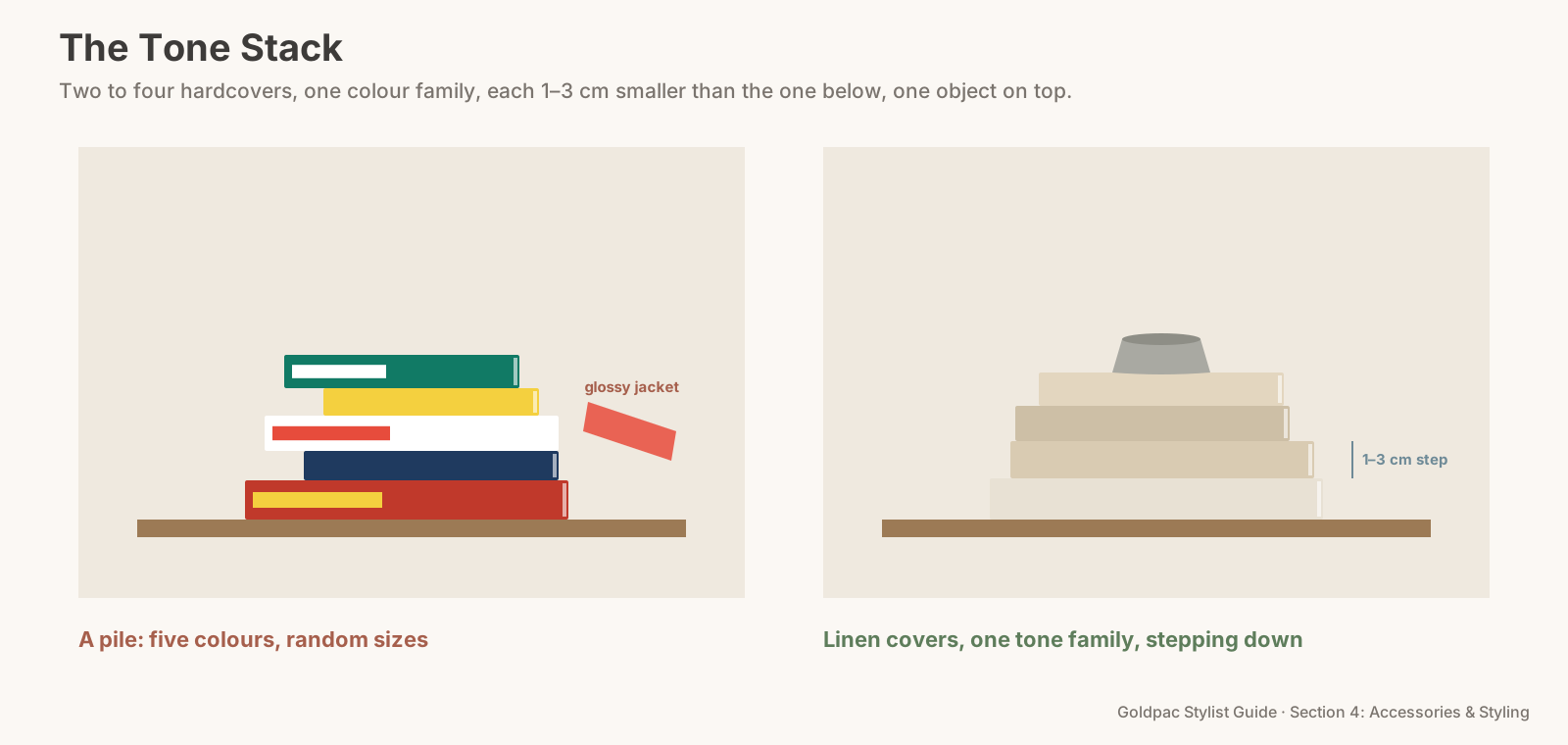
The rule in one minute. Stack books by tone and thickness. Two to four books lying flat, largest at the bottom, each a little smaller than the one below, in one colour family. Remove bright dust jackets to reveal calm cloth covers. Top the stack with one small object. Sorted, books read as styling; unsorted, as a pile.
The recipe
Ingredients, for one stack:
- 2 to 4 books. Large-format hardcovers work best: design, travel, art, photography, cookbooks in the kitchen (Rule #93 covers choosing neutral, design-themed books).
- 1 colour family. Creams and whites, or warm greys, or oatmeal and sand, or black and charcoal.
- Sizes stepping down. Each book about 1 to 3 cm smaller than the one beneath it, on at least one side.
- 1 object on top. A small bowl, a candle, a stone or a small plant.
Proportions:
- Coffee table: one stack of 2 or 3 large books, on the tray or beside it (Rule #102 covers the coffee-table tray).
- Console or sideboard: one stack of 3 or 4, used as a riser under a lamp or vase.
- Bookshelf: flat stacks of 3 to 5 alternating with short upright runs.
- Bedside: one or two books, one novel on top.
How do you stack books for staging?
Stack two to four hardcover books flat, with the largest at the bottom and each smaller book centred or slightly offset on the one below, all in one colour family, spines facing out, with one small object on top. Remove glossy or brightly coloured dust jackets to show the cloth covers beneath.
Two terms worth knowing
Two-term glossary Tone: how light or dark a colour is, regardless of hue. A cream and a pale grey are close in tone; a cream and a navy are not. Step-down stack: books stacked from largest to smallest, so each layer shows a small edge of the one below.
Assembly: The Tone Stack
- Pull every hardcover from the living areas.
- Strip the dust jackets that are glossy, bright or busy. Many cloth covers underneath are plain linen, grey or cream.
- Sort into tone families: lights, mids, darks.
- Build each stack from one family, largest at the bottom.
- Offset slightly, a few millimetres to a centimetre, so the stack looks placed by hand, not machine-squared (Rule #113 covers small angles).
- Spines out, titles readable. Turning spines to the wall looks contrived, and buyers notice.
- Add one object on top, then step back.
The Tone Stack: two to four hardcovers in one colour family, stacked largest to smallest with each book 1 to 3 cm smaller than the one below, dust jackets off if they're bright, spines out, and one object on top.
Stacks as risers
A stack is also a stand. Two or three large books under a lamp, a vase or a plant lift it to the right height and add a layer of texture at the same time (Rule #100 covers varying heights in groupings).
Match the stack to what sits on it. A heavy lamp needs large, sturdy hardcovers; a small vase can sit on two slimmer books. The top book should be at least as wide as the base of the object.
Keep riser stacks low. Two or three books, not six. A tall tower of books under a lamp looks precarious, and buyers notice things that look like they might fall.
Check it through your phone
Photograph the stack from the angle a buyer will see it: from the sofa for a coffee-table stack, from the doorway for a shelf. Bright jackets and white page edges stand out far more in photos than in person. If the stack draws your eye before the room does, swap one book for a calmer one.
Four common slips
- A rainbow of spines in one stack. Split by tone into separate stacks, in separate places.
- Books all the same size. Mix sizes so the step-down shows.
- Paperbacks in the stack. Keep them on the shelf, or out of sight. Hardcovers stack better and look calmer.
- Ten books on the coffee table. Two or three. The rest go on the shelf.
The blind spot: you shelve by meaning, not by look
Owners organise books by subject, author or which ones they love. That's how a home library should work.
For the campaign, the visible books are decor. Nobody will read them; they'll only look at them. Sort the books on display by how they look, and keep the rest in a cupboard or on a shelf out of the main photos.
What if…
You don't own any large hardcovers. Borrow from the library or a friend for the weeks of the campaign, or use what you have in smaller stacks of two.
Your book covers are all colourful. Strip the jackets first; the boards underneath are often plain. If they're still bright, keep the calmest two in one small stack, or skip books on the coffee table and use a tray and bowl instead.
FAQ
Should book spines face in or out when staging? Out. Spines turned to the wall can look contrived; calm covers with readable titles look natural.
Sorted by tone and size, books become part of the styling. Rather have someone build the stacks for you? With Photo Ready Styling, our stylist styles your home with your own furniture, books and accessories before the photos. For empty homes and agent listings, Goldpac stages with our own furniture and accessories: send us the address and a fixed styling quote lands within two hours, through our home staging page. See current prices.
Keep reading: Rule #93: Style with neutral or design-themed books (neutral or design-themed books) · Rule #109: Mix height, texture and shape in every grouping (mixing height, texture and shape)
◀ Previous: Rule #118: Match frame finishes across a room · Section 4 contents · Next: Rule #120: Choose tall branches over small flowers ▶
Part of the Goldpac Stylist Guide: 220+ home staging rules from Goldpac's Sydney styling team.