
Stylist Guide › Section 4: Accessories & Styling › Rule #118
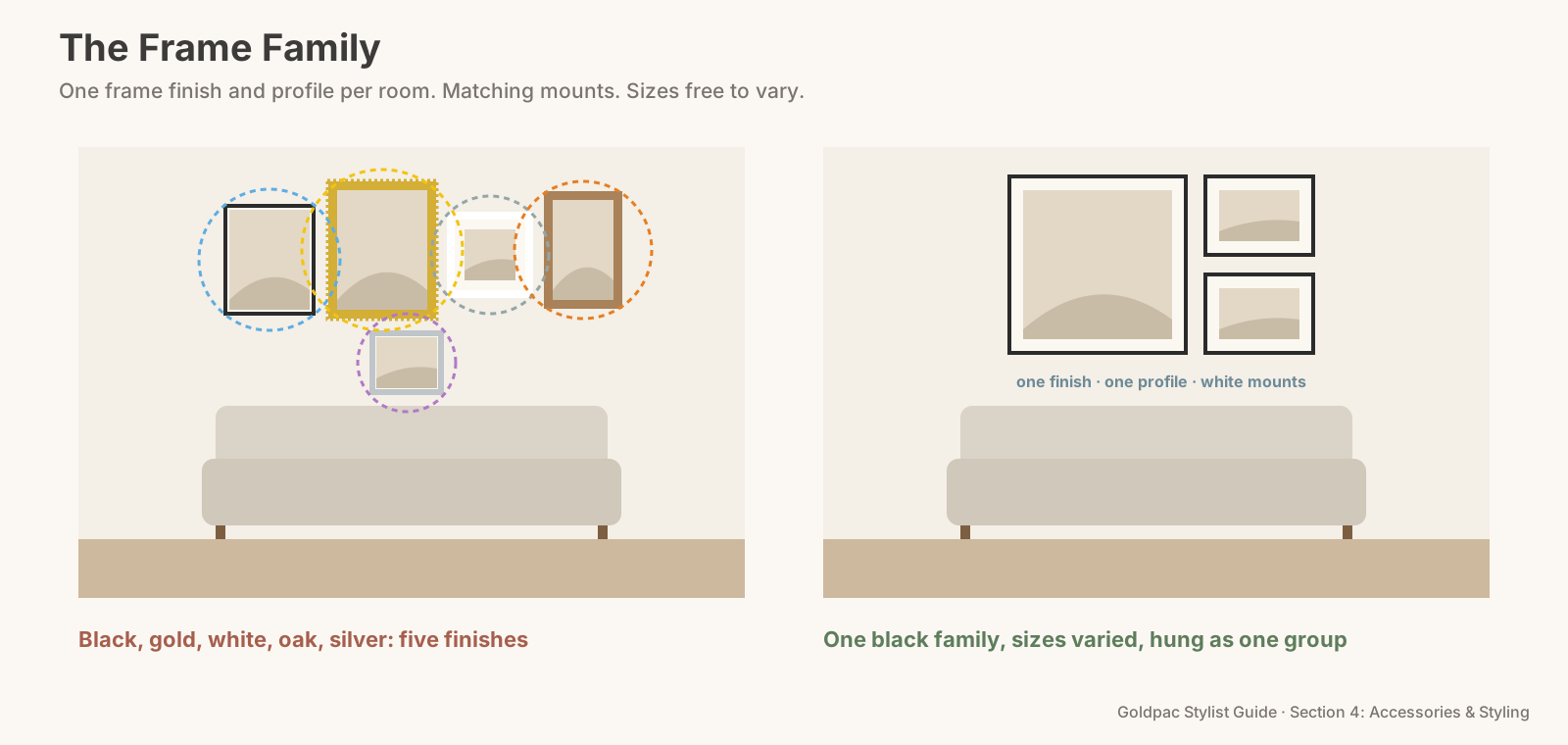
A living room wall, photographed for the listing: a black frame, a gold one, a white one, a timber one and a silver one, all within a metre of each other. Five lovely prints. The photo shows five frames.
The rule in one minute. Match frame finishes across a room. When every frame in one view shares a finish (all black, all natural oak, all white) the eye skips the frames and sees the art. Mixed finishes pull attention to the frames themselves and make a wall look assembled over years. Sizes and art can vary; the finish shouldn't.
The autopsy: a wall that shows its frames
Each frame came from a different moment. The gold one was a gift. The black ones came from a flat-pack store. The timber frame held a wedding photo before it held a print. Each made sense when it went up.
Together they become the subject. In the photo, the eye moves from finish to finish: black, gold, white, timber, silver. It never settles on the art inside.
The wall looks busy before it looks styled. Buyers can't name the problem. They just feel the room is a little cluttered, even though nothing is out of place.
What it costs
Attention. The art was chosen for calm colours and shapes (Rule #99 covers choosing art by palette). Mixed frames compete with it.
Cohesion. A room where the frames match reads as one decision. A room where they don't reads as twenty.
Scale. Five mismatched frames read as five small things. Five matching frames, hung as a group, read as one larger piece.
Why do matching frames matter in staging?
Matching frame finishes make a wall read as one designed group, so buyers see the artwork and the room rather than a collection of different frames; mixed finishes draw the eye to the frames and make the room look assembled piece by piece. One finish per room is the simplest rule, or one finish per view in an open-plan space.
The Frame Family
Pick the finish the room already leans toward. Black frames suit rooms with black window frames, black tapware or charcoal textiles. Natural oak suits timber floors and warm neutrals. White suits pale, coastal and Scandinavian palettes (Rule #106 covers one metal finish per room, the same logic for metals).
Keep the profile similar. Thin frames with thin frames, chunky with chunky. A 1 cm black frame beside a 5 cm black frame still looks mismatched.
Use the same mount colour. White or off-white mounts, the same width where possible. Mounts give small prints breathing room and make different art look like a set.
Let sizes vary. One large frame and two smaller ones in the same finish look deliberate. Identical sizes in a row look like a shop display (Rule #114 covers too many matching accessories).
Count the frames in one view. In a photo from the room's doorway, every frame you can see should share a finish.
The Frame Family: one frame finish and one profile per room, or per view in open-plan spaces, with matching mounts and varied sizes, so the eye sees the art instead of the frames.
Mistake and fix
Mistake: a gold ornate frame in a room of thin black frames. Fix: move it to a room where it's the only frame, or pack it. One ornate frame can be a feature on its own wall; beside plain ones it looks out of place.
Mistake: mixing black and dark brown frames because they look "close enough". Fix: they aren't, in photos. Daylight shows the difference clearly. Pick one.
Mistake: reframing everything before the sale. Fix: move frames between rooms first. Often every room can have a matching family without buying a single new frame.
Mistake: frames with glass that reflects the window. Fix: angle the frame slightly or move it. Glare in a listing photo hides the art completely.
If/then path If most frames in a room are black → the odd ones move to another room or get packed. If they're all different → choose the finish of the largest piece and match the rest to it. If you need one or two new frames → buy the same finish and profile as the ones you keep. If there's only one frame in the room → it can be any finish that suits the room.
The objection: "Designers mix frames all the time"
They do, on purpose and with restraint. A designed mix usually repeats each finish, so the pattern is clear: two black, two oak, one brass. That takes planning and space.
A sale isn't the moment for a curated mix. You're styling for a few weeks of photos and inspections, and the aim is calm. One finish is the fastest way there, and it works in every room.
The blind spot: you see the pictures, not the frames
You chose each piece for what's inside it. When you look at the wall, you see the print from the trip, the drawing from the market, the photo you love. The frames are invisible to you.
Buyers see the frames first, because the art means nothing to them yet. Take a photo of each wall, convert it to black and white, and look only at the outlines. Mismatched frames jump straight out.
What if…
You only have one or two frames per room. Then matching across rooms is less important. Keep each room internally consistent.
The frames are on a wall seen from two rooms, like an open-plan living and dining area. Treat both rooms as one: one finish for every frame in that combined view.
FAQ
Should picture frames match in a room? For a sale, yes: one frame finish and profile per room, with sizes that can vary.
Can you mix black and wood frames? Designers sometimes do, deliberately. For a home being sold, one finish per room is simpler and photographs more calmly.
One frame finish lets the art do the talking. Rather have someone regroup the walls for you? With Photo Ready Styling, our stylist styles your home with your own furniture and art before the photos. For empty homes and agent listings, Goldpac stages with our own furniture and art: send us the address and a fixed styling quote lands within two hours, through our home staging page. See current prices.
Keep reading: Rule #92: Choose one large artwork over a gallery wall (one large artwork over a gallery wall) · Rule #103: Hang artwork at eye level (hanging art at eye level)
◀ Previous: Rule #117: Ground small decor so it doesn't look scattered · Section 4 contents · Next: Rule #119: Stack books by tone and size ▶
Part of the Goldpac Stylist Guide: 300+ home staging rules from Goldpac's Sydney styling team.