
Stylist Guide › Section 4: Accessories & Styling › Rule #113
A room where every object sits parallel to the wall looks like a showroom after closing time. Tidy. Correct. Lifeless.
The rule in one minute. Place decor at angles to create movement. Keep furniture square to the walls, then turn one object in each grouping 10 to 15 degrees off the line: a book stack, a tray, a throw. The small rotation suggests someone just put it down and leads the eye through the room. One angle per grouping. More looks careless.
The myth: "Neat means everything lined up"
It feels right. Lining things up is how we tidy. Books square to the edge of the table, the tray parallel to the sofa, the vase dead centre. It's the opposite of mess.
It photographs as rigid. In a listing photo, a room of right angles reads as stiff and staged, the way a shop display does. Everything is correct and nothing is inviting.
It stops the eye. Parallel lines lead the eye along an edge and off the side of the frame. A slight angle breaks the line and sends the eye somewhere else in the room.
Why a small angle works
It reads as lived-in. A book stack turned slightly looks like someone just set it down. A throw falling at a diagonal looks like someone just got up. Buyers picture themselves in rooms that look used, gently.
It creates a path. Each angled object points somewhere. A tray turned toward the sofa, a chair angled toward the window: the eye follows.
It adds depth to photos. Objects turned at an angle show two faces instead of one. That small shift gives flat surfaces a sense of three dimensions.
How do you angle decor to create movement?
Keep large furniture square to the walls, then rotate one object in each grouping by about 10 to 15 degrees: turn a book stack, angle a tray, drape a throw diagonally across a bed corner or the arm of a sofa. Only one angle per grouping, and never on the biggest pieces, so the room stays ordered.
Square or angled?
| Object | Keep it square | Turn it slightly |
|---|---|---|
| Sofa, bed, dining table | Yes | No, unless the room needs it (Rule #13 covers angling furniture in corners) |
| Rug | Yes, parallel to the main furniture | No |
| Coffee table tray | Either | Yes, 10–15° toward the sofa |
| Book stack | The bottom book | The top one or two, a few degrees |
| Throw on a bed | No | Yes, diagonally across one corner |
| Throw on a sofa | No | Yes, over one arm |
| Armchair | In a formal room | Yes, toward the window or the sofa |
| Art and mirrors | Always level | Never |
The 15-Degree Turn
- Square the big pieces first. Sofa, bed, tables and rugs line up with the walls and with each other.
- Pick one object in each grouping to turn: the tray, the top book, a small bowl.
- Turn it 10 to 15 degrees, about as far as a clock's minute hand moves in two minutes.
- Point it somewhere useful: toward the seat, the window or the next room.
- Drape one throw on a diagonal, across the corner of a bed or over one arm of the sofa.
- Step back. If the room looks messy, you've turned too much. Straighten one.
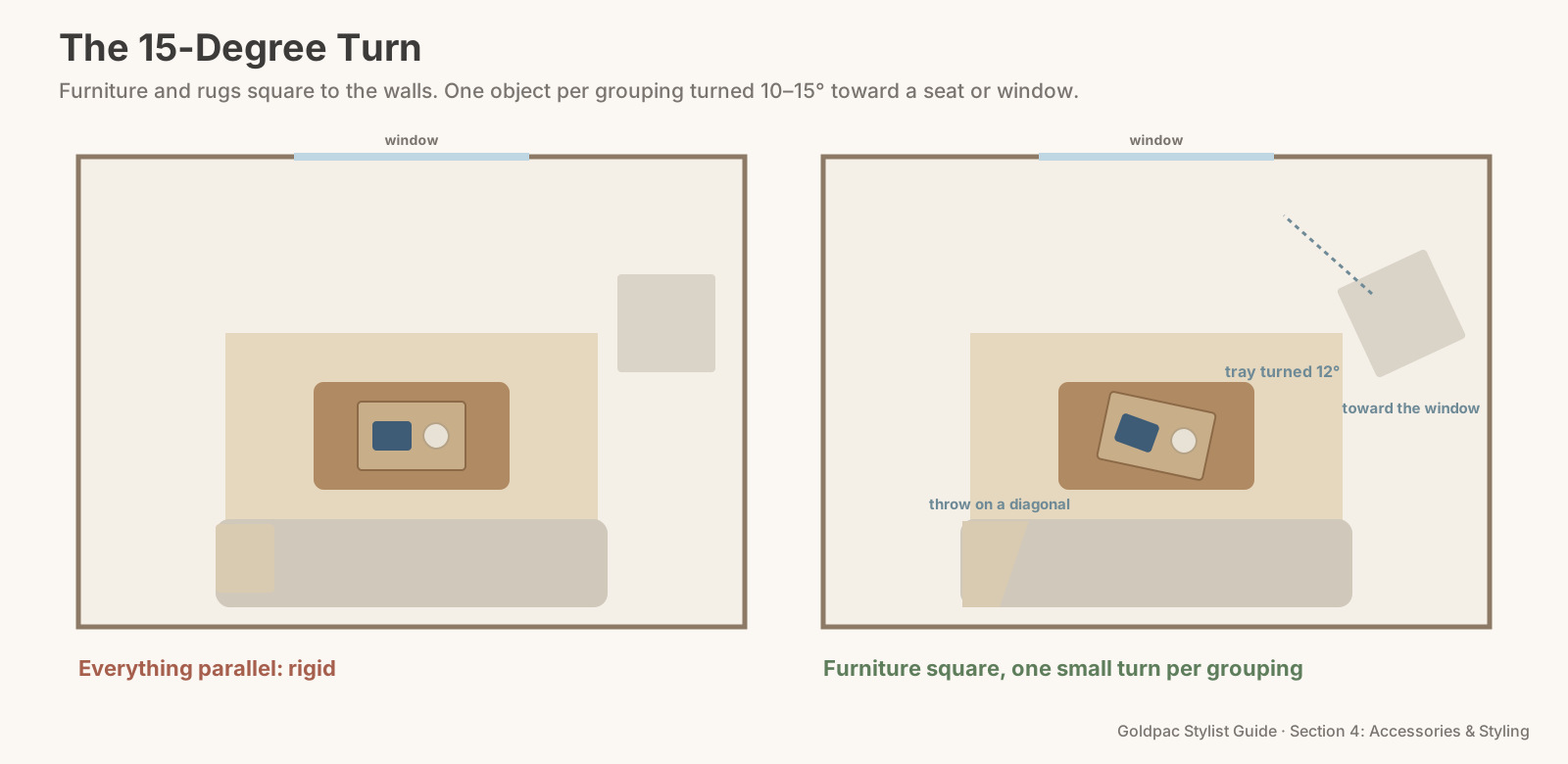
The 15-Degree Turn: furniture and rugs square to the walls, then one object per grouping turned 10 to 15 degrees toward a seat, window or doorway, and never more than one angle per surface.
The second-order point: angles hide nothing
Angles don't create space or hide flaws. They don't make a small room bigger. What they change is how the room feels: relaxed rather than stiff.
That feeling matters because buyers decide quickly. A room that feels relaxed makes it easier to imagine sitting in it. The angles are a small signal, but they're part of what makes a styled home feel like a home rather than a set.
The blind spot: you straighten without thinking
Tidying means straightening. Every time you reset a room, you square the books and centre the tray. It's a habit, and it's a good one most of the year.
During the campaign, the habit undoes the styling. Before each inspection, after you've tidied, go round once more and turn the chosen objects back (Rule #276 covers the 10-minute reset before every inspection).
What if…
The room is very formal. A period dining room or a formal lounge can stay more symmetrical. Use one angle only, such as a throw on a chair, and keep the rest square (Rule #156 covers breaking symmetry a little).
You have young children who move everything. Pick angles that survive: a throw that can be re-draped in seconds and a tray that holds its contents in place.
FAQ
Should decor be straight or angled in staging? Large furniture and rugs should be straight; small decor can be angled, one object per grouping, about 10 to 15 degrees.
How do you drape a throw on a bed for photos? Diagonally across one bottom corner, folded loosely, so it falls over the side of the bed.
Should furniture be angled in a staged room? Usually not. Keep the main furniture square to the walls; angle only an armchair or a piece in a corner where it improves the flow.
Small angles make a styled room feel lived-in. Rather have someone set the room up for the photos? With Photo Ready Styling, our stylist styles your home with your own furniture and accessories before the photos. For empty homes and agent listings, Goldpac stages with our own furniture and accessories: send us the address and a fixed styling quote lands within two hours, through our home staging page. See current prices.
Keep reading: Rule #156: Avoid symmetry overload: break the pattern a little (breaking symmetry a little) · Rule #100: Vary heights in decorative groupings (varying heights in groupings)
◀ Previous: Rule #112: Use a mirror as the statement on a narrow wall · Section 4 contents · Next: Rule #114: Avoid too many matching accessories ▶
Part of the Goldpac Stylist Guide: 220+ home staging rules from Goldpac's Sydney styling team.