
Stylist Guide › Section 5: Textiles › Rule #125
Three layers. That's the difference between a bed that looks slept in and a bed that looks like an invitation.
The rule in one minute. Layer every bed: a smooth quilt cover as the base, a textured throw or folded coverlet across the bottom third, and pillows stacked from back to front. Three layers give depth in photos and make even a single bed in a spare room look generous. One flat layer reads as a slab.
The recipe, by bed size
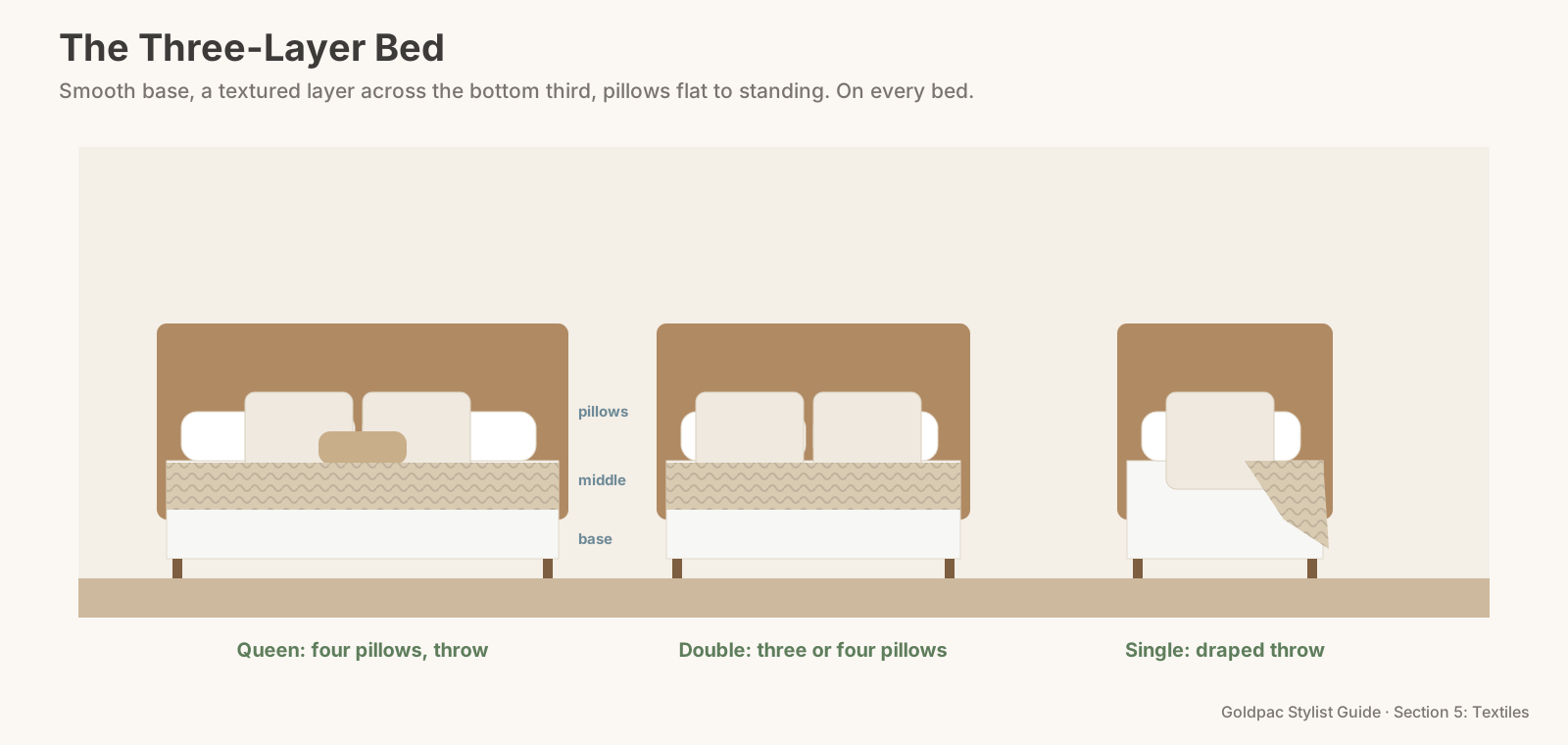
King or queen (main bedroom): - Base: white or soft-neutral quilt cover, one size bigger than the bed for a full drop. - Middle: a throw or folded coverlet across the bottom third. - Pillows: two sleeping pillows flat, two European pillows standing in front, one optional lumbar cushion.
Double (second bedroom): - Base: quilt cover in a soft neutral. - Middle: a throw folded lengthways across the bottom third. - Pillows: two sleeping pillows, one or two Europeans.
Single or king single (kids' room, study, spare room): - Base: plain quilt cover, tucked or with an even drop. - Middle: a throw folded across the foot, or a knitted blanket draped over one corner. - Pillows: one sleeping pillow, one European or one cushion.
Proportions: one colour family per bed, two textures at least (Rule #122 covers mixing textures), the textured layer covering about a third of the bed.
Why layers work
- Depth. Each layer sits at a slightly different height. In a photo, the steps between them read as softness and comfort.
- Texture. A smooth base with a knitted or waffle middle layer catches light differently, so the bed looks rich without any pattern.
- Scale. Layers make a bed look bigger and fuller. In small rooms with single beds, that helps the room read as a real bedroom, not a box room.
- Finish. A single flat quilt looks like the bed is waiting to be made. Layers look made, on purpose.
How do you make a bed look layered for staging?
Start with a smooth quilt cover one size larger than the bed, add a textured throw or coverlet folded across the bottom third, then stack pillows from flat sleeping pillows at the back to standing European pillows in front, all in one colour family. The full main-bedroom formula, step by step, is in Rule #299.
Two terms worth knowing
Two-term glossary Coverlet: a light, flat bed cover, often waffle, quilted or textured cotton, folded across the foot of the bed as a middle layer. European pillow: a large square pillow, usually 65 × 65 cm, that stands upright in front of the sleeping pillows.
Assembly: The Three-Layer Bed
- Base first. Smooth the quilt cover, pull it square, and check the drop is even on both sides.
- Fold the middle layer to about a third of the bed's length, or drape a throw diagonally over one corner on a single bed.
- Stack the pillows from back to front: flat, then standing.
- Add one small accent, like a lumbar cushion, only on a queen or king.
- Step back to the doorway. Can you see three distinct layers? If two merge, change the middle layer's texture or tone.
- Repeat on every bed in the photographed rooms, including the spare room and the kids' rooms.
The Three-Layer Bed: a smooth base, a textured middle layer across the bottom third and pillows stacked flat to standing, in one colour family, on every bed in the photographed rooms.
Where people stop too soon
The main bed gets all the effort. The second and third bedrooms often get a flat quilt and two pillows. In photos, those rooms then look smaller and colder than they are.
Kids' rooms get forgotten. A single bed with a character quilt and no layers reads as a child's mess. A plain cover, a knitted throw and one cushion read as a calm, flexible room that suits any buyer's family (Rule #129 covers plain bedding over patterned or branded).
Daybeds and sofa beds count too. If it's in a photographed room, layer it.
The blind spot: you make the bed to sleep in it
A bed you sleep in is made for comfort. Pillows where your head goes, the quilt folded back, a throw on the chair because it's in the way at night.
A staged bed is made to be looked at from the doorway. Before each inspection, rebuild all three layers, then do the same in every bedroom, not just yours (Rule #285 covers making beds hotel-style every morning).
What if…
You only have one throw. Put it on the main bed. For the other beds, fold a spare quilt or a cotton blanket lengthways across the bottom third.
The bed is pushed against a wall. Layer the visible side and the foot. Let the throw fall over the open side, not the wall side.
If/then path If the bed is a queen or king → base, middle layer, four pillows. If it's a double → base, middle layer, three or four pillows. If it's a single → base, a draped throw, one pillow and one cushion. If the room is tiny → skip extra cushions and keep the middle layer.
FAQ
How do you style a single bed for staging? A plain quilt cover, a throw folded across the foot or draped over one corner, and one pillow with one European or cushion, in one colour family.
Three layers make every bed look ready. Rather have someone dress every bedroom for the photos? With Photo Ready Styling, our stylist styles your home with your own furniture and bedding before the photos. For empty homes and agent listings, Goldpac stages bedrooms with our own beds and linen: send us the address and a fixed styling quote lands within two hours, through our home staging page. See current prices.
Keep reading: Rule #299: Dress the bed: white linen, two pillows, two Europeans, one throw (dressing the bed: white linen, two pillows, two Europeans, one throw) · Rule #285: Make the beds hotel-style every morning until it sells (hotel-style beds every morning) · Rule #144: Choose an upholstered headboard for the main bedroom (an upholstered bedhead for the main bed)
◀ Previous: Rule #124: Choose cushions with full, generous inserts · Section 5 contents · Next: Rule #126: Size the rug so the furniture sits on it ▶
Part of the Goldpac Stylist Guide: 300+ home staging rules from Goldpac's Sydney styling team.