
Stylist Guide › Section 5: Textiles › Rule #144
A bed without a bedhead looks like a mattress waiting for furniture.
The rule in one minute. Choose an upholstered headboard for the main bedroom. A soft bedhead in linen, bouclé or velvet frames the bed, anchors it to the wall and makes the room look finished in photos. Pick a neutral close to the bedding, about 50 to 70 cm above the mattress. A bare wall reads as temporary.
The same bedroom, two ways
| No bedhead | Upholstered bedhead | |
|---|---|---|
| Behind the bed | Bare wall, pillows leaning on paint | Soft fabric panel, pillows resting on it |
| In the photo | Bed floats, room looks half-furnished | Bed anchored, room looks complete |
| Feel | Temporary, like a rental | Comfortable, like a hotel |
| Pillows | Slide down, look flat | Stand up, look full |
| Wall | Scuffs and marks show | Protected and hidden |
Verdict: the upholstered bedhead. It's often the one piece that turns a bedroom from "a bed in a room" into a main bedroom.
Why upholstered, not timber or metal
- Softness reads as comfort. Buyers picture sleeping in the room. A padded bedhead looks restful in a way a hard panel doesn't.
- Texture adds depth. A linen or bouclé bedhead brings texture to the wall, where bedrooms are often flat (Rule #122 covers mixing textures).
- It supports the pillow styling. Euro pillows stand neatly against it instead of sliding down a wall (Rule #125 covers layering the bed).
- It suits most styles. A plain, neutral upholstered bedhead works in a Federation home, a 1970s unit or a new build.
Should a bed have a headboard when selling a house?
Yes, ideally the main bed should have a bedhead, and an upholstered one in a neutral linen, bouclé or soft velvet works best, rising about 50 to 70 cm above the mattress and matching or slightly contrasting the bed linen, so the bed looks anchored and the room looks finished in photos. Secondary bedrooms can go without if the walls are clean and the beds are well dressed.
Two terms worth knowing
Two-term glossary Bedhead: the Australian term for a headboard, the panel at the head of the bed. It can be fixed to the bed frame or to the wall. Upholstered: padded and covered in fabric, such as linen, bouclé or velvet, rather than bare timber, metal or laminate.
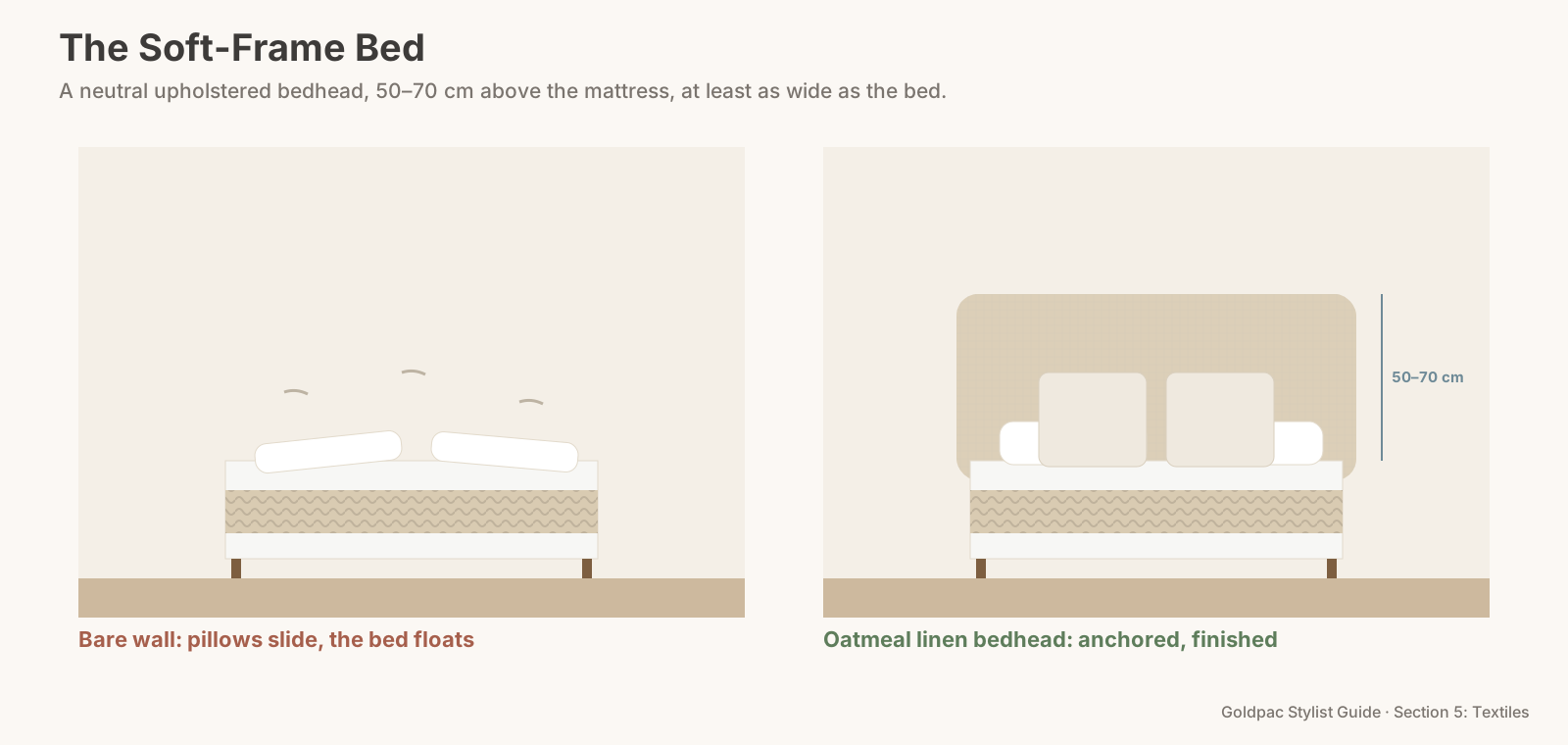
The Soft-Frame Bed
- Measure the mattress top and plan a bedhead that rises about 50 to 70 cm above it. Lower looks like a footboard; much higher can overwhelm a small room.
- Match the width to the bed, or go slightly wider. Never narrower.
- Choose the fabric: linen, linen-look, bouclé or matte velvet in a neutral such as oatmeal, stone, soft grey or ivory.
- Keep the shape simple: a rectangle or a gentle curve. Heavy buttoning, wings and studs date quickly.
- Set the colour a shade apart from the bed linen, so the pillows stand out against it.
- Fix it firmly to the bed frame or the wall, so it doesn't move when someone sits on the bed.
The Soft-Frame Bed: the main bed framed by a neutral upholstered bedhead about 50 to 70 cm above the mattress, at least as wide as the bed, plain in shape, a shade different from the linen and fixed firmly.
Styling around the bedhead
- Art above it: leave 15 to 25 cm between the top of the bedhead and the bottom of the frame, and keep the art about two-thirds of the bed's width (Rule #103 covers hanging art at eye level).
- Bedside tables: a matching pair either side, their tops roughly level with the top of the mattress.
- Lamps: a matching pair, shades a little above the top of the bedhead, so the light washes the fabric.
- Pillows: sleeping pillows flat against the bedhead, Euros standing in front. The bedhead should still show above them.
- Wall colour: if the bedhead and wall are almost the same tone, add contrast with the pillows or a throw.
Where it matters most
- The main bedroom. Always worth a bedhead. It's the bedroom buyers judge first.
- A large second bedroom. Worth it if the room will be pitched as a guest suite.
- Kids' rooms. Not needed. Single beds against a clean wall are fine.
- Studios and units. A slim upholstered bedhead helps define the sleeping zone in an open space.
The objection: "We'll just push the bed against the wall"
- It looks temporary. A bed with no bedhead against a wall reads like a mattress waiting for a frame.
- Pillows won't hold. Without something to lean on, they slide and look flat in every photo.
- The wall shows wear. The paint behind a bed without a bedhead often has scuffs and marks at pillow height.
Choosing a bedhead you'll keep
Buy for the next bedroom, not just this one. A neutral upholstered bedhead suits almost any room, so it moves with you after the sale.
Check the fixing system. Some bedheads bolt to the bed frame, others hang on the wall. Make sure yours suits the bed you'll have in the next home.
Choose a cleanable fabric. Performance linen-look or tightly woven fabrics resist marks from hair products and hands, and spot-clean easily before inspections.
Mind the colour against your walls. A bedhead the same tone as the wall disappears; a shade darker frames the bed. In a white room, oatmeal or stone usually works best.
Size up, not down. A bedhead slightly wider than the bed looks generous. One narrower than the mattress always looks like it came from a different bed.
The blind spot: you stopped noticing the gap
Many beds never had a bedhead. It was on the list after the move, then life happened. Years later, the bare wall behind the bed looks normal.
In the listing photo, the main bedroom without a bedhead looks less finished than the living room. Stand in the doorway and look only at the wall behind the bed: is it a frame, or a gap?
What if…
You don't want to buy a bedhead. For empty homes and staged rooms, a stager can bring one. For a lived-in home, a large piece of art or a row of Euro pillows against a wall-mounted fabric panel is a simpler stand-in.
You have pets that scratch fabric. Choose a tightly woven linen-look or performance fabric, and keep the bedroom door closed between inspections.
The bed is in a narrow room. Choose a slim, low-profile upholstered panel so it doesn't crowd the space.
FAQ
Do you need a headboard for staging a bedroom? For the main bedroom, a bedhead helps the bed look anchored and the room finished. Secondary bedrooms can go without if the walls are clean.
How high should a headboard be above the mattress? About 50 to 70 cm above the mattress suits most rooms.
What colour headboard is best for selling? A neutral, such as oatmeal, stone, soft grey or ivory, a shade different from the bed linen.
A soft bedhead makes the main bedroom look complete. Rather have someone style the bedroom for you? With Photo Ready Styling, our stylist styles your home with your own furniture before the photos, and we bring our own pieces for the rooms that need them. For empty homes and agent listings, Goldpac stages bedrooms with our own beds and linen: send us the address and a fixed styling quote lands within two hours, through our home staging page. See current prices.
Keep reading: Rule #125: Layer the bed: quilt, pillows and one throw (layering the bed) · Rule #138: Choose neutral bed covers over coloured ones (neutral bed covers over coloured ones) · Rule #149: Use velvet sparingly, as an accent (velvet as a single accent)
◀ Previous: Rule #143: Reset cushions so they never slump · Section 5 contents · Next: Rule #145: Replace lace curtains unless the home is period style ▶
Part of the Goldpac Stylist Guide: 300+ home staging rules from Goldpac's Sydney styling team.