
Stylist Guide › Section 5: Textiles › Rule #126
A queen bed in the main bedroom. Beside it, a little bath-mat-sized rug, floating on the floorboards like a stamp on an envelope. The room looks smaller in every photo.
The rule in one minute. Size every rug so the furniture sits on it, not beside it. In a bedroom, it runs under the bottom two-thirds of the bed with 45 to 60 cm showing each side. Under a dining table, it extends 60 to 70 cm past the edges so pulled-out chairs stay on it. Too small shrinks the room.
The same bedroom, two ways
| Small rug beside the bed | Large rug under the bed | |
|---|---|---|
| Rug size | 80 × 150 cm | 200 × 300 cm under a queen |
| Where it sits | On one side, alone | Under the bottom two-thirds |
| Rug showing | One small island | 45–60 cm each side, more at the foot |
| In the photo | A floating mat, a cut-up floor | One soft zone, a bigger room |
| Feel underfoot | Cold floor on one side | Soft on both sides and at the foot |
Verdict: the large rug. It costs more floor space on paper and gives far more room in the photo.
Why small rugs shrink rooms
Small rugs break the floor into pieces. The eye sees floor, mat, floor. Every edge is a line across the room.
They don't belong to anything. A rug that sits beside furniture, not under it, looks like it drifted there.
They make furniture look bigger. A queen bed next to a small rug looks huge and the room looks crowded.
Big rugs do the opposite. One generous rug under the furniture group draws one soft zone and lets the room read as a whole (Rule #11 covers furniture legs on or off the rug in living rooms).
What size rug should go under a bed or dining table?
Under a queen bed, a rug of about 200 × 300 cm, placed under the bottom two-thirds of the bed with 45 to 60 cm showing on each side; under a dining table, a rug that extends 60 to 70 cm past every edge so chairs stay on it when pulled out. In living rooms, size the rug so at least the front legs of every seat sit on it.
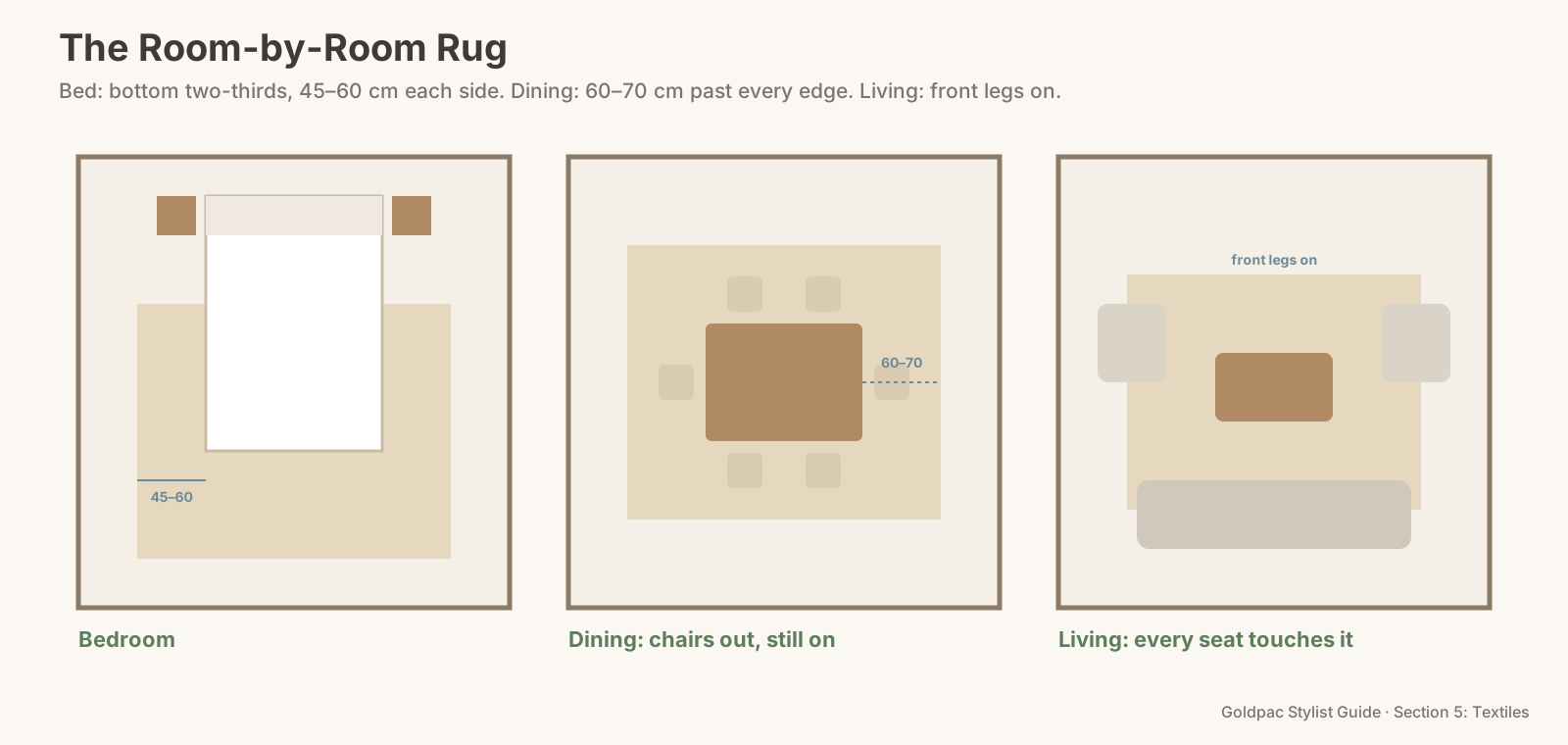
The Room-by-Room Rug
- Bedroom. Rug under the bottom two-thirds of the bed. Bedside tables can sit off it. Aim for 45 to 60 cm of rug each side, a little more at the foot.
- Dining. Measure the table, add 60 to 70 cm on every side. Chairs pulled out should still have all four legs on the rug.
- Living. Front legs of every seat on the rug, or all legs on. Never one chair on and one off.
- Hallway. A runner with 10 to 15 cm of floor showing each side. Not a doormat.
- Entry. One mat, sized to the door. Indoors, skip extra small rugs.
- Bathroom and kitchen. No small mats in the photos (Rule #193 covers bath mats out of the photos).
The Room-by-Room Rug: under the bottom two-thirds of the bed with 45 to 60 cm each side, 60 to 70 cm past every edge of the dining table, front legs of every seat on the living rug, and no small mats in photos.
Mistake and fix
Mistake: a small rug beside each side of the bed. Fix: one large rug under the bed. If you only have small rugs, use none in the bedroom for the photos.
Mistake: a dining rug the same size as the table. Fix: bigger, or no rug. A chair half on the rug tilts and looks unstable in photos.
Mistake: layering three small rugs to fill a big room. Fix: one large rug. Layering only works with one big rug as the base (Rule #131 covers layering rugs).
Choosing a rug for the campaign
Low pile or flat weave. Short wool, jute-look flat weaves and low-pile rugs lie flat, look tidy in photos and recover quickly after an inspection. Shaggy rugs show every footprint and vacuum stripe.
Neutral and quiet. Oatmeal, sand, warm grey or soft cream, with texture rather than a busy pattern. The rug should ground the room, not be the first thing buyers see.
Edges that stay down. A rug with curling corners is a trip hazard at a crowded open home and looks worn in photos. Use a rug underlay that grips, or flatten the corners for a day under heavy books.
Clean before the photos. Vacuum in one direction the evening before, and again on the morning of the shoot, so the pile looks even across the whole rug.
"A big rug will hide our timber floors"
It won't hide them. It frames them.
The floor still shows around the rug on every side. That border is what makes timber look good: a band of floorboards around a soft zone.
Small rugs hide more floor visually, because they break it up. One rug and a clear border reads as more floor, not less.
The blind spot: you bought the rug for the old house
Rugs move house with people. The rug that filled the living room in your last apartment now floats in the middle of a bigger room. You know it's a good rug, so it stays.
In a photo, its size is all that shows. Measure it against the room, not against your memory of where it used to fit. Lay painter's tape on the floor at the size the room needs, then compare it with the rug you have; the gap is usually bigger than people expect, and it's the gap buyers see.
What if…
You can't buy a bigger rug. Use none. Clean bare floors look better than an undersized rug.
The rug is the right size but the wrong colour. Keep the size; size matters more than colour in photos. Choose a neutral next time (Rule #139 covers contrasting the rug's texture with the furniture).
The floors are carpeted. A rug on carpet rarely helps in photos. Skip it, unless the carpet is worn in one spot and a large, flat rug covers it neatly.
You have a dog that loves the rug. Keep it, vacuum it twice before photos and lint-roll the edges. Rules about size still apply.
FAQ
What size rug should go under a queen bed? About 200 × 300 cm, under the bottom two-thirds of the bed, so 45 to 60 cm shows on each side.
How far should a rug extend past a dining table? About 60 to 70 cm on every side, so chairs stay on the rug when pulled out.
Is no rug better than a small rug? Usually, yes. A small rug floating in a room makes it look smaller; a clean bare floor looks larger.
The right rug size makes every room look bigger. Rather have someone size and place the rugs for you? With Photo Ready Styling, our stylist styles your home with your own furniture and rugs before the photos. For empty homes and agent listings, Goldpac stages with our own furniture and rugs: send us the address and a fixed styling quote lands within two hours, through our home staging page. See current prices.
Keep reading: Rule #11: Place furniture legs either all on or all off the rug (furniture legs all on or all off the rug) · Rule #193: No bath mats in the photos (no bath mats in the photos) · Rule #131: Layer rugs only when the room is big enough (layering rugs in large rooms) · Rule #139: Contrast the rug's texture with the furniture (contrasting the rug and sofa textures)
◀ Previous: Rule #125: Layer the bed: quilt, pillows and one throw · Section 5 contents · Next: Rule #127: Choose plump white towels, neatly folded ▶
Part of the Goldpac Stylist Guide: 300+ home staging rules from Goldpac's Sydney styling team.