
Stylist Guide › Section 4: Accessories & Styling › Rule #95
"Is that plant real?"
"Touch it."
"…I honestly can't tell."
"Then it's doing its job."
The rule in one minute. Greenery in a staged home must be real or convincingly realistic. Living plants and branches look alive; premium faux greenery stays perfect for the whole campaign with no watering, wilting or dropped leaves. What fails is the middle: tired real plants with yellow leaves, and cheap fakes that look plastic or dusty. Whatever you use has to pass a close look from 30 cm away in daylight.
The myth: real is always better
- The belief: only living plants will do; anything artificial looks cheap.
- Why it feels right: most of us have seen dusty silk flowers and shiny plastic ferns, and they do look cheap.
- Why it backfires: real plants in a home for sale often struggle. They're moved to new spots, missed on watering days and left in empty homes between inspections. By week three, a real plant with drooping, yellowing leaves says neglect more loudly than any fake.
- What instead: judge greenery by how convincing it is, not by whether it's alive. Premium faux greenery is often the best choice for a staged home, which is why it's what we use when we stage.
Why greenery matters so much
Plants bring life into photos. A single tall plant adds colour, height and a sense of nature that no other accessory can. Rooms without any greenery often feel flat and unfinished.
Greenery softens hard lines. Corners, bare walls and the edges of large furniture all look gentler with leaves in front of them.
It's one of the first things buyers judge up close. Plants sit at eye level beside sofas, in entries and on benches, exactly where people stand. A plant that looks fake or neglected is noticed quickly (Rule #178 covers fake fruit and cheap fakes).
Should you use real or fake plants for home staging?
Either works if it's convincing: real plants and branches that are healthy and fresh, or premium faux greenery realistic enough to pass a close look from 30 cm in daylight. For a staged or empty home, premium faux is often the better choice because it stays perfect for the whole campaign without care. Cheap, shiny, dusty or obviously plastic greenery should never be used.
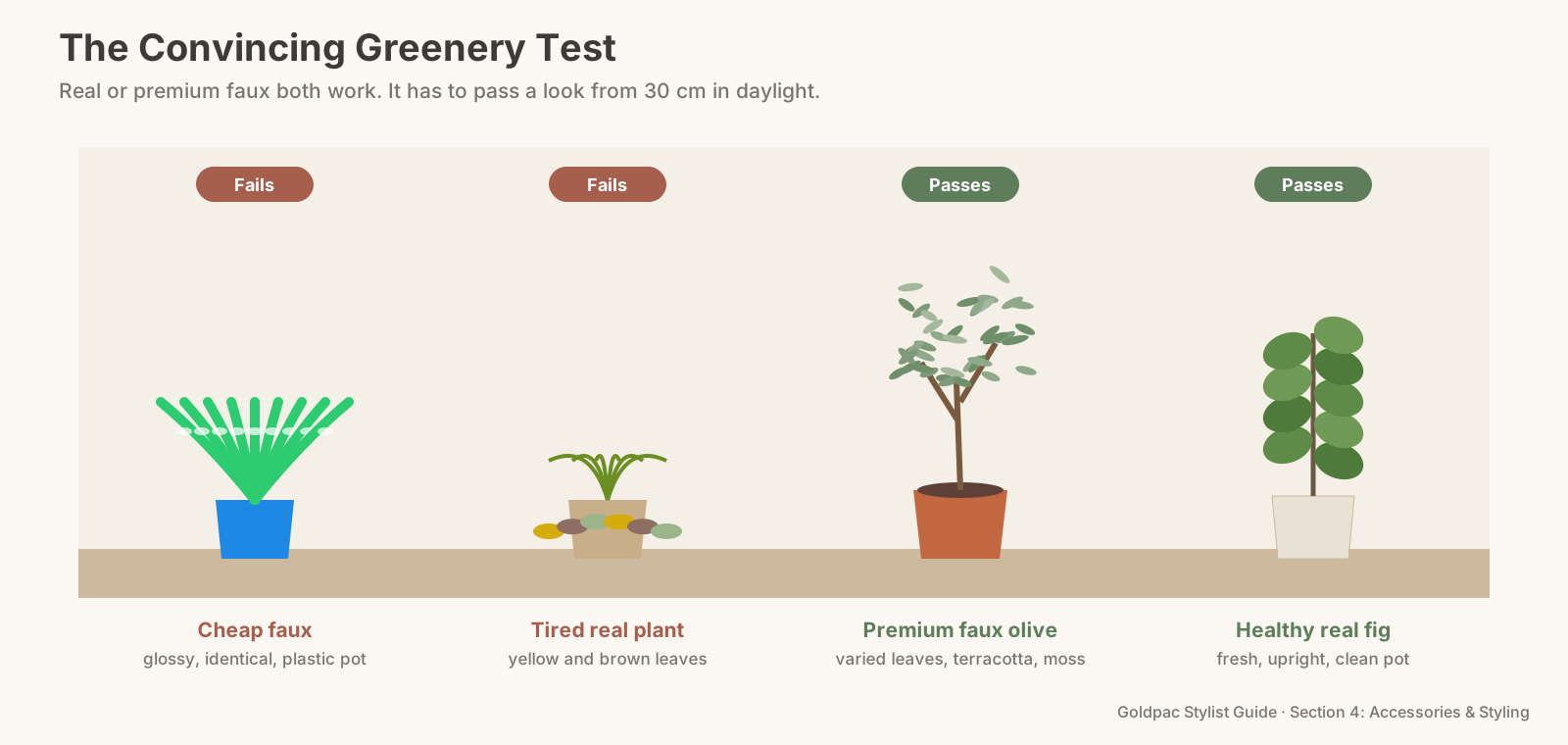
The Convincing Greenery Test
Run every plant in the home through five checks.
- The 30 cm look: stand close, in daylight. Can you tell it's artificial without touching it? If yes, it goes.
- The leaf check: real-looking leaves vary in size, colour and angle, with natural veins and slightly irregular edges. Identical, glossy leaves give fakes away.
- The stem and pot check: realistic woody stems, a real ceramic, terracotta or woven pot, and a top of soil, bark or moss. A plastic pot or visible foam ruins a good faux plant.
- The dust check: wipe faux leaves before every inspection. Dust is the fastest way to make faux look fake.
- The health check for real plants: no yellow or brown leaves, no droop, no pests, no water marks on the floor. Trim or replace anything tired.
The Convincing Greenery Test: every plant passes a look from 30 cm in daylight, varied leaves, real-looking stems in a real pot, no dust, and no yellow leaves on living plants, or it leaves the home.
Buying premium faux: what to look for
Species that fake well. Olive trees, fiddle leaf figs, bird of paradise, eucalyptus stems and trailing pothos tend to look convincing. Ferns, orchids with perfect blooms and anything with very thin, glossy leaves are harder to get right.
Texture and colour variation. Good faux leaves have a matte finish, slightly different greens from leaf to leaf and the odd imperfect edge. Uniform, shiny leaves are the giveaway.
Weight and scale. A heavy, properly sized tree, 1.2 to 1.8 metres tall in a substantial pot, reads as real far more easily than a small tabletop fake.
Finish the top of the pot. Real soil, bark chips or moss over the base hides the foam and makes the plant look rooted.
The phone-camera test
Photograph each plant close up on your phone, then once from the doorway. Faux plants often look more convincing from the doorway than up close, and real plants often look worse in a photo than in person, because the camera picks up every brown tip. Judge the close-up: it's where buyers will be standing.
Time & effort Running the test: about 10 minutes for a whole home. Dusting faux leaves: 1 to 2 minutes per plant before each inspection. Watering and checking real plants: a few minutes a day, every day of the campaign.
Where greenery works best
- Beside the sofa or in a corner: one large plant, 1.2 to 1.8 metres tall (Rule #104 covers using plants for height).
- On the kitchen bench: one herb pot or a small trailing plant.
- In the bathroom: a small plant or a single green stem on the vanity.
- In the entry: one plant or branch arrangement on the console.
- Outside: two matching potted plants at the front door or on the balcony.
One large plant beats several small ones. The lived-in version of this rule makes the same point for everyday homes (Rule #295 covers why one large plant beats five small ones).
The blind spot: you stopped looking at your plants
Plants change slowly, so you don't notice. A fake fern collects a fine layer of dust over months; a real plant loses a leaf a week. Each change is too small to register.
A buyer sees the plant as it is today, often from close up. Look at each one as if you'd just walked in.
What if…
You love your real plants but can't keep them looking good through the campaign. Move the struggling ones out of the photographed rooms, keep the healthiest, and add one or two premium faux pieces where the light is poor.
You have pets. Check that real plants are safe for your animals, and keep faux plants weighted in heavy pots so they can't be knocked over.
FAQ
Do fake plants look bad in real estate photos? Cheap ones do. Premium faux plants with varied leaves, realistic stems and a real pot can look as good as living ones, and they stay perfect for the whole campaign.
What is the best plant for home staging? A large, leafy plant like a fiddle leaf fig, an olive tree or a bird of paradise, real or premium faux, in a simple ceramic or terracotta pot.
How do you make fake plants look real? Choose high-quality faux greenery with varied leaves and natural stems, put it in a real pot with soil, bark or moss on top, and dust it before every inspection.
Convincing greenery brings every room to life. For empty homes and agent listings, Goldpac stages with our own furniture and premium faux greenery that stays perfect for the whole campaign: send us the address and a fixed styling quote lands within two hours, through our home staging page. Living there? A Photo Ready Consultation tells you which plants to keep, move or add, in a written plan within 48 hours of the visit. See current prices.
Keep reading: Rule #295: One large plant beats five small ones (one large plant beats five small ones) · Rule #178: No fake fruit or plastic flowers (real fruit and the 30 cm look)
◀ Previous: Rule #94: Style cushions in coordinated, odd-numbered groups · Section 4 contents · Next: Rule #96: Leave empty space on shelves ▶
Part of the Goldpac Stylist Guide: 300+ home staging rules from Goldpac's Sydney styling team.