
Stylist Guide › Section 5: Textiles › Rule #133
Blackout blinds sell bedrooms, but only if buyers never see them down.
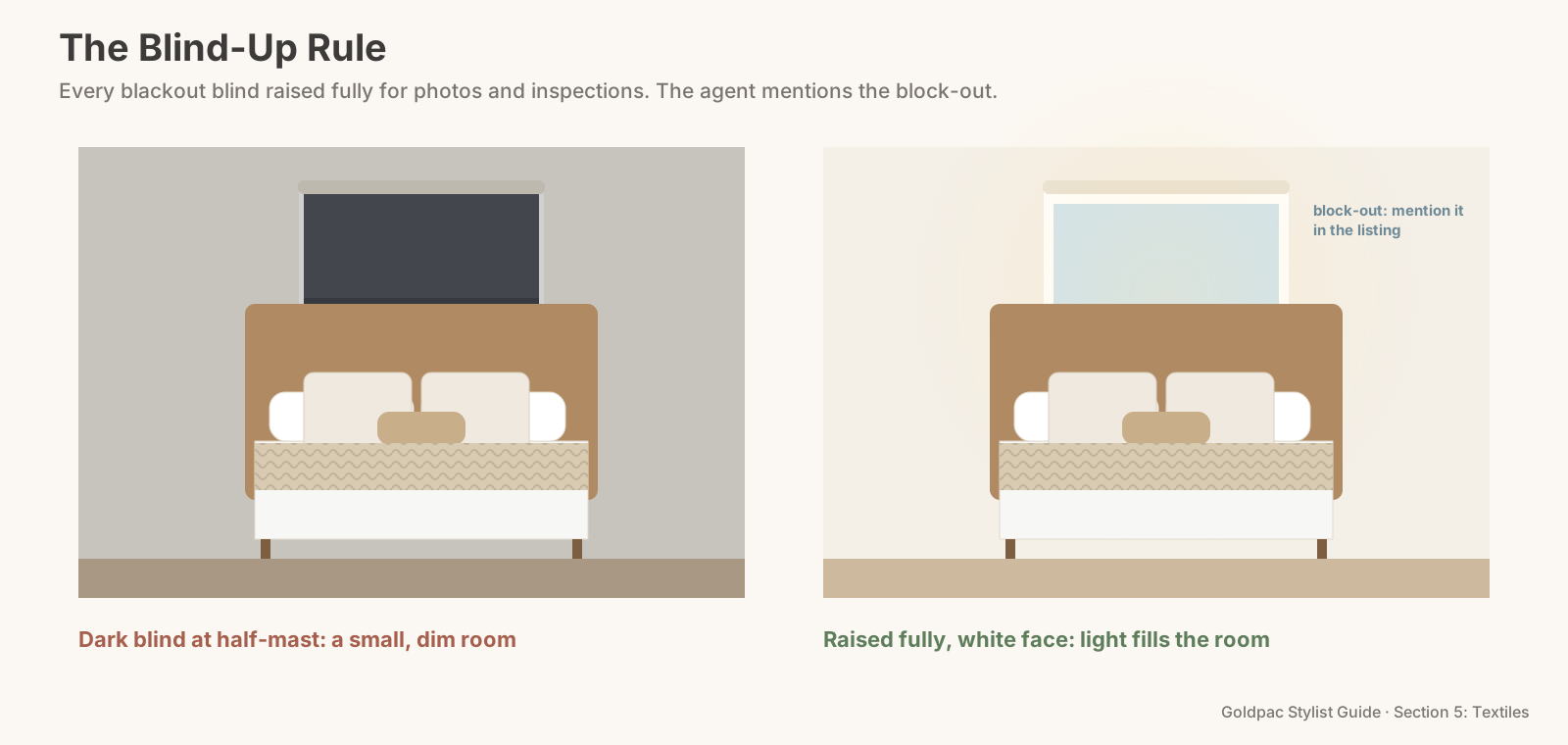
The rule in one minute. Use blackout blinds in bedrooms, open for the photos. Block-out is a real selling point for shift workers, new parents and west-facing rooms, so make sure the agent mentions it. For photos and inspections, raise every blackout blind fully, so the room shows its window and light. A white or soft-neutral fabric that matches the frame disappears when it's up.
Why blackout matters to buyers
Buyers think about sleep. A main bedroom is judged on size and light during the day, and on darkness and quiet at night. Block-out blinds answer the second question before anyone asks it.
Some buyers need it. Shift workers, parents of babies and anyone with a west-facing bedroom in a Sydney summer will look for it. If the blinds are already there, it's one less job after settlement.
It's invisible in photos, unless you mention it. A raised blind looks like any other blind. The listing copy or the agent at the inspection has to say it (Rule #227 covers listing copy that sells feelings, not features).
Why blinds stay up for the photos
Light sells the room. A bedroom photographed with the blackout down looks small, dark and windowless. Even half-lowered, it cuts the light and makes the room look closed in (Rule #302 covers every light on, every blind open).
The window is a feature. Buyers want to see the size of the window and what's outside it. A blind pulled down hides both.
Photographers expect it. Photographers usually ask for every blind open. Having them up before they arrive saves time on the morning of the shoot.
Should blackout blinds be up or down for real estate photos?
Up: raise every blackout blind fully for photos and inspections so the bedroom shows its window, view and daylight, and have the agent mention block-out in the listing or at the inspection, because it's a selling point buyers can't see when the blind is raised. For twilight photos, a blind lowered behind a sheer can work in a bedroom, but only if the window still glows.
The Blind-Up Rule
- Check every bedroom blind works smoothly. A blind that sticks or sags halfway shows in photos and frustrates buyers who test it.
- Raise each one fully, so the bottom rail sits at the top of the frame, not partway down the glass.
- Tidy the chain or cord with a clip at the side of the frame.
- Match the face fabric to the frame. Block-out blinds come with white or neutral room-facing fabric; dark grey or navy blinds look heavy even when raised (Rule #128 covers matching blinds to the wall).
- Tell the agent which bedrooms have block-out, so it goes in the copy.
- Show it at inspections. Some buyers will want to try the blind. Make sure it rolls down and up cleanly.
The Blind-Up Rule: every blackout blind raised fully for photos and inspections, working smoothly, with a tidy chain and a neutral face fabric, and its block-out mentioned by the agent instead of shown.
What to say to the agent
Script block "The main bedroom and the second bedroom both have block-out roller blinds. They'll be up for the photos, so could you mention them in the listing and point them out at the inspections? The main bedroom faces west, so it's a real feature in summer."
The objection: "Then nobody will know they're there"
They will, if you say so. Features that don't photograph well still sell when someone mentions them: block-out blinds, ducted air, a quiet street, good storage. The listing and the agent carry them.
Buyers can test them. At an inspection, a buyer who cares will pull the blind down. That's a better moment than a dark photo, because they choose to see it.
A dark photo costs more than it gains. The first impression of a bedroom online is light and size. A blind down in the photo trades that for a feature most buyers won't notice in a thumbnail.
Check it through your phone
Stand in each bedroom doorway and take a photo. Look at the top of the window. Is any blind visible below the frame? Is any chain hanging into the glass? Raised blinds should be almost invisible in the photo. If you can see a band of blind, raise it further or adjust the stop.
If you're adding block-out blinds
Fit them inside the frame. A roller fitted within the window reveal sits neatly behind any curtain or sheer and almost disappears when raised.
Choose a neutral room-facing fabric. White, soft white or light grey that matches the frame and wall. The street-facing side can be any colour the strata or council allows.
Check the light gaps. Inside-fitted rollers leave a small gap at the edges. For true darkness, a side channel or a curtain in front helps, but for a sale, a neat roller is usually enough.
Keep the hardware tidy. A chain tensioner or a motorised option avoids loose chains hanging in photos.
The blind spot: blinds live at half-mast
Bedroom blinds rarely go all the way up. They're lowered at night, raised partly in the morning, and stay halfway for privacy or to keep the sun off. That height becomes normal.
In photos and at inspections, half-mast blinds make every bedroom look dimmer and smaller than it is. Before each inspection, walk through every bedroom and run each blind to the top.
What if…
The bedroom faces a close neighbour. Use a sheer in front of the raised blind for privacy at inspections, and photograph with the sheer open if the view allows (Rule #132 covers pairing sheers with blinds).
There are no blackout blinds and you're thinking of adding them. If the budget allows one upgrade in bedrooms, neutral block-out rollers fitted inside the frame are a sensible one, but they're not essential for the sale.
The bedroom is photographed at twilight. A raised blind lets the warm room glow through the glass. Leave it up unless the view outside is a wall or a close neighbour's window.
The blinds are old, stained or damaged. Repair or replace before photos; a broken blind is one of the small things buyers notice (Rule #219 covers fixing small things like broken blinds).
FAQ
Are blackout blinds a selling point? For many buyers, yes, especially in west-facing bedrooms and for shift workers or families with babies. Ask your agent to mention them.
Should blinds be open for an open home? Yes. Raise every blind fully so rooms show their light and windows. Buyers who want to test a blind can lower it themselves.
What colour block-out blinds look best? White or soft neutral on the room side, matching the window frame and wall, so they disappear when raised.
Blackout blinds sell quietly, as long as they're up for the photos. Rather have someone set every room before the shoot? With Photo Ready Styling, our stylist styles your home with your own furniture and textiles before the photos. For empty homes and agent listings, Goldpac stages with our own furniture and textiles: send us the address and a fixed styling quote lands within two hours, through our home staging page. See current prices.
Keep reading: Rule #302: Every light on, every blind open (every light on, every blind open) · Rule #132: Line sheer curtains or pair them with blinds (pairing sheers with blinds)
◀ Previous: Rule #132: Line sheer curtains or pair them with blinds · Section 5 guide: styling decor and textiles · Next: Rule #134: Keep bed linen crisp and pressed ▶
Part of the Goldpac Stylist Guide: 300+ home staging rules from Goldpac's Sydney styling team.