
Stylist Guide › Section 5: Textiles › Rule #130
How can one throw make a whole living room look finished?
The rule in one minute. Anchor a room with one statement throw: a single throw in the room's richest texture or accent colour, draped over the arm of the main sofa or across the foot of the bed. It gives the eye a starting point and ties cushions, rug and art together. Three throws look like a laundry pile.
You asked: "What makes a throw a 'statement'?"
It stands out from the sofa, gently. A statement throw is the one textile in the room that differs most from the furniture under it: a chunky knit on a smooth linen sofa, a rust or sage throw on an oatmeal one, a fringed wool blanket on a white bed.
It carries the room's accent. The best statement throw repeats a colour already in the art, a cushion or a vase, so it reads as part of a plan rather than a random blanket (Rule #107 covers letting the art echo the textiles).
It's generous. A small throw looks like a scarf someone left behind. A statement throw is big enough to drape: around 130 × 170 cm or larger for a sofa, wider for a bed.
You asked: "Why only one?"
One throw is a decision. It shows the room was styled. The eye goes to it, then follows its colour or texture to the cushions and the art.
Two throws compete. The eye bounces between them, and neither does its job.
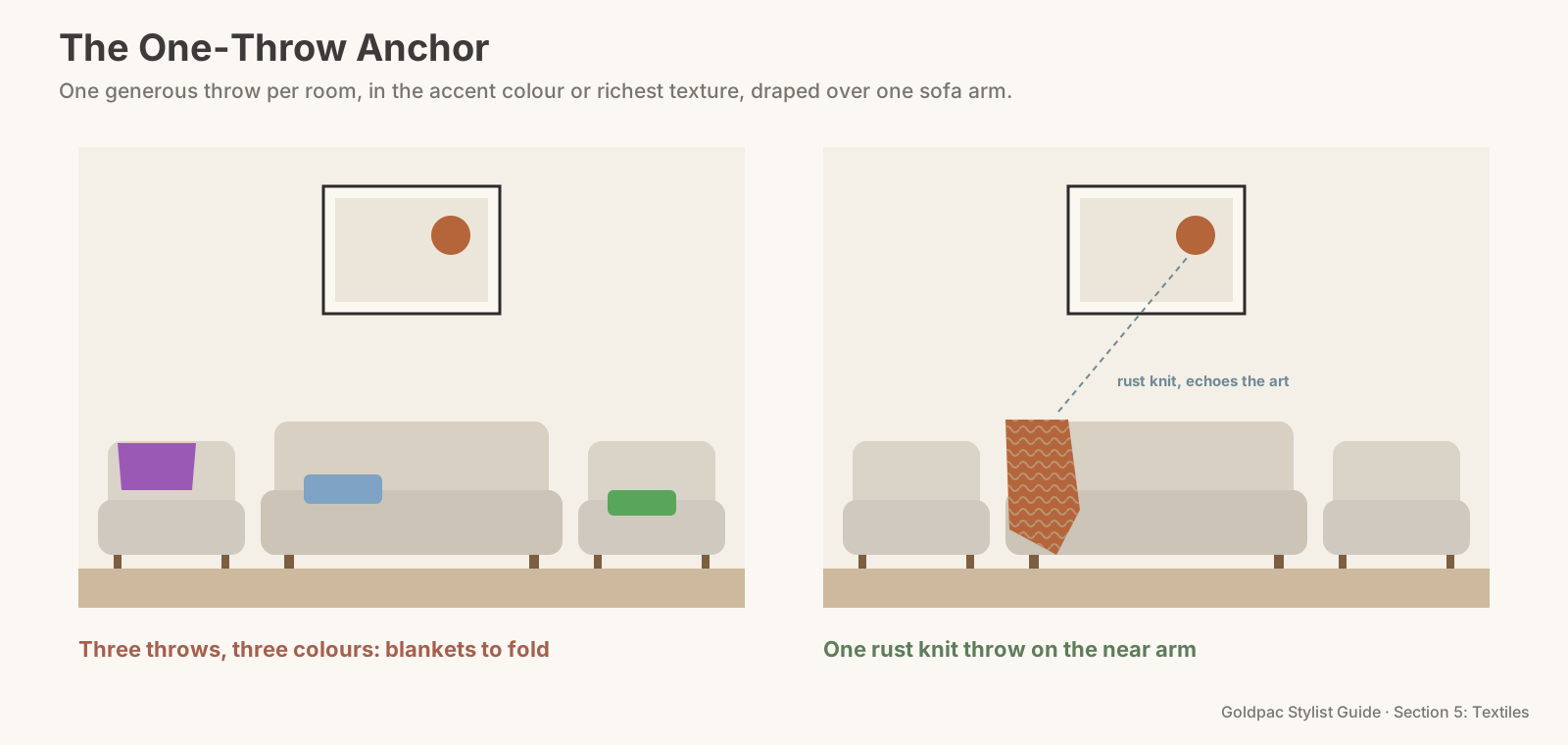
Three throws look unpacked. In a photo, several throws on several seats read as blankets waiting to be folded and put away.
One per room, not one per seat. A sofa and two armchairs share one statement throw. The chairs get a cushion each, or nothing.
Where should a throw go when staging a home?
Place one statement throw over one arm of the main sofa, falling loosely to the seat, or folded across the bottom third of the main bed, and keep every other throw out of that room for photos and inspections. In open-plan spaces, one throw for the living zone is enough; the dining zone gets none.
The One-Throw Anchor
- Choose the throw with the room's richest texture or its accent colour.
- Pick the anchor point: the arm of the sofa nearest the window or the camera's usual angle, or the foot of the main bed.
- Drape, don't fold square. Hold the throw by one corner, lay it over the arm and let it fall naturally, with one corner reaching the seat.
- On a bed, fold it lengthways to about a third of the bed's length and lay it across the foot (Rule #125 covers layering the bed).
- Remove every other throw from the room.
- Step back to the doorway. The throw should be the first soft thing you notice, then lead you to the cushions.
The One-Throw Anchor: one generous throw per room, in the room's accent colour or richest texture, draped over one sofa arm or across the foot of the bed, with every other throw out of sight.
You asked: "What if my throw doesn't match anything?"
Match the room to the throw, a little. If you love a sage throw, add one sage cushion or a small sage vase. Two echoes and the throw becomes the anchor.
Or choose the room's colour. A throw in the same tone as the sofa but a different texture, like an oatmeal knit on an oatmeal linen sofa, is a quieter statement that always works (Rule #122 covers mixing textures).
Avoid busy patterns. Tartan, large florals and graphic prints rarely work as a statement in a sale. Texture and one colour do the job without dating the room.
Mistake and fix
Mistake: a throw folded into a neat square on the seat. Fix: drape it over the arm. A square on the seat looks like it's waiting to be put away.
Mistake: a small fleece blanket used as the throw. Fix: wool, cotton or a knit, big enough to drape. Fleece looks like a TV blanket in photos.
Mistake: the statement throw on the armchair, not the sofa. Fix: the sofa, usually. It's the main piece, and the throw should anchor it.
The blind spot: throws spread through the house
Throws travel. One ends up on the sofa for movie night, another on the armchair by the window, a third on the end of the bed. Each spot makes sense on its own.
During the campaign, every throw except the statement one goes into the linen cupboard before inspections. You can still use them in the evening. They just don't live on the furniture.
What if…
You have pets that sleep on a throw. Use a separate pet blanket during the week and put the statement throw out only for photos and inspections, lint-rolled.
It's summer. Choose a lighter cotton, linen or waffle throw. It still anchors the room without looking heavy.
Do-This-Sunday box Gather every throw in the house. Pick the one with the best texture or the room's accent colour for the living room, and one for the main bed. Fold the rest into the linen cupboard. Drape the two winners and look from each doorway.
FAQ
How many throws should be on a sofa for staging? One. Draped over one arm, in the room's accent colour or richest texture.
What size throw is best for a sofa? Around 130 × 170 cm or larger, so it drapes generously over the arm and down to the seat.
One throw, well placed, anchors a whole room. Rather have someone choose and place it? With Photo Ready Styling, our stylist styles your home with your own furniture and throws before the photos. For empty homes and agent listings, Goldpac stages with our own furniture and textiles: send us the address and a fixed styling quote lands within two hours, through our home staging page. See current prices.
Keep reading: Rule #107: Let the artwork echo the textiles (letting the artwork echo the textiles) · Rule #125: Layer the bed: quilt, pillows and one throw (layering the bed) · Rule #141: Choose double-sided throws for quick changes (double-sided throws) · Rule #150: Pair knitted textures with smooth surfaces (knit on smooth surfaces)
◀ Previous: Rule #129: Choose plain bedding, never patterned or branded · Section 5 contents · Next: Rule #131: Layer rugs only when the room is big enough ▶
Part of the Goldpac Stylist Guide: 300+ home staging rules from Goldpac's Sydney styling team.