
Stylist Guide › Section 3: Lighting › Rule #89
A textured wall lit from the front looks like a flat, slightly dirty wall. Lit from the side, it becomes the most expensive-looking surface in the room.
The rule in one minute. Textured walls (exposed brick, sandstone, timber panelling, VJ boards, rendered or limewashed walls) only show their texture when light hits them at a low angle from the side, top or bottom. Light from the front flattens them. Graze textured walls with an uplight at the base, a wall washer at the top or a lamp placed close beside them, and switch it on for photos. Keep the light warm and the wall clean.
Why angle is everything
Texture is made of tiny shadows. Every brick, every groove in a VJ board, every ridge in sandstone casts a small shadow when light comes from the side. Those shadows are what the eye reads as texture.
Front light erases them. A downlight in the middle of the room, or a camera flash, lights the face of each brick evenly, so the shadows vanish. The wall looks flat, and often patchy or dirty.
Grazing light exaggerates them. Light skimming along the wall from close by makes every ridge throw a shadow. The wall comes alive, and it reads as a feature.
Two ways to light the same brick wall
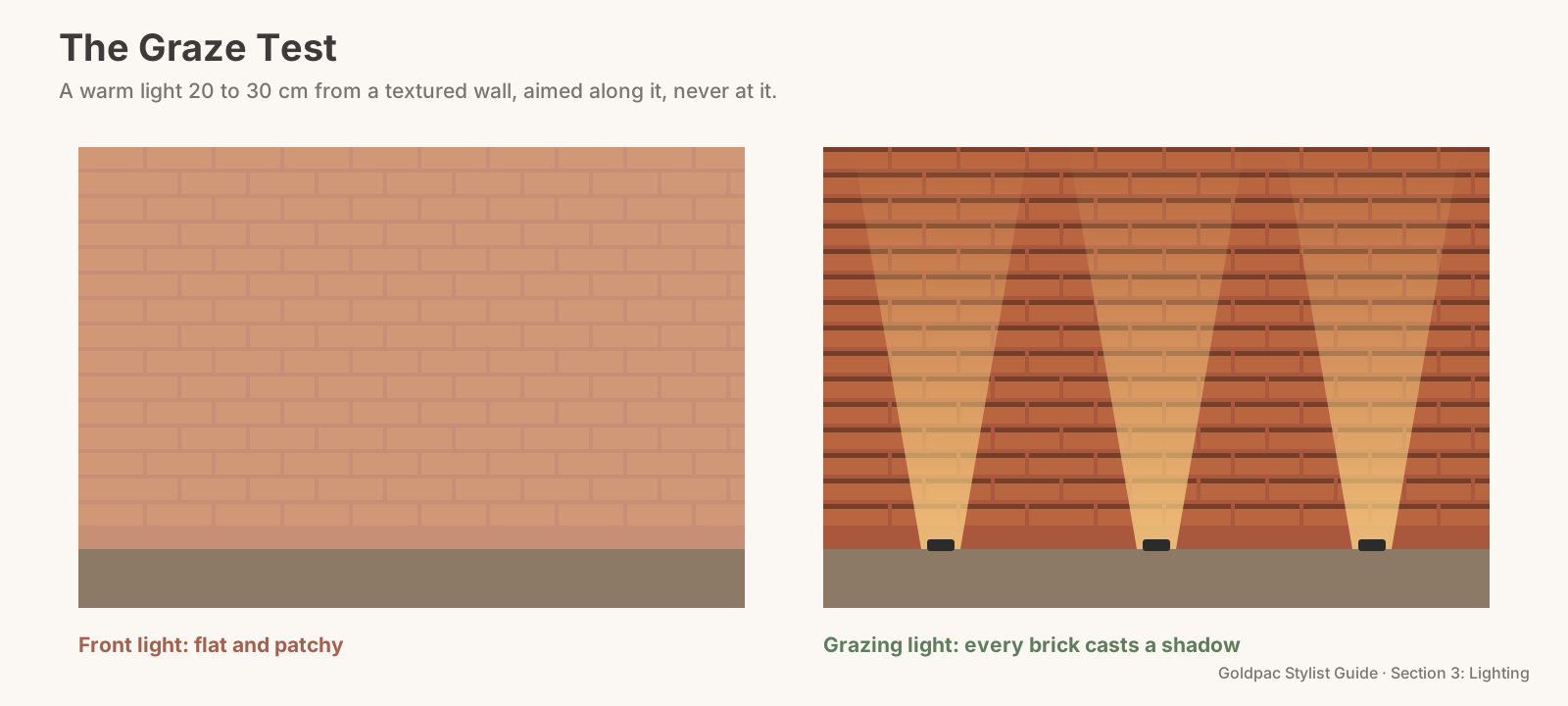
Way one: front light. A downlight in the middle of the room shines across at the wall. Every brick is lit evenly. The mortar lines blur. In photos, the wall looks like a flat red-brown surface with stains.
Way two: grazing light. An uplight on the floor, about 20 to 30 cm from the base of the wall, aimed straight up. Light skims the bricks. Every edge throws a small shadow. In photos, the wall looks rich, warm and deliberate.
| Front light | Grazing light | |
|---|---|---|
| Light position | middle of the room | close to the wall, at the base or top |
| Shadows in the texture | none | small, crisp, even |
| How the wall reads | flat, patchy | rich, three-dimensional |
| In photos | dull | a feature |
| Effort | none | one uplight or wall washer |
Verdict: grazing light, always, for any wall you want buyers to notice.
How do you light a textured wall?
Place a warm light close to the wall, about 20 to 30 cm away, aimed along it from the bottom or top, so the light skims the surface instead of hitting it head-on. A floor uplight, a strip at the top of the wall, or a lamp right beside the wall all work. The closer the light and the shallower the angle, the stronger the texture.
The Graze Test
- Pick the textured wall buyers should notice: a brick feature, sandstone, panelling.
- Turn off the ceiling lights nearest the wall, if they flatten it.
- Hold a torch (your phone's will do) against the base of the wall, pointing straight up. Watch the texture appear.
- Place an uplight there, about 20 to 30 cm from the wall, or a lamp close beside it.
- Use a warm globe, 2700 to 3000K (Rule #63). Warm light flatters brick and timber.
- Clean the wall first. Grazing light shows dust in every groove, cobwebs and scuffs.
The Graze Test: a warm light 20 to 30 cm from a textured wall, aimed along it, never at it, so every ridge throws a shadow.
Two terms worth knowing
Wall grazing. Lighting a wall from very close and at a steep angle, so texture shows. Best for brick, stone and panelling.
Wall washing. Lighting a wall from further back, evenly, so it looks smooth and bright. Best for flat painted walls and artwork backgrounds.
Textured walls worth grazing
- Exposed brick in terraces, warehouse conversions and Federation homes.
- Sandstone in older Sydney homes and garden walls.
- VJ boards and timber panelling in cottages and coastal homes.
- Limewash and Venetian plaster, which look flat under front light and cloudy-soft under grazing light.
- Stone or tile feature walls in bathrooms and outdoor areas.
Styling in front of a lit wall
A grazed wall is a backdrop, so keep what's in front of it simple. One piece of furniture, like a timber console or a low sideboard, and one or two objects with clean outlines: a large vase, a single plant, a stack of books. Busy shelving or a gallery of frames fights the texture, and the eye no longer knows whether to look at the wall or the things on it. Always leave at least a little clear wall above and beside the furniture so the light has somewhere to travel and fade.
Keep the uplights out of the walkway. Tuck them behind a plant pot or the leg of a console, or choose low, slim fittings that read as part of the floor.
Outdoors, at twilight
Sandstone retaining walls, rendered garden walls and brick fences are perfect candidates. A few small garden spotlights at their base, aimed up, turn a backyard into a lit room for twilight photos. Warm white only, evenly spaced along the wall, with every cable buried or hidden behind plants. It also makes the garden look larger after dark, because lit walls mark its edges and show buyers how far it really goes.
The blind spot: you see it every day in daylight
Daylight usually comes from the side. By day, a window beside a brick wall grazes it naturally. You see the texture every morning and assume the wall always looks like that.
At night, or in a twilight shoot, the ceiling lights take over and the wall goes flat. Check the wall at dusk with only the room lights on.
What if…
The wall has flaws (cracked render, crumbling mortar, uneven patching). Grazing light shows every one. Repair first, or light it more softly from further back.
There's no power near the wall. A rechargeable uplight works for photos and inspections.
It's an outdoor sandstone wall. A small garden spotlight at the base, aimed up, does the same job for twilight photos.
You're renting and the brick is painted. Painted brick still shows its shape under grazing light. A warm uplight at the base makes even a white-painted brick wall look deliberate rather than plain.
FAQ
What is the best light for an exposed brick wall? Warm white light from close to the wall, aimed along it from the base or the top. It brings out every brick and makes the wall a feature.
How far from a wall should an uplight be? About 20 to 30 cm for strong texture. Further back gives a softer, more even wash.
Should a feature wall be lit for real estate photos? Yes, especially in twilight shots. A grazed textured wall can become one of the most striking parts of the listing.
A feature wall only looks like a feature when it's lit like one. With Photo Ready Styling, our stylist styles your home with your own furniture and lamps before the photos, including the walls that deserve a light. For empty homes, our home staging brings our own pieces: send us the address and a fixed styling quote lands within two hours. See current prices.
Keep reading: Rule #67: Light art, mirrors and corners to add depth (accent lighting on art, mirrors and corners) · Rule #38: Use the same colour in different textures for depth (three textures in one colour)
◀ Previous: Rule #88: Light rooms without harsh shadows · Section 3 contents · Next: Rule #90: In bathrooms, side lights beat a single ceiling light ▶
Part of the Goldpac Stylist Guide: 300+ home staging rules from Goldpac's Sydney styling team.