
Stylist Guide › Section 3: Lighting › Rule #88
Late afternoon. A buyer steps into the living room. One downlight right over the coffee table. A hard black shadow pools beneath it. The sofa throws a dark band across the rug. The pendant over the dining table casts a crisp circle on the floor. Each shadow has an edge you could cut with scissors. The room feels smaller than it is.
The rule in one minute. Harsh shadows come from small, bright light sources aimed from one direction, usually a single downlight or a bare globe overhead. They make rooms look smaller, darker and more dramatic than a buyer wants. Soften them by adding light from a second and third direction (lamps at the sides, a floor lamp in the corner), using shades and diffusers, and bouncing light off walls and ceilings. Aim for shadows with soft, blurry edges.
Walk in and look down
Shadows live low.
Look at the floor under the coffee table. Hard black edge? That's one light, straight above.
Look under the dining chairs. Sharp stripes across the rug? Same story.
Look at the wall behind the sofa. A dark band where the sofa blocks the light? The only light is in front.
Look at the corners. A sharp line where wall meets wall, one side bright, one side dark? Light from one side only.
Now look up
Bare globes. Small downlights. A single pendant with an open bottom.
Small, bright sources make hard shadows. The smaller the light, the sharper the edge. A bare globe is tiny; a big linen shade is large and soft. Put the same globe inside each and the shadows look nothing alike.
One direction makes deep shadows. Light from one side leaves the other side dark. Light from two or three directions fills it in.
How do you get rid of harsh shadows in a room?
Add light from at least two more directions and make every source larger and softer: lamps with fabric shades at the sides, a floor lamp in the corner, and light bounced off walls or ceilings. Shadows don't disappear, but their edges soften and they lighten, which is what makes a room feel open and calm (Rule #61 covers three light sources).
The Soft-Edge Walk
- Turn on only the ceiling lights. Walk the room and look down.
- Find the hardest shadows: under tables, behind sofas, under pendants, in corners.
- Add a lamp on the opposite side of each hard shadow, so light reaches into it.
- Shade every bare globe and fit frosted or opal globes where a fitting allows.
- Bounce light: aim an adjustable light or an uplight at a pale wall or ceiling, so the whole surface becomes a large, soft source.
- Walk the room again. Shadow edges should be blurry, not crisp.
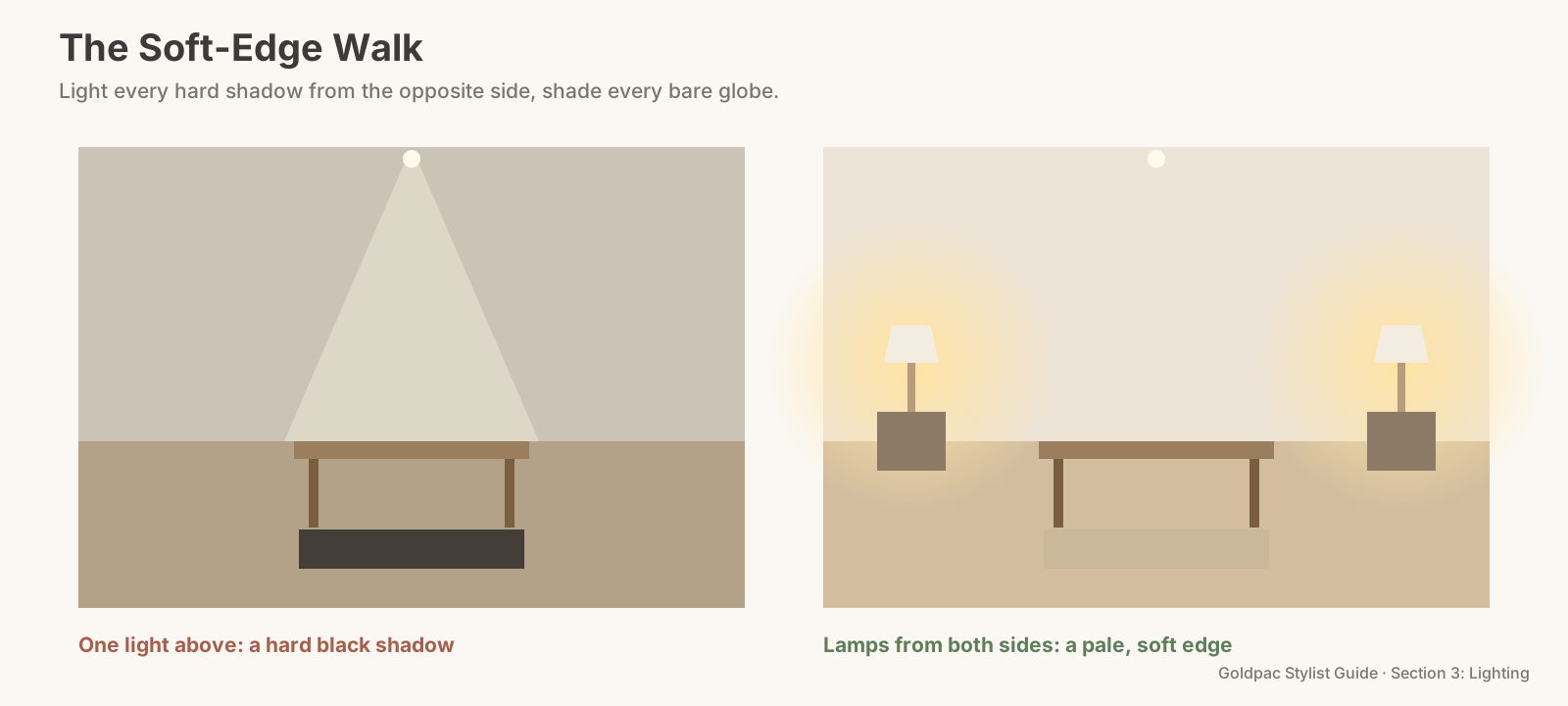
The Soft-Edge Walk: light every hard shadow from the opposite side, shade every bare globe, and bounce light off pale walls until every shadow has a soft edge.
The phone-camera test
Photograph the room from the doorway with only the ceiling lights on, then again with lamps added. Zoom into the floor under the coffee table and the wall behind the sofa. In the first photo, the shadow edges are crisp; in the second, they should blur. If they're still sharp, add another lamp or a larger shade.
Do this Sunday
At dusk, walk each main room with your phone torch off and every light on. Wherever you can see a shadow with a sharp edge, put your hand into it and look for which light is causing it. Then find a lamp that can shine from the opposite side. Fix the living room first; it's usually the hero photo, and the one buyers see before any other.
The objection: "Shadows add drama"
Drama suits a restaurant, not a listing. Strong shadows look moody in a magazine shoot lit by professionals. In a home for sale, they read as dim and cramped, and they hide the floor area buyers are trying to measure with their eyes.
The blind spot: shadows move with you
You never stand still long enough to see them. As you walk through your home, shadows shift and change, and you're always moving toward a light.
A camera stands still. Every shadow in the frame is captured, sharp edge and all. Stand in the doorway, perfectly still, and look down at the floor.
What if…
You can't add lamps (no power points, small room). Swap clear globes for frosted ones, and switch off the single downlight casting the worst shadow if other light is enough.
The room has only one window. Daylight is one direction too. Add lamps on the window side and the opposite side so faces and furniture are lit from both.
FAQ
Why does my room have harsh shadows? Usually because most of the light comes from a few small, bright sources overhead. Adding lamps at the sides and using shades or frosted globes softens the shadows.
Harsh shadows are a lighting problem that looks like a space problem. With Photo Ready Styling, our stylist styles your home with your own furniture and lamps before the photos, softening every shadow in the frame. If you'd rather do it yourself, a Photo Ready Consultation leaves a written room-by-room plan within 48 hours of the visit. See current prices.
Keep reading: Rule #61: Use at least three light sources in every room (three light sources in every room) · Rule #78: Avoid harsh spotlights over furniture (spotlights on walls, not the sofa)
◀ Previous: Rule #87: Fix flickering globes and tubes · Section 3 contents · Next: Rule #89: Use accent lighting on textured walls ▶
Part of the Goldpac Stylist Guide: 300+ home staging rules from Goldpac's Sydney styling team.