
Stylist Guide › Section 3: Lighting › Rule #63
"Which globes should I buy?"
"What does the box say?"
"Daylight."
"Put it back."
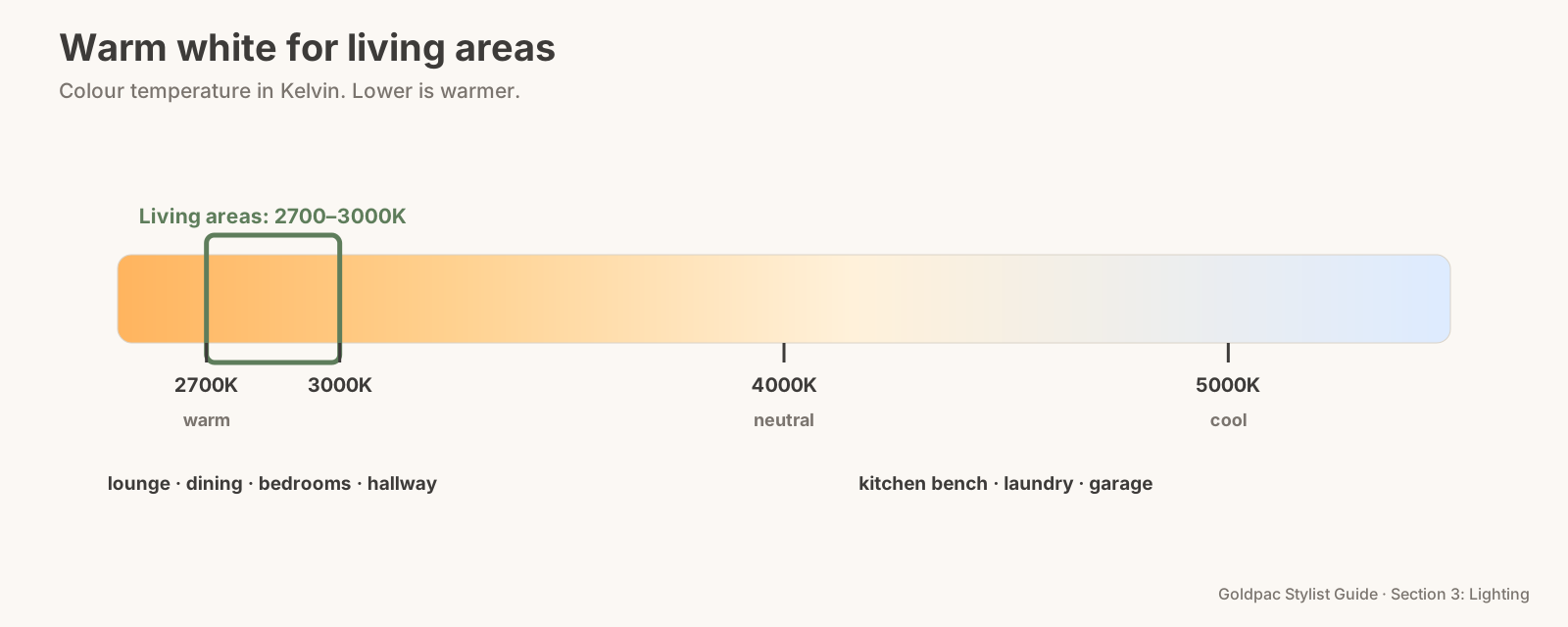
The rule in one minute. In living areas (lounge, dining, bedrooms, hallways), use warm white globes between 2700K and 3000K. Lower Kelvin numbers mean warmer, softer light; higher numbers mean cooler, bluer light. Warm white makes rooms feel relaxed and makes timber, linen and skin look good. Save cooler light for task areas like the kitchen bench, and keep every globe in one room the same colour.
Your questions, our answers
Globes are the cheapest styling decision in a home and one of the most often wrong. These are the questions sellers ask most, and our answers.
"What does the K number mean?"
It's the colour of the light, measured in Kelvin. Low numbers are warm and yellowish, like a lamp at dusk. High numbers are cool and bluish, like an overcast midday. The NSW Government's lighting guide describes warm white at 2700K as suited to bedrooms and living areas, and cool white at 5000K as better for tasks in kitchens and garages (Energy NSW, "Advice for energy efficient lighting").
Living rooms aren't for tasks. They're for sitting, talking and imagining a life. That's warm-white territory.
"Why 2700 to 3000K, not lower or higher?"
2700K is the classic warm glow. Soft and golden, close to the look of an old incandescent globe. Great for bedrooms, lamps and evening living.
3000K is a crisper warm. Still warm, but cleaner. It suits living areas with white walls and modern finishes, and it photographs well in daylight.
Above about 4000K, light starts to look cool. Fine on a kitchen bench or in a garage. In a lounge, it reads as clinical.
Below 2700K, light turns orange. It's moody, but it can make white walls look yellow in photos.
"Does it really show up in the photos?"
Yes, especially when globe colours are mixed. A camera balances its colour to the overall scene. A cool globe in a warm room shows up as a bluish patch; a warm globe in a cool room glows orange. Rule #298 covers matching every globe for photo day.
And the colour of light changes how everything else looks. Warm light flatters timber floors, linen, cream walls and people. Cool light makes the same room look grey.
"What about the kitchen and bathroom?"
Warm or neutral, not cold. Kitchens and bathrooms often have cooler light for working. For inspections and photos, a kitchen that's all 5000K can feel stark, and food looks flat under it (Rule #45). If you're replacing globes there anyway, a neutral white is a sensible middle. If not, add a warm lamp nearby and leave the task lights alone.
The Warm-Globe Swap
- Walk every living area with all the lights on: lounge, dining, bedrooms, hallway, entry.
- Look for the odd ones out. Any fitting that looks white-blue next to the others is cooler.
- Check the globe or its box. Note the Kelvin and the fitting type (bayonet, screw or a specific downlight).
- Buy one colour for all living areas, 2700K or 3000K, and swap every globe in each room so they match.
- Recheck at dusk, when globe colour shows most.
The Warm-Globe Swap: every globe in every living area replaced with one warm white between 2700K and 3000K, checked again at dusk.
What to say at the hardware store
If you're unsure, take a photo of the fitting and ask:
"I need globes for living rooms and bedrooms. Warm white, 2700 or 3000K, to fit this. Can you show me the ones that match each other?"
Buy them all from the same brand and range if you can. Two "warm whites" from different brands can still look different side by side.
Mistake and fix
Mistake: a cool "daylight" globe in the bedside lamp, because it was the one in the cupboard. Fix: swap it for 2700K. The bedside lamp should be the warmest light in the house.
Mistake: one cool globe left in a three-light pendant. Fix: swap it. One mismatched globe in a fitting shows up instantly.
The blind spot: you replaced them one at a time
Globes fail one by one. Each time, someone grabs whatever's in the cupboard or the supermarket. After a few years, one room has three different whites in it.
You've watched it change so slowly that it looks normal. Turn every light on at dusk and look along the ceiling: the mismatches are obvious once you're looking for them.
What if…
The downlights are integrated LEDs you can't swap. Live with them, but make sure every lamp you add matches their colour as closely as you can.
You're renting. Swapping globes is usually fine, but keep the old ones in a box to put back when you leave.
FAQ
Is 3000K or 4000K better for a living room? 3000K is generally better for living rooms. It's warm and relaxed. 4000K is a neutral white that suits kitchens, laundries and work areas.
Globes are a ten-minute job that most homes never get to. With Photo Ready Styling, our stylist styles your home with your own furniture before the photos and checks that every room's light works with it. If you'd rather do it yourself, a Photo Ready Consultation lists every fitting to fix in a written room-by-room plan within 48 hours of the visit. See current prices.
Keep reading: Rule #298: Same light colour in every globe (matching globes for photo day) · Rule #45: Choose kitchen colours that make food look good (kitchen colours that make food look good) · Rule #69: Avoid cold LED strips, except for a soft ambient glow (warm versus cool LED strips) · Rule #75: Avoid coloured lighting in a staged home (why coloured lights should go white for photos)
◀ Previous: Rule #62: Combine overhead lighting with side lamps · Section 3 guide: colour and lighting · Next: Rule #64: Never rely on ceiling lights alone ▶
Part of the Goldpac Stylist Guide: 300+ home staging rules from Goldpac's Sydney styling team.