
Stylist Guide › Section 3: Lighting › Rule #64
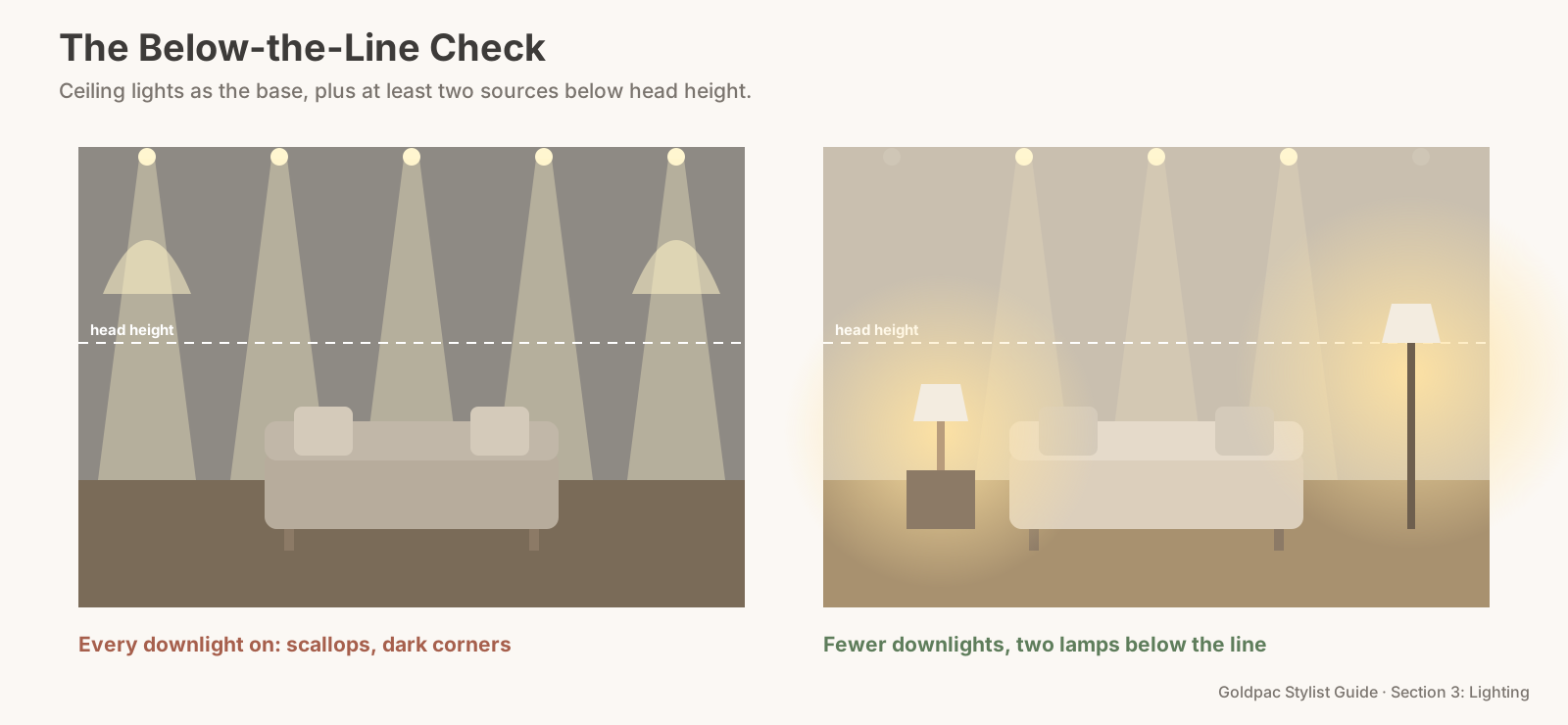
Thursday, 6 pm, twilight open home. Twelve downlights blaze across the living room ceiling. The floor is bright, the coffee table glares, and the sofa sits in its own shadow. On the walls, a row of bright half-circles marks where each downlight hits. A buyer walks in, squints a little, and heads straight for the kitchen.
The rule in one minute. Ceiling lights, whether downlights, a pendant or a fan light, shine down, so used alone they light floors and tabletops and leave walls, faces and corners in shadow. A staged room always needs light from lower down as well: table lamps, floor lamps or wall lights. Keep the ceiling lights on as the base layer, add at least two sources below head height, and check the room at dusk, when ceiling-only lighting looks worst.
The autopsy: what ceiling-only light does
- Hot floors, dark walls. Downlights pool light on the floor and benchtops. Walls, where the eye judges a room's size, stay dim.
- Scallops. Downlights close to a wall throw bright half-circles up it. In photos they look like stains.
- Top-down shadows. Light from directly above puts shadows under every object: under the coffee table, under shelves, under eyes.
- Glare. Look up and you see the globe. In a twilight photo, a grid of bright dots across the ceiling pulls the eye up, away from the room.
- A cave at the edges. The centre of the room is bright; the edges fall away. The room reads smaller than it is.
What it costs at an inspection
The room looks smaller. Buyers judge size by the walls and corners. If those are dim, the room shrinks.
It looks colder. Ceiling-only light, especially from cool downlights, makes a room feel like a corridor or an office.
It looks unlived-in. Without a single lamp, a living room has no warm point for the eye to settle on. It feels like a display, not a home.
And twilight shoots punish it most. At dusk there's no daylight to soften the walls. Every flaw of ceiling-only lighting shows at once, in the photo that's meant to be the most atmospheric.
Why do rooms look dark even with all the downlights on?
Because downlights light the floor, not the walls. A room feels bright when its vertical surfaces are lit: walls, curtains, artwork, the sides of furniture. Downlights send most of their light straight down. You can have twelve of them on and still have dim walls and a gloomy feel.
The ten-minute fix: The Below-the-Line Check
Think of an imaginary line at head height. Ceiling light is above it. Everything else is below it.
- Turn on every ceiling light in the room and stand in the doorway.
- Find the dim walls and corners. Usually the walls furthest from the downlights and the corners behind furniture.
- Add at least two light sources below the line. Table lamps, a floor lamp, a wall light, a lamp on a bookshelf, placed toward the dim walls.
- Dim the ceiling if you can, or turn off the downlights closest to a wall that are throwing scallops.
- Turn off the ceiling fan light if its globes are bare or mismatched.
- Check again at dusk. If the room still looks like a cave at the edges, add one more source below the line.
The Below-the-Line Check: keep the ceiling lights as a base, and add at least two sources below head height aimed at the dimmest walls.
If this, then that
- If the ceiling fan has a light kit: turn the fan light off for photos, especially if its globes are bare or mismatched. Keep the downlights.
- If a single pendant is the room's only light: treat it as a feature, not a system, and add two lamps at the sides of the room.
- If downlights sit within a metre of a wall: switch those off and keep the ones in the middle, so the walls lose their scallops.
- If it's photo day: downlights on, lamps on, fan light off, and let your photographer adjust from there (Rule #302 covers lights and blinds for the shoot).
The blind spot: you live under the ceiling lights
Ceiling lights are the ones on the switch by the door. You flick them on, you see well enough to cook, to clean, to find things. They've done their job, so you've never needed to notice what they don't do.
Lamps take an extra step, so in many homes they rarely get switched on. Buyers arriving at dusk see the room exactly as your switch by the door leaves it.
What if…
There are no lamps and no power points where you need them. Rechargeable cordless lamps work for an open home. They're light, portable and need no cord.
It's a rental with harsh, cool downlights you can't change. Turn off the ones nearest the walls, keep the centre ones on, and let warm lamps carry the edges of the room.
Your agent wants a twilight shoot. Plan the lamps first. Twilight photos show interior lighting more than any other kind.
FAQ
Are downlights enough to light a living room? Usually not on their own. Downlights light the floor and benches well but leave walls and corners dim. Add lamps or wall lights at lower heights to make the room feel bright and warm.
Should the ceiling fan light be on for photos? Usually off, especially if the globes are bare or don't match. Ask your photographer on the day.
Ceiling-only lighting is the default in most homes, because the switch is by the door. With Photo Ready Styling, our stylist styles your home with your own furniture and lamps before the photos, so every room has light below the line. Want a plan to follow yourself? A Photo Ready Consultation leaves one, room by room, within 48 hours of the visit. See current prices.
Keep reading: Rule #302: Every light on, every blind open (lights and blinds on photo day) · Rule #62: Combine overhead lighting with side lamps (combining ceiling lights and lamps)
◀ Previous: Rule #63: Use warm white globes (2700–3000K) in living areas · Section 3 contents · Next: Rule #65: Floor lamps add height and warmth ▶
Part of the Goldpac Stylist Guide: 220+ home staging rules from Goldpac's Sydney styling team.