
Stylist Guide › Section 3: Lighting › Rule #67
"The room's bright enough. Why does it still look flat?"
"Where's your eye supposed to go?"
"…Everywhere?"
"That's why."
The rule in one minute. Even light makes a room visible; accent light gives it depth. Put small, directed pools of light on three kinds of places: artwork, mirrors and dark corners. A picture light or a lamp aimed at a painting, a lamp beside a mirror, and an uplight or floor lamp in a corner create layers of near and far that the eye reads as space. Three accents per living room is plenty.
Why accents add depth
"So more light isn't the answer?"
Different light is. A room lit evenly from above looks like a photograph of a room: everything at the same brightness, nothing in front or behind. Accent light creates contrast, small bright areas against softer surroundings, and that contrast is what the eye uses to judge depth.
"Why art, mirrors and corners?"
Because each one does a different job.
- Art is a focal point. Lit, it becomes the place the eye lands first.
- Mirrors multiply light. A lamp beside a mirror is two lights for the price of one.
- Corners are where rooms end. Light them, and the room seems to extend; leave them dark, and it closes in.
How do you use accent lighting in a living room?
Pick three targets (one artwork, one mirror and one dark corner) and give each its own small, directed light, warmer and softer than the ceiling light. Use picture lights, small spotlights on a track, table lamps placed beside the target, or uplights on the floor. The goal is three soft highlights, not three spotlights.
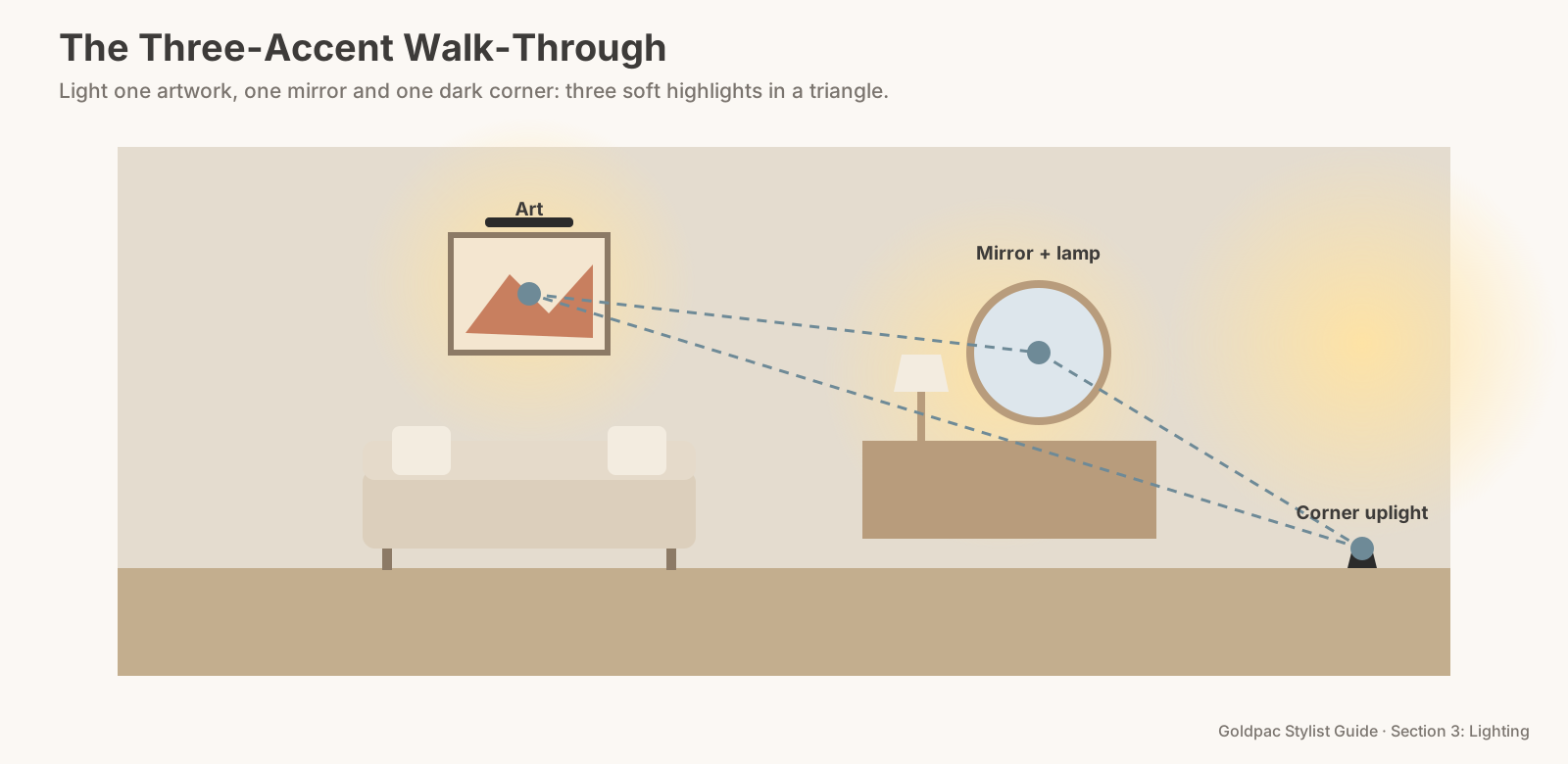
The Three-Accent Walk-Through
Walk the room with these steps, in this order.
- The art. Choose the main artwork. Is there light on it? If not, add a picture light above it, or place a lamp on the sideboard below or beside it so the glow catches the frame.
- The mirror. Find the largest mirror. Put a lamp next to it, not in front, so the mirror reflects the glow back into the room (Rule #68 covers mirror placement).
- The corner. Stand in the doorway and find the darkest corner. Add a floor lamp or a small uplight on the floor, pointing up the wall.
- The balance. Turn everything on. The three accents should sit in different parts of the room, ideally forming a loose triangle.
- The ceiling. Dim it a step if you can. Accents read best when the general light is slightly lower.
- The colour. Same warm globe colour everywhere (Rule #63).
The Three-Accent Walk-Through: light one artwork, one mirror and one dark corner, so three soft highlights form a triangle across the room.
Beyond the living room
Bedrooms take one accent well: a lamp beside a mirror on a dresser, or a picture light over the bedhead artwork. Hallways take one too: a lit print at the far end draws buyers along the corridor. Dining areas can use the sideboard lamp to light the art above it.
Mistake and fix
Mistake: a bright spotlight aimed straight at a glossy painting. Fix: glare. Angle the light from above at about 30 degrees from the wall, or use a warm lamp placed below instead.
Mistake: a lamp directly in front of a mirror. Fix: the mirror shows the back of the shade. Move the lamp to one side so the mirror reflects its glow.
Mistake: an uplight under a dusty plant. Fix: uplights show every leaf and every speck. Clean the plant and the wall first, or light a clean corner instead.
The phone-camera test
Take a photo from the doorway with only the ceiling light on, then one with the three accents added. On your phone, the second photo should show a clear front, middle and back to the room. If it still looks flat, one of the accents is too weak or too close to the ceiling light's brightest area.
The blind spot: you know where the art is
You don't need light to see your own artwork. You chose it, you hung it, you know what it shows. In the evening, it can sit in shadow and you still "see" it.
A buyer doesn't. Unlit, your favourite painting is a dark rectangle in the photo. Lit, it's the first thing they notice.
What if…
You don't own any art. A large mirror, a bookshelf or a beautiful plant can be the focal point instead. Light whichever one you have.
There are no power points near the art. Battery or rechargeable picture lights mount without wiring and last long enough for a campaign.
It's a small unit. Two accents are enough: one on the art or mirror, one in the corner.
FAQ
What is accent lighting? Accent lighting is small, directed light that highlights one thing, like a painting, a mirror or a corner, to add depth and draw the eye. It sits on top of the general light from the ceiling.
Accent light is the layer most homes are missing. With Photo Ready Styling, our stylist styles your home with your own furniture, art and lamps before the photos, placing each light where it adds depth. Prefer to do it yourself? A Photo Ready Consultation leaves a written room-by-room plan within 48 hours of the visit. See current prices.
Keep reading: Rule #61: Use at least three light sources in every room (three light sources in every room) · Rule #65: Floor lamps add height and warmth (where to put a floor lamp) · Rule #71: Place lights at different heights (layering lights at three heights) · Rule #78: Avoid harsh spotlights over furniture (spotlights on walls, not the sofa)
◀ Previous: Rule #66: Use lighting to zone open-plan spaces · Section 3 guide: colour and lighting · Next: Rule #68: Use mirrors to double the light ▶
Part of the Goldpac Stylist Guide: 300+ home staging rules from Goldpac's Sydney styling team.