
Stylist Guide › Section 3: Lighting › Rule #66
How does a buyer know where the dining room ends in a home with no walls?
The rule in one minute. In open-plan homes, light tells buyers where each zone is. Give every zone its own anchor light: a pendant over the dining table, lamps beside the sofa, pendants or under-cabinet light at the kitchen bench. Each anchor sits over or beside the zone's main piece of furniture, inside its rug or footprint. Lit this way, one big room reads as three generous spaces, each with a clear purpose.
Stand at the front door
You open the door. Ahead: one long room. Kitchen on the left. Dining in the middle. Living at the far end, by the glass doors.
Every downlight is on. Everything is the same brightness.
Where do you look first? Nowhere in particular. The room is one flat field of light. Nothing tells you where to go.
Now walk in
Now light it another way.
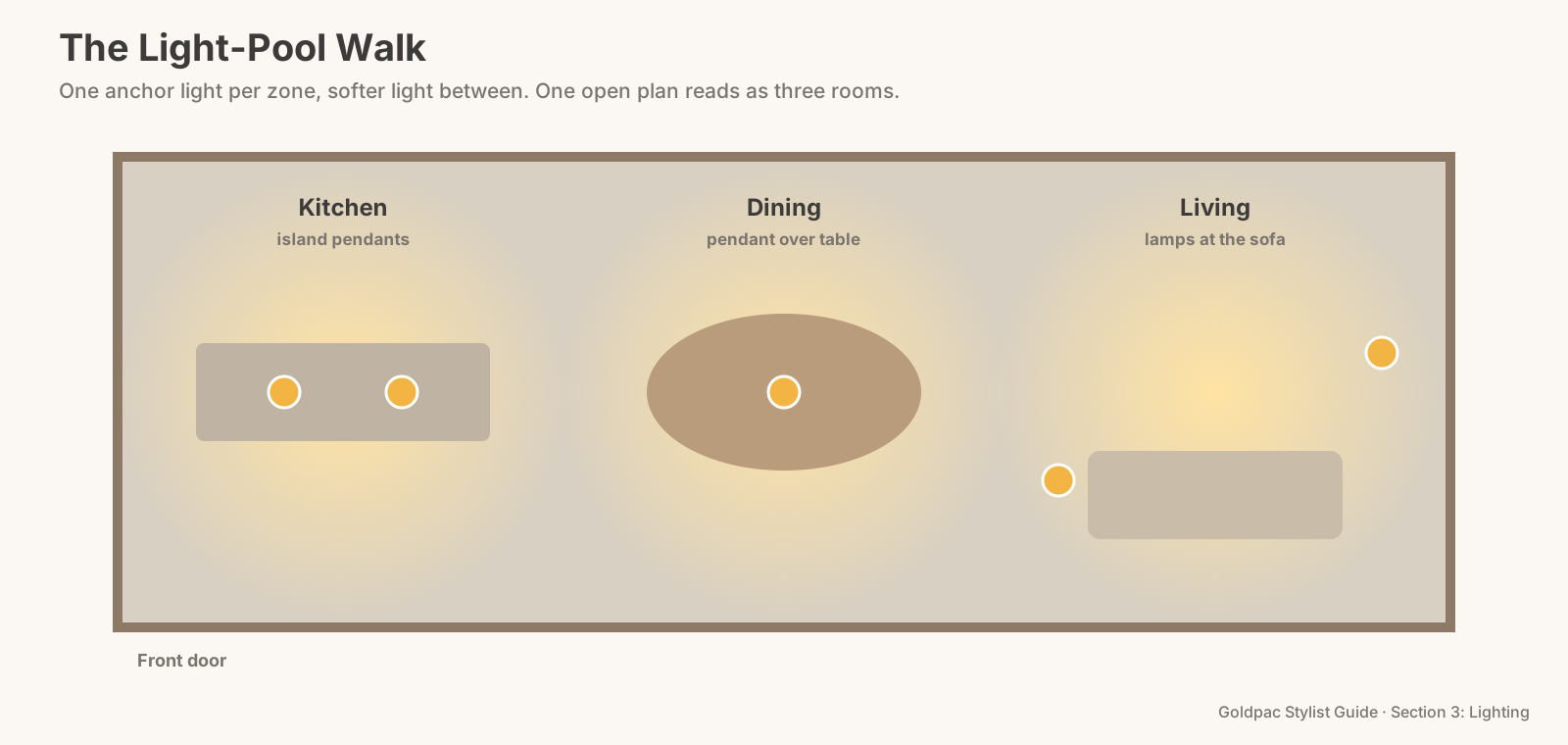
Over the island: two warm pendants. The bench glows. That's the kitchen.
Over the table: one pendant, low and warm. A pool of light on the timber. That's where dinner happens.
By the sofa: a table lamp at one end, a floor lamp in the corner. That's where the evening ends.
Between them: softer light. Gaps. The eye jumps from pool to pool.
The floor plan hasn't changed, but it now reads as three rooms.
Why light zones a room
The eye reads pools of light as places. A brighter area with a soft edge is one of the oldest ways of marking a space. Campfires, reading lamps, a lit table in a dark restaurant. Buyers feel the boundary without seeing a wall.
Zones make open plans feel bigger. A uniformly lit open space can feel like a hall. Divided into lit zones, it feels like several rooms joined together, which buyers usually value more.
And zones tell the story of daily life. Cooking, eating, relaxing. Each lit zone answers the question "what happens here?" before anyone asks it.
How do you zone an open-plan space with lighting?
Give each zone its own anchor light, placed over or beside its main piece of furniture, and keep the light between zones softer. Kitchen: pendants over the island or light under the cabinets. Dining: a pendant centred over the table. Living: lamps at the sofa and in the corner. Turn down or switch off the general downlights between zones if you can.
The Light-Pool Walk
- Name the zones. Usually kitchen, dining and living. Sometimes a study nook or entry too.
- Find each zone's main piece. The island, the dining table, the sofa.
- Give each one anchor light, inside the zone's rug or footprint: a pendant over the table, pendants over the island, lamps at the sofa.
- Soften the gaps. Dim or switch off the downlights between zones, if they're on separate switches.
- Match the light colour across every zone, so it reads as one home (Rule #63 covers warm white).
- Walk in from the front door and check that your eye moves from pool to pool.
The Light-Pool Walk: one anchor light per zone, placed over or beside its main piece of furniture, with softer light between, so an open plan reads as separate rooms.
Zone by zone
Kitchen. The island or main bench is the stage. Pendants over an island should hang low enough to feel like part of the zone but high enough to keep sightlines across the room clear. No island? Under-cabinet light along the bench does the same job, and it makes a clear, clean benchtop glow in photos.
Dining. One pendant centred over the table, or a pair over a long table. The table should be the brightest thing in the dining zone. If the pendant blocks the view across the table, it's too low (Rule #73 covers this).
Living. Two lamps: one at the sofa, one in the corner or on a sideboard opposite. The living zone should be the warmest, softest pool of the three.
Entry or hallway. A small lamp on a hall table, or the hallway light on its own. It marks the start of the walk and leads the eye in.
Time and effort
- Rearranging lamps into zones: about 15 minutes.
- Checking which downlights are on which switch: about 10 minutes, and worth writing down for the photographer.
- Hanging a plug-in pendant over a dining table if there's no fitting: under an hour with a ceiling hook and a cord cover.
- Installing a new hardwired pendant: a job for a licensed electrician, booked well before photos.
Do this Sunday
At dusk, turn off every light in the open-plan space. Then turn on only one light for each zone: the dining pendant, one lamp at the sofa, the island pendants or kitchen bench light. Stand at the front door. If you can name each zone from there, the zoning works. If one zone is dark, that's where to add light.
The objection: "Isn't one big bright space better?"
Bright, yes. Uniform, no. Buyers want light, but they also want to understand the space. A room lit evenly from wall to wall gives them light without structure. Lit zones give them both, and they still read as bright, because each zone is well lit where it matters.
The blind spot: you live in one zone at a time
At home, you light the zone you're in. Kitchen lights for dinner, lamps for TV, nothing over the dining table because you eat on the sofa. You rarely see all three zones lit at once.
A buyer sees all of them in one glance from the front door. If one zone is always dark in your house, it's always dark in theirs.
What if…
It's a studio apartment. The zones are smaller but just as important: a lamp by the bed, a pendant or lamp at the table, the kitchen bench light. Three small pools make a studio read as a home, not a room.
There's no pendant over the dining table. Place a lamp on a nearby sideboard, or a pair of candles in glass holders on the table for photos only. The table still needs its own light.
The downlights are all on one switch. Leave them on, and make the zone lights warmer and closer so they still read as pools.
FAQ
Should every zone in an open-plan space have its own light? Yes, ideally. One anchor light per zone, over or beside the main piece of furniture, helps buyers see where each area starts and ends.
Do pendant lights over a dining table help sell a house? They help define the dining zone and make the table look like a place to gather, which is what buyers picture when they see it.
Can I use lamps instead of pendants to zone a room? Yes. Table lamps and floor lamps can define living and dining zones just as well, especially in rentals where you can't add fittings.
Zoning by light is one of the quickest ways to make an open plan feel bigger. With Photo Ready Styling, our stylist styles your home with your own furniture and lamps before the photos, setting up each zone. If you'd rather follow a plan yourself, a Photo Ready Consultation leaves one, room by room, within 48 hours of the visit. See current prices.
Keep reading: Rule #49: Change tones gradually from room to room (colours that flow room to room) · Rule #64: Never rely on ceiling lights alone (why ceiling lights alone aren't enough) · Rule #79: Use matching lamp styles across open-plan zones (matching lamp styles across zones)
◀ Previous: Rule #65: Floor lamps add height and warmth · Section 3 contents · Next: Rule #67: Light art, mirrors and corners to add depth ▶
Part of the Goldpac Stylist Guide: 220+ home staging rules from Goldpac's Sydney styling team.